
Firm operations
Accounts Payable Workflows for Small Firms: Bill Pay Without the Paper Chase
The true cost of the paper chase ($15 an invoice, 15-day approvals), the five-gate AP workflow that works for a one-person practice, why checks are still the top fraud target, the 36.7% return hiding in 2/10 net 30 terms, and the January 1099 process — worked out in plain numbers.

The short answer
Accounts payable is the part of bookkeeping the client actually feels. The monthly close is your world; bill pay is theirs. Every week, someone's money moves on your recommendation, and when a bill gets paid twice, paid late, or paid to the wrong vendor, the client doesn't think "process inefficiency." They think their money isn't safe with you.
The numbers on the manual way are brutal. Processing a single invoice by hand costs $15 to $16, against roughly $3 for an automated flow — up to an 80% gap (Resolve, 2026, citing APQC research). Manual approval cycles run 10 to 20 days; automated ones finish in 2 to 3. Labor alone is 62% of what AP costs in a manual shop. And every error costs about $53 to fix (Medium/@mathewpro, 2025).
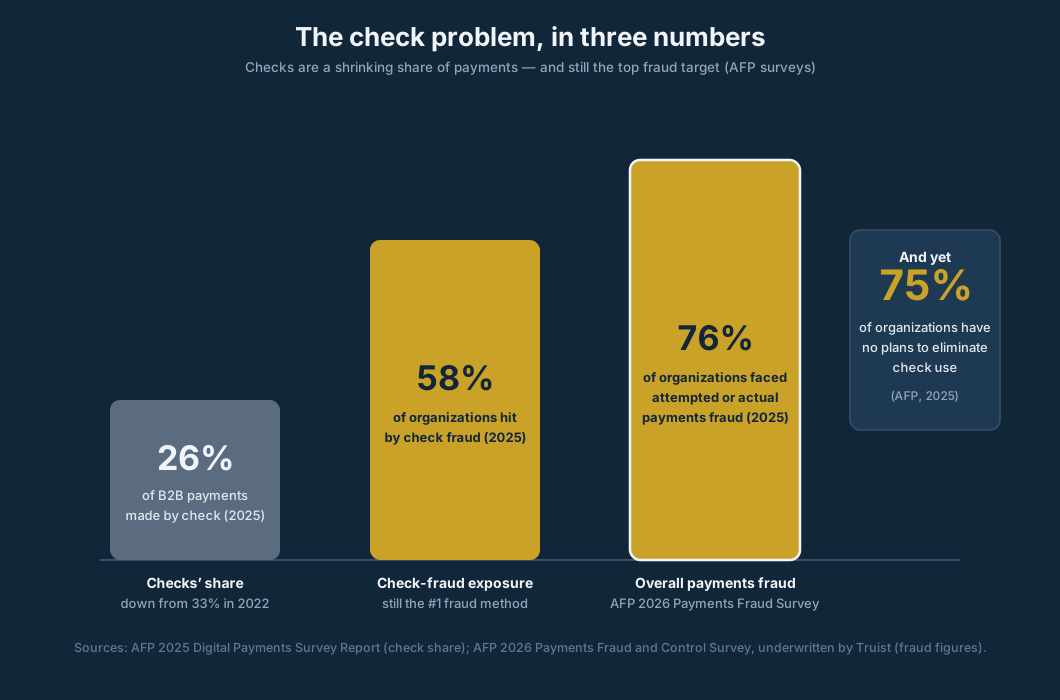
Here's the part firms underestimate: the paper chase isn't just expensive, it's exposed. 76% of organizations experienced attempted or actual payments fraud in 2025, and checks remain the most-frequently-hit payment method — 58% of organizations reported check fraud last year (AFP 2026 Payments Fraud and Control Survey, underwritten by Truist). Yet checks still carry 26% of B2B payments, and three-quarters of organizations have no plan to eliminate them (AFP 2025 Digital Payments Survey). Your smallest client's checkbook is a bigger fraud surface than most firms admit.
This article builds the disciplined workflow that kills the paper chase: five gates every bill passes through, the payment rails that actually protect you, the duplicate-payment controls, the early-payment-discount math that turns AP into a profit center, and the January 1099 process that punishes firms who didn't collect W-9s in March. All of it works for a one-person practice — the rules are what matter, not the headcount.
The true cost of the paper chase
Before you can sell a client on a better AP workflow, you need the real cost of the one they have. Most businesses wildly underestimate it, because they count only the data-entry minutes and miss the labor, the errors, the chasing, and the corrections.
Start with the per-invoice cost, because it compounds fast. A firm with a client who pays 150 bills a month is looking at $2,250 a month to process them manually at $15 each — versus roughly $450 in an automated flow. That's a $1,800-a-month difference, or $21,600 a year, for one client, before a single error or late fee enters the picture. Scale it to 1,000 invoices a month and Resolve's numbers show $84,000 to $144,000 a year in savings from switching.
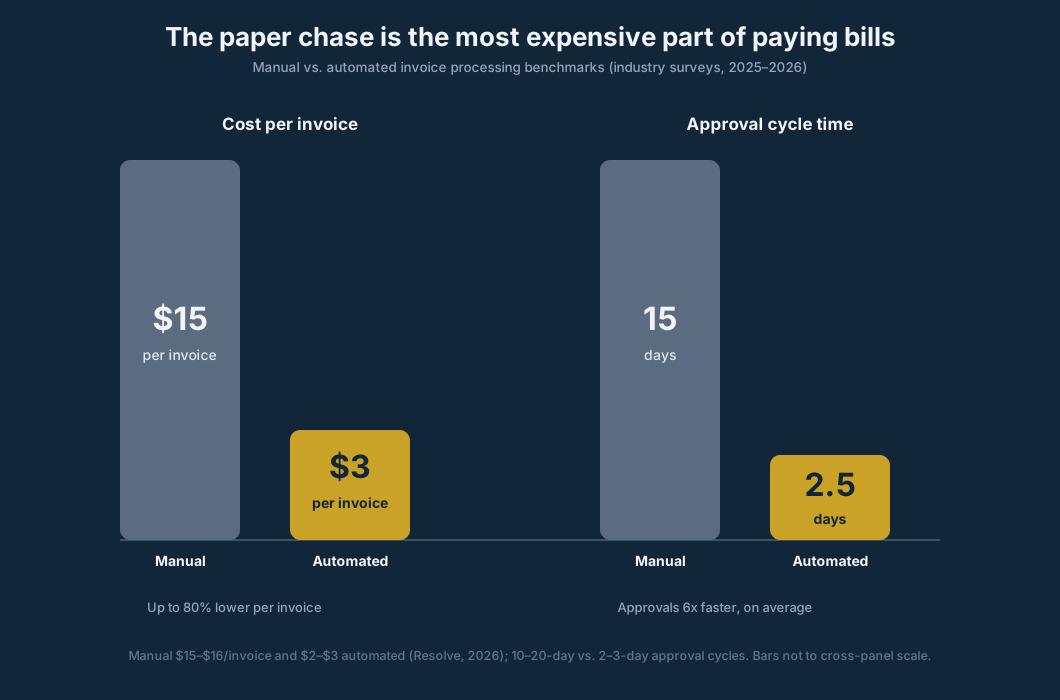
The approval lag is where the real bleeding happens, because it's invisible. Ten to twenty days of a bill sitting in an inbox, on a desk, or in an email thread means three things happen: early-payment discounts expire, late fees accrue, and the books lie about what's actually owed. Planergy's 2025 benchmarks put the contrast even more sharply: best-in-class AP teams approve in 3.2 days at $2.75 per invoice, against 19.5 days and $13.11 for non-automated setups — and their discount-capture rates run 30% higher.
Then the errors. Manual processing carries roughly a 1.6% error rate per invoice and duplicate payments on about 2% of them (Resolve, 2026). At 150 bills a month, that's two or three errors a month — each costing ~$53 to fix, and that's only the ones caught before money moved. Duplicate payments are the quiet killer: at 2%, a client paying 1,800 bills a year is sending roughly 36 payments twice. A firm that catches them looks like a guardian; a firm that doesn't finds out from the vendor's credit memo, if it finds out at all.
The cash-flow context makes all of this worse. Bluevine's 2026 Payment Gap Report found 59% of small businesses experience late payments at least occasionally; 29% of owners delayed paying themselves because customers hadn't paid, and 17% missed or nearly missed payroll. When AP is slow and sloppy in a business like that, it isn't a back-office nuisance — it's the difference between paying rent on time and not.
The five-gate workflow
Forget "AP automation" as a product category for a moment. The workflow that works is five gates every bill passes through, in order, with no skipping:
1. Capture. Every bill arrives through one inbox. Scan it, email it, or pull it from a vendor portal — but if it didn't come through the inbox, it doesn't exist until someone forwards it. The paper chase is born when bills arrive through six channels and nobody knows which is current.
2. Code. Vendor, account, amount, and — critically — a duplicate check before anything posts. Coding is also where the W-9 question gets answered: if this is a new vendor who might need a 1099 in January, the tax details get resolved now, not in a January panic.
3. Approve. The owner approves; thresholds route big bills for review. The one non-negotiable control, even in a solo practice: the person who codes the bill is never the only approver on it. For a client's owner-operators, that means the bookkeeper codes and the owner approves — which is also how the firm documents that it didn't unilaterally move the client's money.
4. Pay. On a calendar, not when the stack looks tall. Twice a week, batched, with early-payment discounts captured on schedule (see the discount math below). ACH and cards are the defaults because they carry the audit trail with them; checks are the exception, documented, for the one vendor who still demands one.
5. Reconcile. The bank feed clears the payments; the ledger ties to the penny. This is the gate most paper workflows skip, and it's where duplicate payments and misdirected ACHs get found — in days, not months.
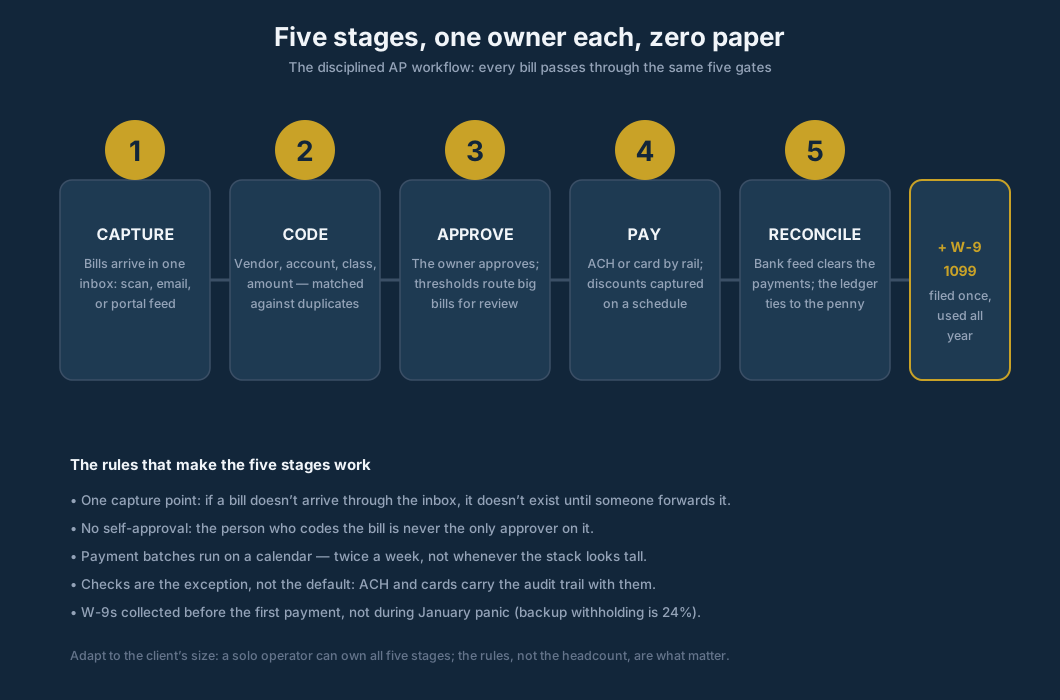
Two honest caveats. First, the workflow doesn't require a headcount — a solo operator can own all five gates; the rules are the control, not the staffing. Second, the workflow is what makes January's 1099 season survivable: a firm that captures W-9s at the code gate in March files 1099s from data it already has. A firm that doesn't starts January with a manhunt.
The check problem
Now the fraud section, because no AP article in 2026 is honest without it — and this is where the paper chase goes from "inefficient" to "actively dangerous."
The AFP's numbers tell a story of a payment method that won't die. In 2024, 79% of organizations faced payments fraud, and checks were the most-frequently-hit method: 63% of financial professionals experienced attempted or actual fraud via checks (AFP 2025 Payments Fraud and Control Survey). In 2025 the headline barely improved: 76% of organizations hit, 58% reporting check fraud — still the #1 method (AFP 2026 Survey). Fraudsters are stealing checks out of the mail and selling them online in organized rings; the tactics are old and they work (AFP via Truist analysis, 2025).
And yet: checks still carry 26% of B2B payments (down from 33% in 2022 — progress, but slow), and 75% of organizations have no plans to eliminate check use in the next two years (AFP 2025 Digital Payments Survey). The two reasons cited for considering elimination were manual processing and fraud vulnerability — cited by 75% and 66% of those planning the move. In other words, the market knows checks are the problem and is keeping them anyway.
The impersonation side is growing into the gap. Business email compromise remains the most common fraud method, cited by 63% of respondents, with spoof emails hitting 79% of organizations; vendor imposter fraud jumped 11 percentage points to 45% (CTMfile, summarizing the AFP 2025 survey). Vendor imposter fraud is an AP fraud — it lands in the inbox the bill lands in, and the control is the same one: an approval workflow that verifies a changed payment detail before money moves, not after.
So the rail recommendation is blunt. Default every client to ACH for vendor payments and cards (including virtual cards, whose global transaction value Juniper Research projects at $6.8 trillion in 2026, per Finexio) where the vendor accepts them. Both carry structured remittance data that makes the reconcile gate work; both leave an audit trail a check never did. Keep checks as the documented exception — and when the client writes one, Positive Pay goes on it. The bookkeeping firm's value proposition here is simple: your client's money moves through rails you can see, verify, and audit. A shoebox of check stubs is none of those.
The early-payment discount math
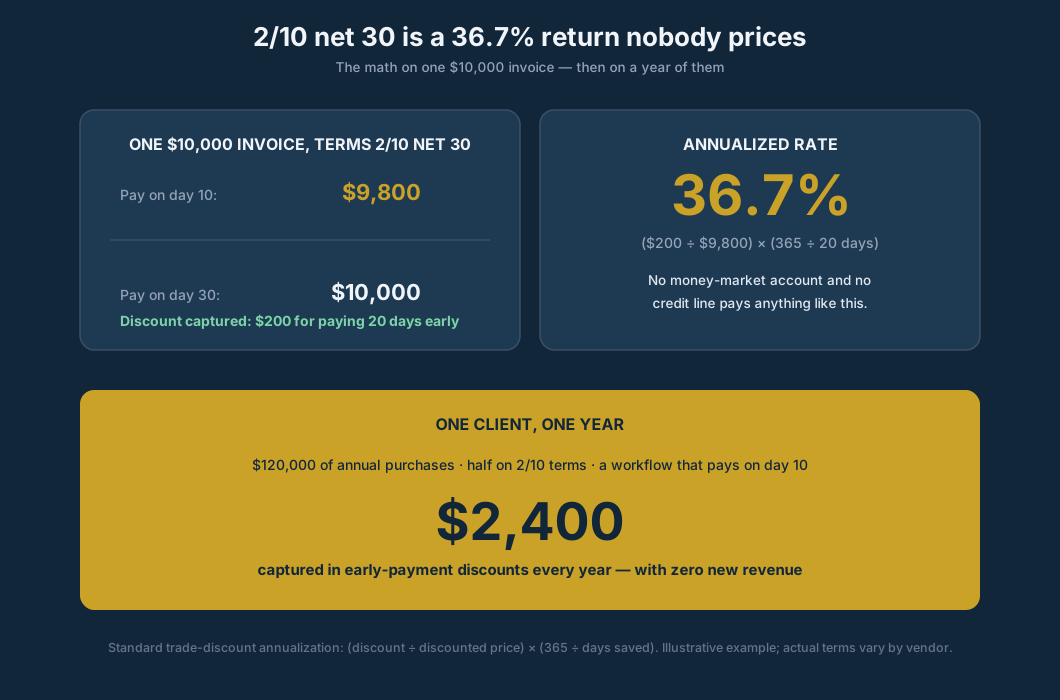
Here's the part that turns AP from a cost center into something the client pays you to improve. A standard 2/10 net 30 term — 2% off if you pay within 10 days instead of 30 — works out to roughly a 36.7% annualized return using standard trade-discount annualization math ((2/98) × (365/20)). No money-market account and no credit line pays anything like this (Stacker/AP-automation-ROI, September 2026).
Make it concrete. One $10,000 invoice on 2/10 net 30:
- Paid on day 10: $9,800
- Paid on day 30: $10,000
- Discount captured: $200 for paying 20 days early
Now the client scale. A business running $120,000 a year in purchases, with half its vendors on 2/10 terms, and a payment workflow that reliably pays on day 10: $2,400 a year captured — with zero new revenue, zero new customers, and zero risk. That's the argument for a scheduled pay cycle over an ad-hoc one: a 15-day manual approval cycle can never capture a day-10 discount. Speed is money here, literally.
The honest counterweight: not every client should grab every discount. A business drawing on an 18% credit line to pay early is trading 36.7% for nothing — that's a win, but a business with real cash-flow pressure (see the Bluevine numbers above) should prioritize survival over optimization. The workflow's job is to make the discount available; the bookkeeper's job is to advise which clients should take it.
Catching the duplicate payment
Duplicate payments deserve their own section because they're the most common AP failure clients never notice — and the easiest one for a firm to turn into a win.
The benchmark: roughly 2% of manually processed invoices get paid twice (Resolve, 2026). The causes are all process, not judgment: the same bill arriving by mail and by email, an invoice number typed slightly differently, a vendor re-sending an unpaid statement that looks like a new bill, a mid-month statement and an end-of-month statement both entered as payables.
The control is old and boring: match before you pay. In its full form it's the three-way match — purchase order, receiving record, invoice — but small firms rarely have all three. The practical version for a client's books:
- Invoice number is the identity. Every bill entry carries the vendor's invoice number, and the system flags a second entry with the same vendor + invoice number. No invoice number, no entry — a bill without one gets one assigned before it's coded.
- Statement reconciliation monthly. Every vendor statement gets matched against the open payables list before the batch runs. A statement showing an invoice already paid is a duplicate-in-progress; a statement showing an invoice never entered is a capture failure.
- Round-amount review. Duplicate payments disproportionately show up as identical amounts on the same vendor within 30 days. A monthly scan of same-vendor, same-amount pairs catches what the flags miss.
- The reconcile gate does the rest. When the bank feed clears, a payment that doesn't match an open bill is an exception, not a shrug — and the exception gets investigated in days, because money that moved twice gets harder to recover every week.
A firm that recovers even one $1,200 duplicate for a client has paid for a year of its AP service in the client's mind. That's not cynicism; it's the economics of trust.
The January tax: vendor 1099s
January is when sloppy AP workflows pay their bill. The 1099 process is a pure function of what the firm did — or didn't do — during the year.
The calendar for 2026 filings (covering 2025 payments): Form 1099-NEC is due Monday, February 2, 2026 — January 31 falls on a Saturday, so the IRS shifts it to the next business day. Note the trap: recipient copies and IRS filing are due the same day, with no extension available for 1099-NEC (makepaystubpro, 2026; taxguidedaily, 2026). And the threshold matters this year: for 2025 payments the familiar $600 threshold applies; thanks to the One Big Beautiful Bill Act signed in 2025, payments starting in 2026 (filed in 2027) get a $2,000 threshold (taxguidedaily, 2026) — a real relief for clients with long tails of small vendors, but not retroactive.
The penalty math per form, for information returns due in 2026:
- Within 30 days late: $60
- 31 days late through August 1: $130
- After August 1 or never filed: $340
- Intentional disregard: $680, no cap
(IRS General Instructions for Certain Information Returns, via commenda.io and Wisemonk, 2026.) And the penalty applies per form and per failure — one missed contractor can be charged twice, once for the IRS filing and once for the payee statement (Wisemonk, 2026). Five contractors, six weeks late: $600 (makepaystubpro worked example). E-filing is mandatory at 10 or more information returns in aggregate (T.D. 9972, effective 2024); the IRS's free IRIS portal handles up to 100 returns per session (ts2.tech, 2026).
The good news, and the whole point of this article's workflow: nearly every 1099 failure is a process failure, not a tax judgment. Wisemonk's 2026 list of the five errors that account for almost all 1099 pain — wrong form (MISC for services that belonged on NEC), double-reporting a 1099-K payment, skipping incorporated attorneys (who need a 1099-NEC anyway), ignoring backup withholding after a CP2100 notice, treating January 31 as IRS-only — reads like a checklist of things the five-gate workflow prevents. The fix is unglamorous: collect a W-9 before the first payment, verify the TIN, and flag every vendor over the threshold at the code gate. A firm that does this in March files in February from data it already has.
Where LedgerHQ fits
Honesty first, because this is where marketing articles usually lie: LedgerHQ's public site does not advertise a bill-pay payment rail. It doesn't execute vendor payments, it doesn't integrate with a bill-pay network, and it doesn't claim to. Any article that implies otherwise is inventing a product. Here's what it actually says and does.
LedgerHQ's help docs describe the AP bookkeeping surface directly: "Manage vendors, bills, and payments — create vendor records, enter bills, record payments, and review accounts payable activity" — plus vendor 1099 prep: "Review reportable vendor payments, resolve missing tax details, and download 1099 preparation files" (ledgerhq.ai/docs/help/collections/vendors-and-1099). In other words: LedgerHQ is the system of record for accounts payable, not the payment rail. The bills, the vendor records, the payments as recorded, and the 1099 preparation all live in the books — and the workflow above runs in the books where the controls can be audited.
The AI bookkeeper, Tally, does the AP-adjacent work the homepage promises: "Tally codes transactions, works reconciliations, follows up for missing information, and prepares the financials" (ledgerhq.ai). In AP terms: the vendor payments that clear through the bank feed get coded, the reconciliation gates get worked, and the missing bill or the unmatched payment gets chased by Tally instead of sitting in your inbox. "Reconnect each bank once and keep moving" is the feed staying alive underneath it all (ledgerhq.ai).
So the practical stack for a firm running the five-gate workflow on LedgerHQ: payments execute through the client's bank or payment provider (ACH, card) — the rails the fraud section recommends — and LedgerHQ holds the records those payments reconcile against: vendor master, bills entered, payments recorded, 1099 data prepared. The economics are the site's: $20 per month per business, same software and same price for firms and businesses, with a free preview — start with a card today and pay nothing until January 1, 2027 (ledgerhq.ai).
That's the honest shape of it. The workflow is the firm's value; the software is the place the workflow lives.
FAQ
How many vendor bills does it take to justify a formal AP workflow? Fewer than most firms think. At $15 a manual invoice, even 40 bills a month costs $600 a month in processing — and the duplicate-payment risk starts at bill one. The five-gate workflow is a checklist, not a software purchase; it works at 10 bills a month. The automation spend makes sense once a client crosses roughly 100 bills a month, where the $12-per-invoice gap ($15 vs. $3) is $1,200 a month.
Should a bookkeeping firm offer bill pay as a service, or just the bookkeeping? Offer the workflow, be careful with the execution. Entering bills, coding, running the approval process, and reconciling is firmly bookkeeping. Actually initiating vendor payments from client accounts is a different liability profile — the firm is moving the client's money. Many firms run the full workflow up to the pay gate and let the owner release the batch, which keeps the control (no self-approval) and the liability boundary in the right place.
ACH or check — what should I recommend to a client who "likes checks"? ACH, with the check as the documented exception. The fraud numbers aren't close: checks are the most-frequently-hit payment method two years running (AFP surveys), ACH fraud trails well behind. Positive Pay on the account if checks stay. The client's preference for the familiar is real; so is the 58%-of-organizations exposure.
What's the single highest-ROI AP change for a small client? A twice-weekly scheduled pay batch with a day-10 rule for discount terms. It costs nothing, captures 2/10 discounts automatically (36.7% annualized), and ends the ad-hoc payment chaos that causes duplicates. Second: W-9s before the first payment — the entire January 1099 season goes from manhunt to mail merge.
Do duplicate payments really happen at 2%? That's the industry benchmark for manual processing (Resolve, 2026). A client's rate depends on their volume and how many channels bills arrive through — a client whose bills come by mail, email, and vendor portal is at the high end. The monthly statement-to-payables match is the control that tells you your client's actual rate.
What's the 1099 threshold for payments made in 2026? $2,000, up from $600, under the One Big Beautiful Bill Act signed in 2025 — but only for payments made in 2026 and later (filed in 2027). The returns you're filing in early 2026 cover 2025 payments and still use the $600 threshold. Don't let a client apply the new number to the old year.
Can LedgerHQ pay my clients' vendors directly? No — and be wary of any article that implies it does. LedgerHQ's public site doesn't advertise a bill-pay execution rail or a bill-pay network integration. What it provides is the AP system of record: vendor records, bills entered, payments recorded, AP activity reviewed, and 1099 preparation files — with Tally coding the transactions and working the reconciliations. Payments themselves run through the client's bank or payment provider on the rails above.
Sources
- Resolve, "13 Invoice Processing Stats: Manual vs. Automation," 2026 — $15–$16 manual vs. ~$3 automated per invoice; labor 62% of AP costs (APQC); 1.6% manual error rate; ~2% duplicate payments; $53 per error; 10–20 vs. 2–3 day approval cycles. resolvepay.com/blog/13-statistics-that-quantify-cost-per-invoice-in-manual-vs-automated-flows
- AFP, 2026 Payments Fraud and Control Survey Report (underwritten by Truist), 2026 — 76% of organizations experienced attempted or actual payments fraud in 2025; checks the most-frequently-impacted method; 58% reported check fraud. financialprofessionals.org/training-resources/resources/survey-research-economic-data/Details/payments-fraud
- AFP, 2025 Payments Fraud and Control Survey (underwritten by Truist), 2025 — 79% experienced fraud in 2024; 63% experienced fraud via checks. financialprofessionals.org
- AFP, 2025 Digital Payments Survey Report, 2025 — 26% of B2B payments made by check (down from 33% in 2022); 75% of organizations have no plans to eliminate checks; manual processing and fraud cited as the top elimination reasons. (S3-hosted highlights PDF)
- CTMfile, "Payment fraud remains pervasive globally as sophistication increases," April 25, 2025 — BEC cited by 63%; spoof emails at 79%; vendor imposter fraud at 45% (+11pp). ctmfile.com/story/payment-fraud-remains-pervasive-globally-as-sophistication-increases
- Finexio, "Two B2B Payment Signals for 2026," June 2026 — Juniper Research: $6.8T projected global virtual card transaction value in 2026. finexio.com/resources/state-of-b2b-payments-2026
- Stacker, "How your finance team can calculate AP automation ROI," September 2026 — 2/10 net 30 ≈ 36.7% annualized; ACFE typical organization loses ~5% of revenue/year to fraud. pontevedrarecorder.com
- Planergy, "Accounts Payable in 2025," 2025 — best-in-class $2.75 vs. $13.11 per invoice; 3.2 vs. 19.5-day approval cycles; +30% discount capture. planergy.com/blog/accounts-payable-in-2025
- Bluevine, "Payment Gap Report," March 2026 — 59% of SMBs experience late payments; 29% of owners delayed paying themselves; 17% missed or nearly missed payroll. roi-nj.com
- Tax Guide Daily, "1099 Deadline Alert: February 2, 2026," 2026 — Feb 2, 2026 deadline; $600 threshold for 2025 payments; $2,000 for 2026 payments under the One Big Beautiful Bill Act. taxguidedaily.com
- commenda.io, "IRS Form 1099-NEC Filing Requirements and Key Rules," 2026 — penalties $60/$130/$340, $680 intentional disregard; e-file mandatory at 10+ returns (T.D. 9972); no extension for 1099-NEC. commenda.io/blog/irs-form-1099-nec-requirements-file-report-deadline-penalty
- Wisemonk, "Independent Contractor Tax Form: 1099-NEC Guide," 2026 — penalty doubling (IRS filing + payee statement); the five errors behind most 1099 pain. wisemonk.io/blogs/filing-tax-form-independent-contractor
- LedgerHQ, ledgerhq.ai (homepage, verified October 1, 2026) — Tally coding/reconciliation claims; $20 per business; free preview until January 1, 2027.
- LedgerHQ Help Center, "Vendors and 1099" collection (verified October 1, 2026) — vendor/bill/payment records; 1099 preparation files. ledgerhq.ai/docs/help/collections/vendors-and-1099