One Place to See the Firm
Find unfinished work across every company without opening each set of books.
 LedgerHQ
Multi-company bookkeeping
See every company in one place, ask what needs attention, and keep each set of books separate.
Only $20 per month · Tally's AI use is includedOne Question. Every Company.
See the firm-wide workload without mixing a single record.
Which companies need attention today?
Ask TallyAlder Point Interiors
12 transactions to code
Beacon Harbor Outfitters
Statement needed
Kestrel Coffee
Books current
Find unfinished work across every company without opening each set of books.
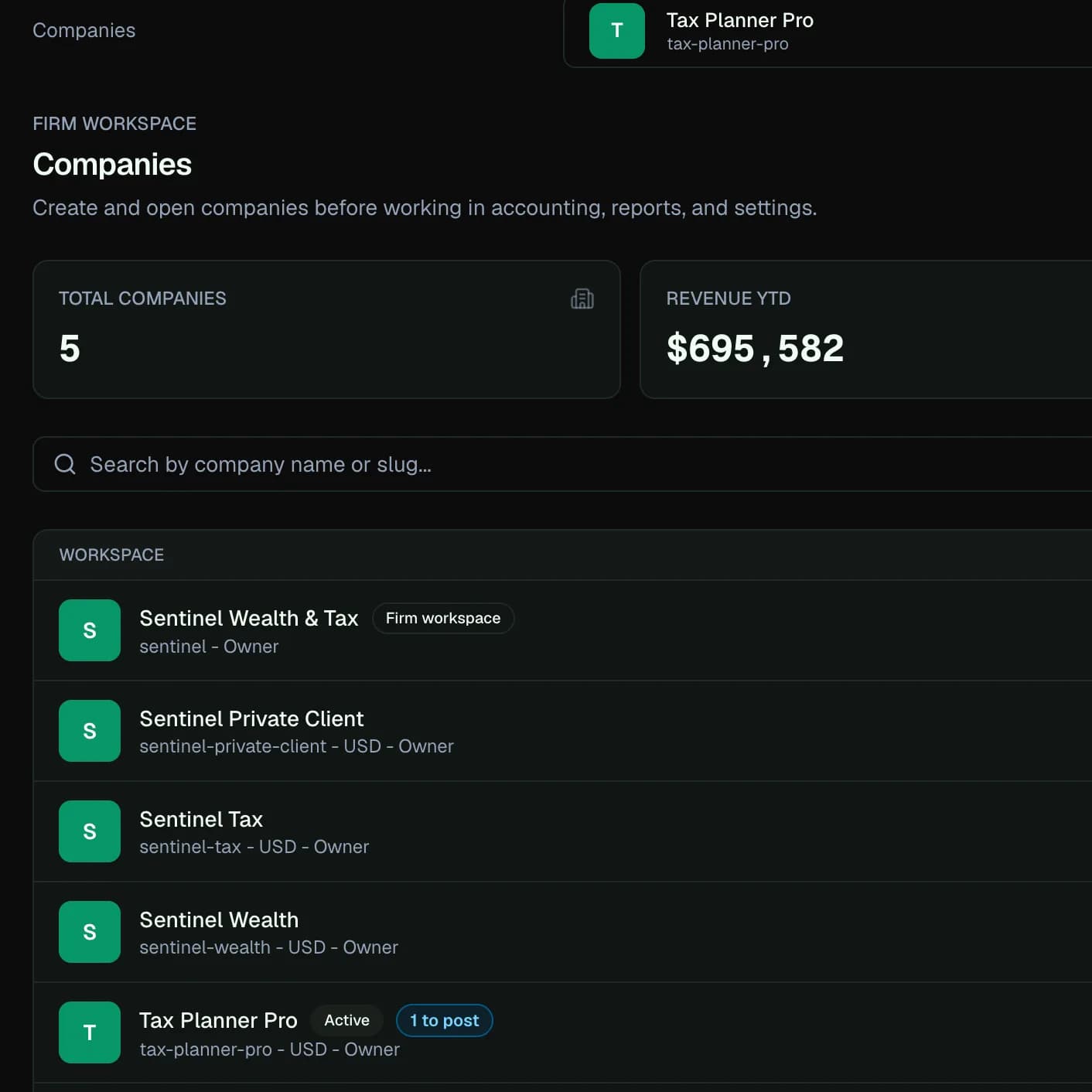
Each company keeps its own chart, ledger, bank accounts, permissions, requests, and reports.
Firm-wide questions are answered in the product instead of assembled by hand in a spreadsheet.
A morning across the firm
Find what is behind, pick the company that needs work, finish it, move on.
1 min 10 secSee every walkthrough
Inside LedgerHQ
Which companies still have uncoded transactions over a thousand dollars? Which books need attention? Which bank connections broke this week? Which companies consumed the most staff time?
How It Works
The work stays connected inside the same books, ready for you to review.
One firm-wide question
See the whole firm. Keep every ledger separate.
Which companies need attention today?
Tally
Ready to answer
Four separate ledgers searched. No records cross company lines.
Alder Point
Checking…
Beacon Harbor
Checking…
Kestrel Coffee
Checking…
Northwind Studio
Checking…
The Difference
See what stays on your plate today and what LedgerHQ takes over.
Questions, Answered
Yes. The firm workspace in LedgerHQ Pro covers every managed company, each with its own ledger, while the firm-wide queue and Tally answer questions spanning all of them. Business owners with several businesses get the same multi-company account without the firm layer. Products built around a single company file, including QuickBooks Online, require opening each file separately.
No. Each company keeps its own chart and its own accounting records.
No. Company-owner access is limited to their own company.
No. Multi-company bookkeeping means managing many separate sets of books efficiently. LedgerHQ does not perform multi-entity consolidation with intercompany eliminations.
Only $20 per month
No contracts. Tally's AI use is included.
Start Free