
Bookkeeping operations
AI in Bookkeeping: What It Actually Does Today (vs. the Pitch)
A data-backed look at AI in bookkeeping: what deployed systems really do (OCR, categorization, matching, draft reconciliations), what the 'fire your bookkeeper' pitch claims, documented AI failures at the Big Four, and what the profession's standards say about human oversight.

The short answer
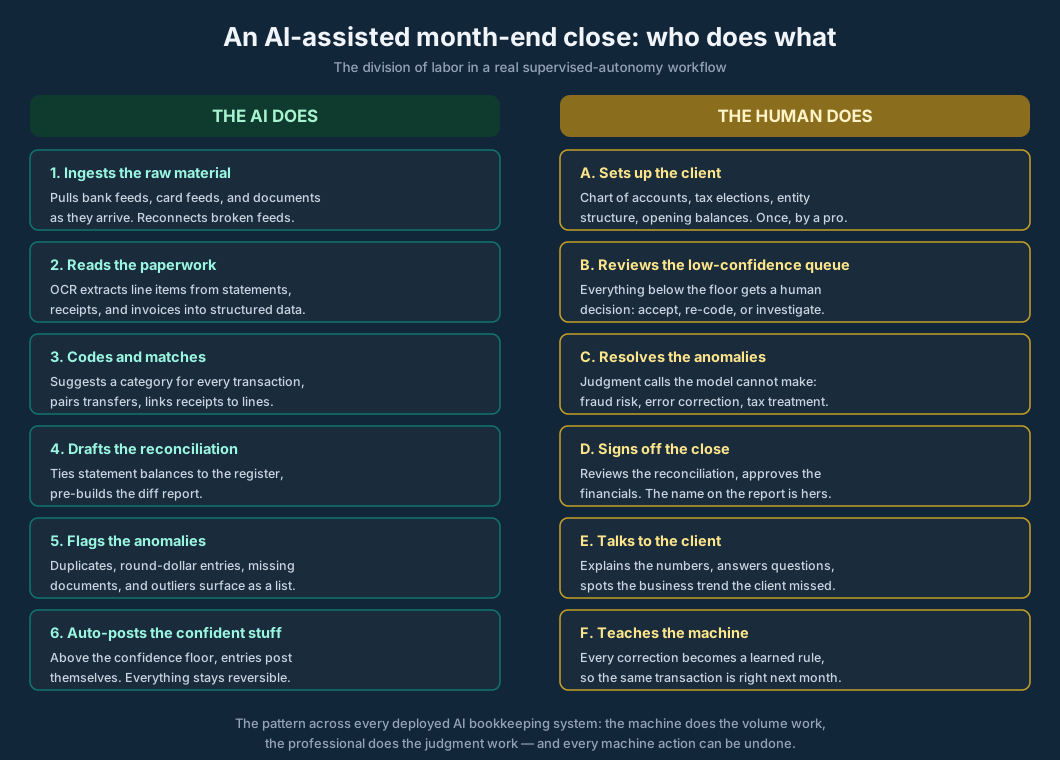
AI in bookkeeping is real, deployed, and genuinely useful — and it is much narrower than the pitch. What deployed systems actually do today is volume work under supervision: read documents, suggest categories, match transfers, draft reconciliations, and surface anomalies for a human to decide on. What they do not do is the professional work: set up a client, exercise judgment on edge cases, or take responsibility for the financials. The pattern is consistent across every serious deployment: supervised autonomy with confidence gates — the machine handles what it is confident about, and everything else lands in a human review queue.
The gap matters because the pitch has outrun the product. Vendor landing pages say "fire your bookkeeper"; the profession's own data says 90% of practitioners agree human judgment matters more, not less, as AI spreads (Financial Cents, September 2026). The Big Four have collectively withdrawn multiple AI-touched reports in the last year — Deloitte, KPMG, EY, and PwC all caught shipping hallucinated citations. And the AI bookkeeping flagship, Botkeeper, shut down in February 2026 after raising ~$90M — with its founder calling the technology "world-class" and the business a failure.
This guide separates the two ledgers: what AI actually does in bookkeeping today, with the receipts; and what the pitch claims, with the fine print.
What AI actually does today
Strip out the marketing and the deployed capabilities are six, all of them real, all of them narrower than they sound:
1. It reads the paperwork. Optical character recognition plus language models extract line items from bank statements, receipts, and invoices and turn them into structured data. This is the most mature capability in the stack — document extraction is a solved-enough problem that banks, lenders, and auditors all run it in production.
2. It suggests a category for every transaction. Given the vendor, amount, memo, and history, the system proposes an account for each line. The important design detail: serious systems attach a confidence score to every suggestion. High-confidence items post automatically; low-confidence items go to a human queue. The suggestion is a draft, never a verdict.
3. It matches transfers and pairs. When money moves between a client's own accounts, the two legs are recognized as one transfer instead of income and an expense. Transfer-pair matching is pattern work at exactly the scale machines are good at.
4. It drafts the reconciliation. Statement balances get tied to the register automatically and the system pre-builds the difference report — the list of what did not tie, which is the part a human actually needs to look at. This is the same shape as the workflow in this site's bank-reconciliation guide: the AI clears the matching activity and shows the remaining difference.
5. It flags the anomalies. Duplicates, round-dollar entries, missing documents, outliers against the account's own history — these surface as a review list. Note what the machine does not do here: decide whether the anomaly is fraud, error, or legitimate. That decision is the professional's.
6. It chases the missing information. Follow-up questions — "was this charge business or personal?", "where's the receipt for this one?" — get drafted and sent, and the replies get applied to the books. The conversation loop is automated; the judgment about the answers is not.
What is conspicuously absent from the deployed list: no system in production sets up a new client's chart of accounts unsupervised, decides tax treatment, or signs the financials. The professional's name is still on the work — and the standards say it has to be (more on that below).
The pitch, line by line
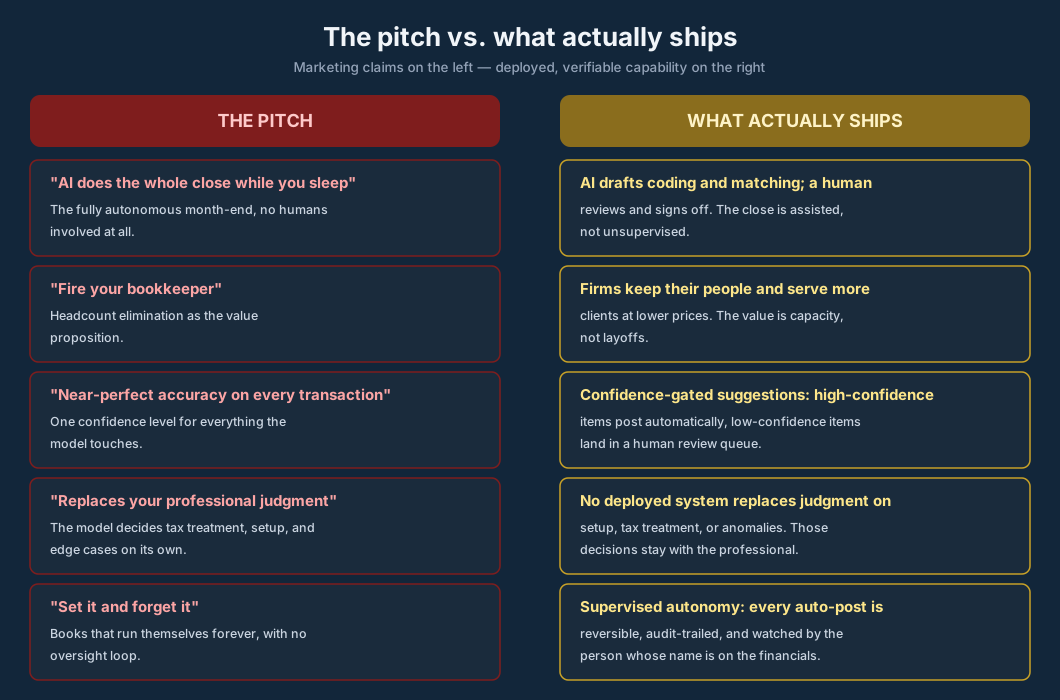
The "fire your bookkeeper" pitch is not a strawman — it is live copy on vendor sites right now. Read it closely, because the gap between the headline and the subhead is the whole story.
RetailWatcher (retailwatcher.app) leads with, literally, "Fire your bookkeeper" — "No manual entry. No monthly bookkeeper fees," claiming it "saves $300–500/month in bookkeeper fees." Qdero (qdero.com) goes further: "Fire your bookkeeper. Keep your profits. QDERO runs your books, chases your invoices, forecasts your cash, and files your taxes — automatically," from "$1/month," claiming to replace "the $400/mo you pay your bookkeeper." Note the escalation: not just the bookkeeping goes, but the tax filing — a regulated professional service — handled "automatically." Cashflowy (cashflowy.ai) runs the same headline ("Fire your $400/mo bookkeeper... 1/10th the Price") while the landing page quietly admits the product is "AI + human bookkeeper" — the headline fires the human, the fine print keeps one.
Even Intuit's autonomy pitch, for all its budget, is hedged: its July 2025 announcement of a "virtual team of AI agents" stresses the customer is "always in control" and the agents work "along-side trusted AI-enabled human experts." The incumbent's marketing department has apparently read the failure data.
The instructive case is Botkeeper — the company that was the autonomous-bookkeeping thesis. Its founder's farewell letter claimed the "Infinite" platform could "clean up years of messy data in minutes," "reconcile accounts autonomously," and "code 80%+ of transactions with a staggering 98% accuracy." The company shut down in February 2026 after 11 years and roughly $90M raised (including a $42M Series C in 2021). The founder's own verdict: the technology was "world-class"; the business never found sustainable product-market fit (reported by CPA Practice Advisor, February 2026; Inside Public Accounting, February 2026). Treat the accuracy figures as company claims — they were never independently measured (codebridge.tech) — but the shutdown is documented trade press: autonomous-bookkeeping technology, even at flagship scale, did not translate into a viable standalone business. (CountingWorks PRO's epitaph for it: "Can AI replace accountants end-to-end in a regulated profession where 95% correct is 100% wrong?")
The academic hype artifact is worth naming too: the OpenAI researchers' "GPTs are GPTs" paper (arXiv, March 2023) rated accountants and tax preparers at 100% "exposure" to language models — widely misread as "AI will automate accounting." The paper's own definition: exposure means models could cut task time by at least 50%. "It does not necessarily suggest that their tasks can be fully automated by these technologies." Time reduction is real. Replacement is a different claim, and the paper never made it.
What the profession actually thinks
If you want the industry's honest read on AI, skip the vendor pages and read the practitioner surveys. The most striking one is fresh: Financial Cents' 2026 State of AI in Accounting and Bookkeeping Report (survey of 486 North American firm owners and partners, July–August 2026, published September 2026). The headline numbers:
- 90% agree "human judgment matters more, not less, with the advent of AI" — the most agreed-upon statement in the entire survey.
- Only 19% trust AI output enough to use it with limited review — and human review is "not seen as something firms will eventually grow out of. Rather, it is part of the design itself."
- Only 18% say clients expect them to use AI. Firms are not being pushed into AI by clients; they are choosing it for themselves.
- 95% use or explore AI, but only 20% report clear, measurable ROI, and 90% have no written AI policy.
- The top actual uses are drafting emails (75%) and summarizing documents (71%) — "bank reconciliation and tax return prep sit at the bottom of the list."
- Trust in AI output is "essentially flat across experience levels" — veterans and juniors are equally (un)trusting.
That last cluster is the reality check on the adoption story: near-universal experimentation, a fifth with measured return, and the core bookkeeping tasks — reconciliation, return prep — at the bottom of the usage list. AI in accounting is currently a writing assistant with ambitions, not an autonomous bookkeeper.
The institutional voices line up behind the survey. AICPA president and CEO Mark Koziel told Axios (~September 2026) the profession's posture is keeping the "human in the lead" — with CPAs positioned to provide assurance on companies' AI governance. The Journal of Accountancy's "Accounting ethics in the age of AI" (August 2026) names "human in the loop" as the core concept of responsible AI use, warns of automation bias, overconfidence bias, and anchoring bias, and is explicit: "Treat AI as an assistant, not a substitute for your own critical thinking." The AICPA Code's duties of competence, due care, confidentiality, and independence "don't disappear just because new technology is involved."
The failures are documented — and instructive
The strongest evidence for human oversight is not theory; it is the casualty list. In the last eighteen months, all of the Big Four have been caught shipping AI-hallucinated work:
- Deloitte Australia (2025): a AU$440,000 government report — a 237-page review of Australia's Targeted Compliance Framework — contained roughly 20 errors, including 12 references to nonexistent academic work attributed to a real professor and a verbatim quote from a Federal Court ruling no judge ever wrote. A Sydney researcher found them; the revised report (September 2025) disclosed that sections were "drafted using Azure OpenAI (GPT-4o)." Deloitte partially refunded the fee. Covered by AP, The Guardian, Fortune, and the Financial Times.
- KPMG (October 2025, withdrawn June 2026): "Total Experience: Redefining Excellence in the Age of Agentic AI." GPTZero's forensic analysis of all 45 citations found only 5 fully accurate; 28 contained paraphrased or fabricated components. UBS, the NHS, Swiss Federal Railways, and Transport for London told the FT the report's claims about their AI use were untrue or misleading. KPMG withdrew the report and opened an internal review (FT, June 12, 2026).
- EY Canada (May 2026): a cybersecurity report withdrawn after GPTZero found 16 of 27 references fabricated or broken — including a citation to a nonexistent McKinsey "Loyalty Economics Report."
- PwC Middle East (2024–2026): four publications with hallucinated "vibe citations" — one citation URL contained "utm_source=chatgpt.com" (verified by the FT; PwC said it is updating citations).
The pattern holds outside the Big Four. Macabacus' September 2026 survey of 75,000 financial-services users found 87% use AI daily or weekly for models and client presentations — but only 23% have comprehensive guardrails, 62% believe an AI-generated error reached a client or decision-maker in the last 12 months, and 46% admit an error "probably" landed in a deliverable without being caught (via FF News, September 2026).
And the courts have noticed. In Clinco, T.C. Memo. 2026-16 — the first Tax Court case on AI hallucination — an attorney filed a brief with three fictitious Tax Court citations. Judge Mark V. Holmes: "Submitting a brief with fictitious caselaw is a recipe for sanctions," calling the briefing "a bouillabaisse of case names... suggesting something cooked up by AI" (Journal of Accountancy, September 2026, Newkirk & Webber). Counsel repeated a fictitious citation even after the IRS flagged it.
The practitioner's version of the same lesson, from the Virginia Society of CPAs (2026): "AI Can Be Confidently Wrong. Accountants Cannot." — "It does not carry your license or take responsibility for the conclusion." Their practical rule: make the AI show its sources, open them yourself, and explicitly permit the tool to say it doesn't know — "In accounting, honest limitation is more useful than confident fiction."
The standards say the human stays
This is not vibes; it is written into the profession's rules. Under AICPA SSTS §1.4 (effective January 1, 2024), a member may reasonably rely on tools — including AI — but is "not thereby absolved of professional responsibility" (¶1.4.4), must "exercise appropriate professional care and judgment" (¶1.4.3), and AI may "enhance or improve... understanding of a tax issue but not... supplant their professional judgment" (¶1.4.8); the member "remain[s] responsible for the resulting work product" (¶1.4.7). Circular 230 §§10.22, 10.35, and 10.37 impose parallel due-diligence duties. The IRS Office of Professional Responsibility's ~September 2026 "Introductory Guidelines for Responsible AI Use in Federal Tax Practice" extends the point: AI does not replace the practitioner's independent duty to verify "facts, authorities, citations, calculations, and client data safeguards." And the AICPA's new Council on AI Risk in Tax (launched ~September 22, 2026, with former IRS Commissioner Danny Werfel) is building a cross-sector AI-risk-in-tax framework (via The Accountant Online).
The Journal of Accountancy's September 2026 firm-policy checklist (Newkirk & Webber) is the most authoritative best-practice list published to date:
- Define permitted and prohibited AI uses — including restrictions on uploading taxpayer data to unsecured platforms
- Treat AI-generated text as a draft, never a final work product
- Require human verification of all cited authorities, facts, calculations, and legal conclusions
- Secure data-handling protocols, access controls, and breach/error procedures
- Train staff on AI limitations: hallucination, bias, confidentiality
- Vet third-party AI tools on security, confidentiality, and data-use terms
- Maintain supervisory review procedures
- Document the AI use, the review, and the citation verification
The shadow-AI data explains why item 1 comes first: a CPA Australia poll found 40% of public-sector employees were using publicly available AI tools for work, while only 30% said their organization had an AI policy — client data flowing into tools with unclear privacy policies, no audit trail, and no oversight. A firm's AI policy that nobody reads is not a policy; the firms that survive the next Deloitte-style embarrassment will be the ones where the review loop is built into the workflow, not stapled on after.
Where the numbers actually move
Start with adoption, because the adoption story is two stories at once: fast growth, shallow depth.
Adoption is climbing fast. Thomson Reuters' Generative AI in Professional Services (2024) found just 12% of professionals using GenAI at work, with 45% having no plans at all. By TR's 2026 AI in Professional Services report, GenAI use had nearly doubled year over year: 22% → 40%, and 81% of tax and audit professionals now use AI tools several times a week (via Accounting Today, September 2026). The AICPA & CIMA Economic Outlook (December 2024) showed 30% of CPA decision-makers experimenting with GenAI (up from 23%) but only 6% having implemented it. Blue J and CPA.com's AI Tax Research Outlook (June 2026; 1,000+ US tax pros) found 60% now use AI for tax research weekly — nearly doubled from 33% a year earlier. KPMG's global survey (via the Journal of Accountancy, May 2026) found 75% of senior finance leaders actively using AI in finance, up from 30% two years earlier. The direction is unambiguous.
Depth is the problem. The Sage × AccountingWEB "State of the nation" report (600+ UK practitioners surveyed late 2025, published 2026) is the most candid vendor-commissioned study in the set: AI/ML for repetitive tasks like invoice processing and bank reconciliation sits at 45% usage, document processing/OCR at 39% — but 53% of practitioners report only minimal or moderate benefits, and just 7% call the impact transformational. The report's own framing: AI is "a keen but scattershot junior that needs constant supervision: handy for speeding up drafts and research, useful for structured extraction, coding and pattern-spotting, but not reliable enough to make the big decisions" — versus vendors pitching "'agentic AI accounting platforms'" while reality is "thousands of micro experiments."
The strongest independent evidence comes from Choi & Xie (2026), "Human + AI in Accounting: Early Evidence from the Field," published in the Journal of Accounting Research (Stanford/MIT authors; 277-accountant survey plus field data from 79 SMEs and 200,000+ transactions on a GenAI accounting platform). The measured gains are real and modest:
- A one-standard-deviation increase in GenAI use → ~19% more clients supported per week;
- 2.6 percentage points less time on routine data entry — about 1 hour in a 40-hour week — reallocated to communication and assurance;
- ~12% more granular ledgers (~0.9 more unique GL accounts per firm-month);
- Month-end close 7.5 days faster;
- In a framed experiment, AI assistance improved classification accuracy by 18 percentage points — but reliance on non-consensus AI recommendations increased error risk, and experienced accountants intervened more when AI confidence was low.
That last finding is the whole thesis in one sentence: the gains are real, and they scale with the human's willingness to distrust the machine at the right moments. Caveats, honestly noted: single platform, SME-only, mostly observational associations (only the experiment is causal).
Now the number the pitch never mentions: the verification tax. Maximor's survey of 100 CFOs (via the Journal of Accountancy, February 2026) found 86% had encountered inaccurate or hallucinated data in AI finance tasks, and roughly 40% of AI's promised productivity was lost to rework. Sage's finance-pro poll (via Accounting Today, July 2026): 48% spend 15+ hours a week verifying AI outputs (19% spend 30+); only 9% want broad "lights-out" autonomy; and 71% would veto a 99%-accurate tool that couldn't show a human-readable reasoning trace. Workday found 37% of AI time saved was offset by correcting low-quality outputs; one Foxit study found net time savings of roughly minus ten minutes a week in the US — executives saved 4.6 hours but spent 4 hours 20 minutes validating. Dext's 2025 surveys (500 accountants/bookkeepers each, UK and Canada; vendor-commissioned) found 50% of UK practitioners know businesses that suffered direct financial losses from incorrect AI advice, 31% encounter AI-caused mistakes weekly, and 40% spend 4–10 hours a month fixing them — mostly miscoded business expenses (46%), VAT errors (41%), and payroll mistakes (34%).
And governance lags everything: TR's 2026 data shows 35% of professionals using unauthorized "shadow AI" tools; only 14% of tax firms have a visible AI strategy; fewer than 20% of tax-firm respondents had received any GenAI training (TR 2024); and the AICPA found 58% of firms had no AI security policies (December 2024). The IRS Office of Professional Responsibility issued Circular 230 guidance explicitly covering AI use by tax practitioners in June 2026 — the regulator has now formally noticed the gap between adoption and governance.
So where does that leave the hour-per-client math? Vendors reporting to CPA.com's 2025 AI in Accounting Report claim 30–70% time savings on bank reconciliations, transaction coding, month-end close, and reporting — directional, vendor-sourced, but consistent with the independent evidence. The chart below puts that band onto a typical small-business client (illustrative hours; the shape is the point).
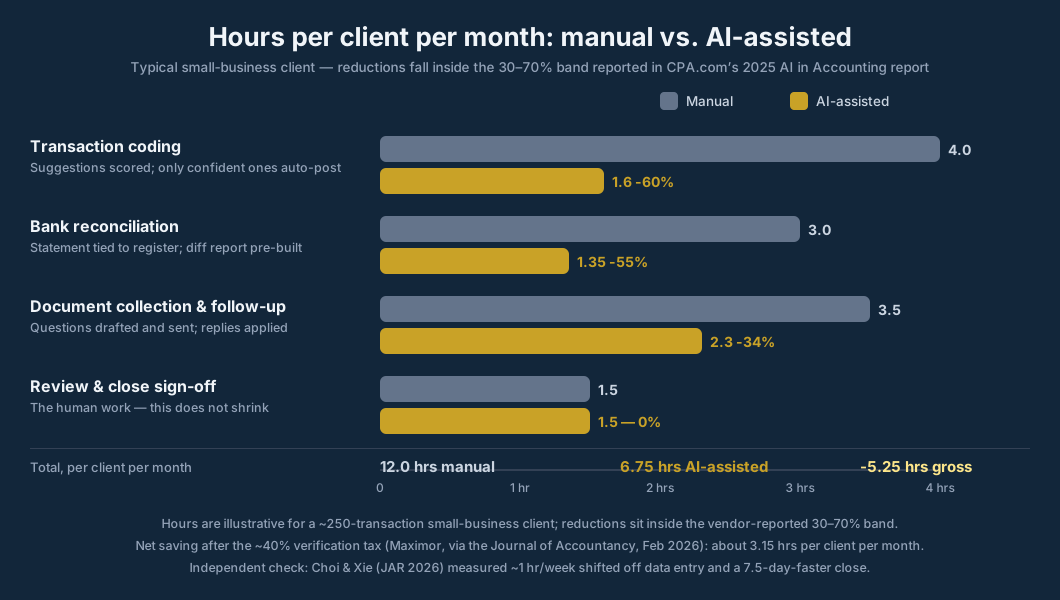
Three things to notice. First, the biggest reductions land exactly where the deployed-capability list said they would: coding, matching, reconciliation — the volume work. Second, review and sign-off don't shrink at all — which is what the Financial Cents data predicted: human review is part of the design. Third, the gross saving (~5.25 hours) is before the verification tax. Apply Maximor's 40%-lost-to-rework figure and the net saving is about 3.15 hours per client per month — still meaningful, roughly a third of the gross, and directionally consistent with Choi & Xie's measured ~1 hour per week shifted off data entry. The honest pitch for AI bookkeeping is not "fire your bookkeeper." It is: roughly a third of the month's volume work goes away, and what comes back is review work, anomaly work, and client work — the work that was always the valuable part.
The worked example: a 40-client firm, before and after
Take a 12-person bookkeeping firm with 40 small-business clients — the mid-sized practice the industry data describes. Baseline month, manually:
| Monthly line | Hours | Cost at $55/hr blended |
|---|---|---|
| Transaction coding, 40 clients | 160.0 | $8,800 |
| Bank reconciliations, 40 clients | 120.0 | $6,600 |
| Document collection and follow-up | 140.0 | $7,700 |
| Review and close sign-off | 60.0 | $3,300 |
| Total | 480.0 | $26,400 |
Now apply the reductions from the chart — the 30–70% band CPA.com's report documents:
| Monthly line | Hours | Cost at $55/hr blended |
|---|---|---|
| Transaction coding (−60%) | 64.0 | $3,520 |
| Bank reconciliations (−55%) | 54.0 | $2,970 |
| Document collection and follow-up (−34%) | 92.4 | $5,082 |
| Review and close sign-off (unchanged) | 60.0 | $3,300 |
| Total | 270.4 | $14,872 |
Gross saving: 209.6 hours, $11,528 a month. Now apply the verification tax — Maximor's finding that ~40% of promised AI productivity is lost to rework and checking:
| Hours | Cost | |
|---|---|---|
| Gross saving | 209.6 | $11,528 |
| Less verification tax (40%) | −83.8 | −$4,611 |
| Net saving | 125.8 | $6,917 |
That net number — ~$6,900 a month, ~$83,000 a year — is the honest figure for this firm, and it is still a good investment by any standard. It also explains the Financial Cents finding that only 20% of firms report "clear, measurable ROI": most firms measure the gross, feel the verification tax as vague extra work, and never reconcile the two. The firms that win do what Choi & Xie's top performers did: take the freed capacity and reallocate it — to communication, assurance, and advisory (the ~19% more clients per week) — rather than counting hours saved and stopping there.
One more honest caveat before moving on. Nearly every time-saving figure in this section is vendor-reported or vendor-surveyed: unnormalized, communications-heavy, and self-selected. The surveys mix legal, tax, and accounting or corporate finance rather than firm bookkeeping specifically. "Accuracy %" means different things everywhere (character vs. field vs. invoice vs. classification). The one peer-reviewed study is one platform and 79 SMEs. The direction is consistent across all of it — real, modest, supervision-dependent gains — but treat any single number as an estimate, including the ones in the worked example above.
How LedgerHQ does it: one concrete example
The design pattern this article has been describing — confidence-gated suggestions, reversible auto-posts, quarantine for the uncertain — is exactly how LedgerHQ's Tally works, and every claim below was verified in the product or its codebase (not asserted from memory):
Tally does the volume work. LedgerHQ's pricing page states the job plainly: Tally "codes the bank activity, works the reconciliations, asks for whatever is missing, and hands you finished financial statements" — routine coding, matching, statement tracking, follow-up questions, and finished reports (ledgerhq.ai/pricing, verified September 2026).
Confidence gates are in the code. AI categorization suggestions carry confidence scores, and only suggestions above the floor auto-post — the floor is a named constant in the codebase (AI_AUTO_POST_MIN_CONFIDENCE = 0.7, i.e. 70%, in lib/banking/ai-confidence-policy.ts). Below the floor, items land in the Fast Coding queue for a human (lib/api/bank-feed-summary.ts; components/tally/guided-fast-coding-widget.tsx).
Uncertain items get quarantined, not posted. The bank-statement OCR worker extracts statement line items for reconciliation (railway.statement-ocr-worker.json, scripts/workers/statement-ocr-worker.ts, app/api/v1/bank-statements/[statementId]/extract/route.ts); transfer legs are auto-paired instead of double-counted (lib/banking/transfer-pair-auto-settlement.ts); corrections feed learned coding rules (lib/banking/rule-auto-code.ts, lib/banking/auto-rule.ts); and suspicious paper checks go through an explicit quarantine-and-release workflow for human review (lib/banking/check-quarantine.ts) rather than posting on the machine's say-so.
The economics underneath. $20 a month per business, Tally's AI use included — free until January 1, 2027 (ledgerhq.ai/pricing, verified September 2026). The pattern the article opened with — AI does the volume, the professional does the judgment — is the product architecture, not a slogan.
What clients expect — and what they don't
The pitch assumes clients want their bookkeeper fired. The client data says otherwise. Karbon's July 2026 survey of 350 US business owners found clients "increasingly expect their accounting firms to use AI" — while continuing to prioritize "the trust, judgment, and strategic guidance central to the profession." Trust was the top reason clients choose an accountant (39%); the profession earned a +49 NPS, with 84% of clients rating their accountant 8 or higher on a 10-point scale (via GlobeNewswire, July 27, 2026). Note the tension: that survey was commissioned by Karbon, an AI practice-management vendor — and the Financial Cents practitioner survey found only 18% of firm owners feel clients expect AI use. Practitioners aren't feeling client pressure; clients say they want AI plus judgment. Both can be true: clients expect the tools, not the replacement.
Bill's Accounting Firm AI Ambitions Survey (200+ firm leaders, reported by Accounting Today, ~July 2026) found 82% say AI has raised client expectations — on speed of service (79%), better advice (67%), data privacy (66%), stronger cybersecurity (65%), compliance (63%), and transparency (51%). "Firms are getting more rush requests, more fee scrutiny, and a growing risk of client churn."
And the general public is not handing its finances to the machine: the New York Life Wealth Watch survey (2,278 US adults, released September 16, 2026) found 27% asked an AI tool a financial question in the past year — but only 23% of those accepted the advice without validating it first (54% ran their own internet search to verify), only 24% are comfortable using AI for financial guidance, and 27% say using AI increased their need for a human advisor. The machine answers the question; the professional keeps the client.
Ten rules for using AI in bookkeeping without getting burned
- Buy the workflow, not the headline. "Fire your bookkeeper" is a pricing page, not a capability. Ask any vendor what their confidence threshold is and what happens below it — the answer tells you whether you're buying supervised autonomy or a guessing machine.
- Insist on confidence gates. Auto-posting everything at one confidence level is how miscoding runs unchecked all year (the Kristi Pippert warning). The serious systems score every suggestion and queue the uncertain ones.
- Never automate judgment. Setup, tax treatment, anomaly resolution, and anything leaving the firm stay human. The Australian practitioner framework (Agentive, 2026) puts it well: always review anything leaving the firm or above materiality; sample routine categorization at measured-accuracy rates; never automate judgment. "A reviewer who looks at everything sees nothing."
- Treat every AI output as a draft. The JofA checklist's rule #2. If nobody re-read it, it isn't finished.
- Verify the sources, not the confidence. The Big Four failures were all citation failures — confident, fabricated, footnoted. Ask the AI for its source, open the source yourself, and permit the tool to say it doesn't know (VSCPA, 2026).
- Keep client data out of public AI tools. Shadow AI is the measured risk (40% of employees using public tools for work, 30% with a policy — CPA Australia). Confidentiality duties don't pause for convenience.
- Demand reversibility and audit trails. Every auto-post must be undoable, and the system must log what it did, what data it used, and why (CPA Practice Advisor, January 2026). If the machine can't show its work, don't let it touch the books.
- Write the AI policy before you need it. 90% of firms have none (Financial Cents, 2026). The policy is one page: permitted uses, prohibited uses, the review loop, the documentation. The JofA's eight-point checklist above is the template.
- Measure the ROI yourself. Only 20% of firms report clear, measurable ROI from AI (Financial Cents, 2026). Track hours per client per month before and after — not vendor accuracy claims, which are marketing.
- Spend the saved hours on the client, not on headcount math. The firms winning with AI aren't firing anyone — they're the ones using the capacity for more clients at lower prices, or for advisory work clients actually pay for.
Frequently asked questions
Can AI do my bookkeeping without a bookkeeper?
No deployed system does unsupervised bookkeeping end to end. AI handles volume tasks — reading documents, suggesting categories, matching transfers, drafting reconciliations — with a human reviewing, deciding the edge cases, and taking responsibility for the financials. The profession's standards (AICPA SSTS §1.4, Circular 230) require the professional to exercise judgment and remain responsible for the work product. Even Intuit's AI-agent pitch keeps "the customer... always in control" alongside human experts.
Is AI bookkeeping accurate?
Accuracy claims are almost entirely vendor marketing — Botkeeper's "98% accuracy" was a company claim, never independently measured (codebridge.tech). What the data does show: Macabacus (September 2026) found 62% of financial-services professionals believe an AI-generated error reached a client or decision-maker in the last year, and 46% admit one "probably" landed in a deliverable uncaught. The safe design is confidence gating: auto-post what the system is sure about, queue the rest for a human.
Will AI replace bookkeepers?
The evidence says augmentation, not replacement. 90% of practitioners agree human judgment matters more, not less, as AI spreads; only 19% trust AI output with limited review — and review is "part of the design itself," not a phase to outgrow (Financial Cents, 2026). The OpenAI "GPTs are GPTs" paper, often misread as an automation forecast, actually measured task-time reduction potential, not automation likelihood. And Botkeeper — the flagship autonomous-bookkeeping company — shut down in February 2026 despite world-class technology and ~$90M raised.
What should my firm's AI policy cover?
The Journal of Accountancy's September 2026 checklist: permitted and prohibited uses (including restrictions on uploading taxpayer data to unsecured platforms), treating AI output as a draft, human verification of authorities/facts/calculations, data-handling protocols, staff training on AI limitations, vetting third-party tools, supervisory review, and documentation of the AI use and its review. 90% of firms currently have no written AI policy (Financial Cents, 2026).
Do clients expect my firm to use AI?
Partly. Karbon's July 2026 survey of 350 business owners found clients increasingly expect firms to use AI — while ranking trust (39%) as the top reason they choose an accountant. Bill's survey of 200+ firm leaders found 82% say AI has raised client expectations on speed, advice, privacy, and transparency. But practitioners themselves report little direct pressure: only 18% say clients expect AI use (Financial Cents, 2026). The read: clients expect modern tools plus human judgment — not a human-free process.
How does LedgerHQ use AI in bookkeeping?
LedgerHQ's Tally is the AI bookkeeper: it codes bank activity, works reconciliations, asks for whatever is missing, and hands over finished financial statements (verified on ledgerhq.ai/pricing, 2026-09-25). In the product, AI categorization suggestions are confidence-gated — only suggestions above the confidence floor auto-post (lib/banking/ai-confidence-policy.ts, verified in the ledgerhq-pro codebase); the bank-statement OCR worker extracts statement line items for reconciliation (railway.statement-ocr-worker.json, scripts/workers/statement-ocr-worker.ts); and suspicious paper checks are quarantined for human review rather than posted (lib/banking/check-quarantine.ts). Pricing is $20 a month per business with Tally's AI use included — free until January 1, 2027 (ledgerhq.ai/pricing, verified 2026-09-25).
Sources
- "Fire your bookkeeper" pitch copy: RetailWatcher (retailwatcher.app); Qdero (qdero.com); Cashflowy (cashflowy.ai); Futureproof (runfutureproof.com) — vendor marketing pages, accessed September 2026
- Intuit "virtual team of AI agents" (customer "always in control"; "along-side trusted AI-enabled human experts"; "up to 12 hours a month"): Intuit press release, July 2025 — https://investors.intuit.com/news-events/press-releases/detail/1258/intuit-introduces-ground-breaking-virtual-team-of-ai-agents-to-fuel-growth-for-businesses
- Botkeeper shutdown; "Infinite" platform claims ("code 80%+ of transactions with a staggering 98% accuracy"; "clean up years of messy data in minutes"; "reconcile accounts autonomously"); ~$90M raised; founder's "world-class" technology verdict: CPA Practice Advisor, February 9, 2026 — https://www.cpapracticeadvisor.com/company/botkeeper/ ; Inside Public Accounting, February 25, 2026 — https://insidepublicaccounting.com/2026/02/25/botkeeper-announces-closure-after-11-years/ ; cfotech.news — https://cfotech.news/story/ai-bookkeeping-startup-botkeeper-shuts-after-11-years
- Botkeeper accuracy figures flagged as company claims, never independently measured: codebridge.tech (via research)
- "Can AI replace accountants end-to-end in a regulated profession where 95% correct is 100% wrong?": CountingWorks PRO, 2026 — https://www.countingworkspro.com/blog/botkeeper-shutdown-ai-accounting-automation
- "GPTs are GPTs" (100% exposure for accountants/tax preparers = ≥50% task-time reduction potential, "does not necessarily suggest... fully automated"): Eloundou, Manning, Mishkin & Rock, arXiv, March 2023 — http://arxiv.org/pdf/2303.10130
- Financial Cents, 2026 State of AI in Accounting and Bookkeeping Report (n=486 firm owners/partners, July 15–August 7, 2026; 90% human judgment matters more; 19% trust with limited review; 18% client expectations; 95% use/explore vs 20% measurable ROI; 90% no written AI policy; drafting 75%, summarizing 71%, reconciliation "at the bottom"): published September 2026 — https://financial-cents.com/resources/guides/the-state-of-ai-in-bookkeeping-accounting/
- AICPA CEO Mark Koziel, "human in the lead": Axios interview, ~September 16, 2026 — https://www.youtube.com/watch?v=lkqquOw2V0k
- "Accounting ethics in the age of AI" ("human in the loop"; automation/overconfidence/anchoring bias; "assistant, not a substitute"): Journal of Accountancy, August 2026 — https://www.journalofaccountancy.com/issues/2026/aug/accounting-ethics-in-the-age-of-ai/
- "The AI revolution in accounting is real. So is the new risk" (autonomous AI "by design, cannot satisfy" PCAOB AS 1105/AS 1000; PCAOB Acting Chair warning, December 2025): Accounting Today opinion, ~June 2026 — https://www.accountingtoday.com/opinion/the-ai-revolution-in-accounting-is-real-so-is-the-new-risk
- "AI Can Be Confidently Wrong. Accountants Cannot." ("It does not carry your license"; "honest limitation is more useful than confident fiction"): Virginia Society of CPAs, 2026 — https://www.vscpa.com/news/51f5e303-5bfc-4923-b539-0205c0455c4f:ai-can-be-confidently-wrong-accountants-cannot
- "AI gives you data. A professional gives you clarity." (unchecked AI miscategorizing "all year long"; forensic-accounting bills): Kristi Pippert, LinkedIn, September 15, 2026 — https://www.linkedin.com/pulse/ai-gives-you-data-professional-clarity-kristi-pippert-m6p1c
- Deloitte Australia AU$440,000 government report (~20 errors; 12 fabricated references; invented Federal Court quote; "drafted using Azure OpenAI (GPT-4o)"; partial refund): reported by AP, The Guardian, Fortune, Financial Times, 2025 — https://joshthompson.co.uk/ai/deloitte-australia-ai-hallucination-public-sector-lessons/
- KPMG "Total Experience" report (45 citations; 5 accurate; 28 fabricated/mangled; UBS/NHS/Swiss Federal Railways/TfL denials; withdrawn June 2026): Financial Times, June 12, 2026 — via https://www.eweek.com/news/gptzero-flags-suspected-ai-content-and-false-citations-in-pwc-reports/ and https://startupfortune.com/kpmg-pulled-an-ai-report-after-its-own-facts-fell-apart/
- EY Canada cybersecurity report (16 of 27 references fabricated; nonexistent McKinsey "Loyalty Economics Report"; withdrawn May 2026): via https://startupfortune.com/the-big-four-are-selling-ai-governance-while-their-own-reports-hallucinate/
- PwC Middle East (four publications; hallucinated "vibe citations"; "utm_source=chatgpt.com"): Financial Times via https://www.eweek.com/news/gptzero-flags-suspected-ai-content-and-false-citations-in-pwc-reports/
- Clinco, T.C. Memo. 2026-16 ("recipe for sanctions"; "bouillabaisse of case names"): Kaitlin Newkirk, CPA & Sarah Webber, CPA, Journal of Accountancy, September 2026 — https://www.journalofaccountancy.com/issues/2026/sep/a-recipe-for-sanctions-ai-hallucinated-citations-in-tax/
- Macabacus, "GenAI for Financial Services: Velocity and Verification" (87% daily/weekly use; 23% comprehensive guardrails; 62% error reached a client/decision-maker; 46% "probably" uncaught): September 2026 — via https://ffnews.com/news/62-of-financial-services-professionals-say-an-ai-generated-error-has-reached-a-c-494a08a2
- "False info, real problems: Can accountants tame AI hallucinations?" (hallucination as "a fundamental property of generative AI"; ~2,000 logged legal-filing cases): Accounting Today, ~September 1, 2026 — https://www.accountingtoday.com/news/false-info-real-problems-can-accountants-tame-ai-hallucinations
- AICPA SSTS §1.4 (eff. January 1, 2024; "not thereby absolved of professional responsibility," ¶1.4.4; "not... supplant their professional judgment," ¶1.4.8; "remain responsible for the resulting work product," ¶1.4.7) and Circular 230 §§10.22/10.35/10.37: via Journal of Accountancy, September 2026 (same Clinco article URL above)
- IRS Office of Professional Responsibility, "Introductory Guidelines for Responsible AI Use in Federal Tax Practice" (~September 2026): via Journal of Accountancy, September 2026
- AICPA Council on AI Risk in Tax (CART), launched ~September 22, 2026 with former IRS Commissioner Danny Werfel: The Accountant Online — https://www.theaccountant-online.com/news/aicpa-partners-with-former-irs-commissioner-to-address-ai-tax-risks/
- JofA firm AI-policy checklist (eight items): Newkirk & Webber, Journal of Accountancy, September 2026 — https://www.journalofaccountancy.com/issues/2026/sep/a-recipe-for-sanctions-ai-hallucinated-citations-in-tax/
- Agentive, "Human in the Loop AI Accounting: Where to Check the Work" (three-tier review; "A reviewer who looks at everything sees nothing"; ASA 530): September 2026 — https://agentive.au/blog/human-in-the-loop-ai-bookkeeping-review-checkpoints/
- "What Accountants Need to Know About Agentic AI" (detailed action logs; human review of the agent): CPA Practice Advisor, January 28, 2026 — https://www.cpapracticeadvisor.com/2026/01/28/what-accountants-need-to-know-about-agentic-ai/177022/
- "5 AI Risks CPA Firms Miss" (shadow AI; client data into public tools; no audit trail): Sonareon, Medium, January 2026 — https://medium.com/@sonareon1/5-ai-risks-cpa-firms-miss-f837b75ccfd8
- CPA Australia poll (40% using public AI tools for work; 30% with an AI policy): reported ~2025 (via research)
- Karbon, "The Future of Client Trust in the Age of AI" (n=350 US business owners; trust top selection reason 39%; +49 NPS; 84% rate 8+): July 27, 2026 — https://www.globenewswire.com/news-release/2026/07/27/3333774/0/en/Karbon-Report-Finds-AI-Raises-the-Standard-for-Client-Relationships-in-Accounting.html (commissioned by Karbon; sponsorship noted)
- Bill, Accounting Firm AI Ambitions Survey (200+ firm leaders; 82% AI raised client expectations): reported by Accounting Today, ~July 2026 — https://www.accountingtoday.com/news/ai-raising-expectations-for-human-accountants
- New York Life Wealth Watch (2,278 US adults; 27% asked AI a financial question; 23% accepted advice without validating; 24% comfortable; 27% increased need for human advisor): released September 16, 2026 — via https://completeaitraining.com/news/ai-use-drives-clients-back-to-human-financial-advisors-new/
- Karbon, State of AI in Accounting 2026 (98% of firms use AI; ~60 min/day/employee saved ≈ 21 hrs/month; only 21% have an AI policy/strategy; 61% of clients want trusted-adviser work entirely human): January 20, 2026 — via https://www.cpapracticeadvisor.com/2026/09/15/ai-disclosure-is-not-about-the-tool-it-is-about-the-trust/190218/ (vendor survey; sample-bias risk noted)
- LedgerHQ capabilities (Tally codes bank activity, works reconciliations, asks for missing items, hands over finished statements; $20/month per business, Tally AI included, free until January 1, 2027): ledgerhq.ai/pricing — https://ledgerhq.ai/pricing (verified 2026-09-25)
- LedgerHQ confidence-gated auto-post (
AI_AUTO_POST_MIN_CONFIDENCE = 0.7); Fast Coding queue (lib/api/bank-feed-summary.ts); statement-OCR worker; transfer-pair auto-settlement (lib/banking/transfer-pair-auto-settlement.ts); learned coding rules (lib/banking/rule-auto-code.ts); check quarantine for human review (lib/banking/check-quarantine.ts): verified in the ledgerhq-pro codebase snapshotChrisRagainTR-ledgerhq-pro-cc7d8bcc9ef2252b380ed88326ac920260038aa5(2026-09-25)