
Bookkeeping operations
Catch-Up Bookkeeping: Cleaning a Year of Messy Books, Step by Step
A deep, evidence-backed guide to catch-up bookkeeping: how far behind businesses get, what a year of neglected books really costs (real firm pricing and IRS penalties), the 8-step cleanup playbook practitioners actually use, and where cleanups go wrong.

The short answer
A year of untouched books is not one problem. It is a stack of problems, and the order you solve them in matters more than the speed: missing documents first, then the timeline, then the coding, then the reconciliation, oldest month to newest, then the close. Skip the order and you build a clean-looking set of books on a foundation you can't defend — and "clean-looking but indefensible" is worse than messy, because at least the mess is honest.
The industry's catchphrase for this work is catch-up bookkeeping: months or years of records that were never entered or reconciled (SDO CPA). The typical client, in one firm's description, is "established, profitable businesses that fell behind on their books. Growth, a busy season, a bookkeeper who left, or a software change can each leave a gap" — and, the crucial line, "the gap doesn't fix itself" (SDO CPA, 2026). The pricing is published openly: roughly $150–$1,200+ per month of history depending on complexity, with SDO CPA posting $320 per month of history ($299 when the books are clean enough). A full 12-month cleanup runs anywhere from $1,800 to $14,400+ by complexity band (SDO CPA cost guide, September 2026).
But the bookkeeping bill is the cheap part of waiting. The expensive part is the penalties, and the penalties have a brutal asymmetry: filing late is roughly ten times worse than paying late. The IRS charges failure-to-file at 5% of unpaid tax per month (capped at 25%) versus failure-to-pay at 0.5% per month. On a $20,000 balance over 12 months, filing on time but not paying costs about $1,200 in penalties; neither filing nor paying costs about $5,700 — nearly five times more, on the identical underlying debt (Clear Start Tax, April 2026). Then the interest compounds daily on top of all of it, and it cannot be abated.
This guide walks the whole job: how far behind businesses actually get, what the mess looks like when you open the file, what waiting costs in real numbers, the eight-step playbook practitioners use (with why each step sits where it does), a worked example of a 12-month cleanup with manual and AI-assisted math, the failure modes that turn cleanups into second cleanups, and how LedgerHQ handles the volume work — verified against the real product, not asserted from memory.
How far behind businesses get
The backlog is not an edge case; it is the modal state of small-business bookkeeping. Start with who's doing the books: Guidant Financial's 2026 survey found only 45.6% of small business owners outsource bookkeeping (against 80.8% who outsource tax prep and 63.3% payroll) — a survey of Guidant's own financing clients rather than a national sample, but the shape is right: most owners DIY the books, and the DIY books are where backlogs are born (via useCarly, checked September 2026). And what "doing the books" means at many shops: QuickBooks' small-business financial-literacy survey found 71% of owners still use pen and paper or spreadsheets for at least part of their finances (via TechBullion, September 2026). The same survey line lands the punch: owners with low financial literacy — often tied to handling books without professional help — lose an average of $118,121 in profit annually; 45% report losing at least $10,000, and 13% estimate losses of $500,000 or more (via Chase Miller, LinkedIn, 2026 — a vendor survey reported through secondary sources; treat the magnitude as directional, but the mechanism is real).
The delay curve is steeper than owners expect. Practitioners put the danger zone at about 60 days: "If more than 60 days pass without reconciling, transactions pile up, receipts go missing, and what should take 15 minutes turns into hours of cleanup" (Sabrina's Admin Services, September 2026). The same practice's rule of thumb: if you've fallen more than a month behind more than once, it's time to outsource. The mechanism is receipt decay — one 2026 writeup put it memorably: "By December, half of them are unreadable, missing, or filed under the wrong month", describing the typical owner's paper-receipt drawer (Medium, February 2026). The books don't just get stale; the evidence rots.
The downstream symptoms show up in the surveys. Intuit's data finds 61% of small businesses experience regular cashflow issues (via Medium, December 2025) — and cashflow surprises are what neglected books produce: the P&L can look healthy while the cash is gone, because nobody reconciled the register. Meanwhile 17% of owners rank bookkeeping and taxes as the #1 job they'd trust AI to do perfectly (2026 Intuit QuickBooks Business Owner Report, via QuickBooks, September 2026). The profession reads that as demand signal: the backlog market is enormous, and owners are already mentally outsourcing it to software.
What the mess actually looks like
Every cleanup starts the same way: you open the file, and it's worse than the client described. It is always worse than the client described. Here's the taxonomy — the six layers you'll find, roughly in the order you'll have to clear them:
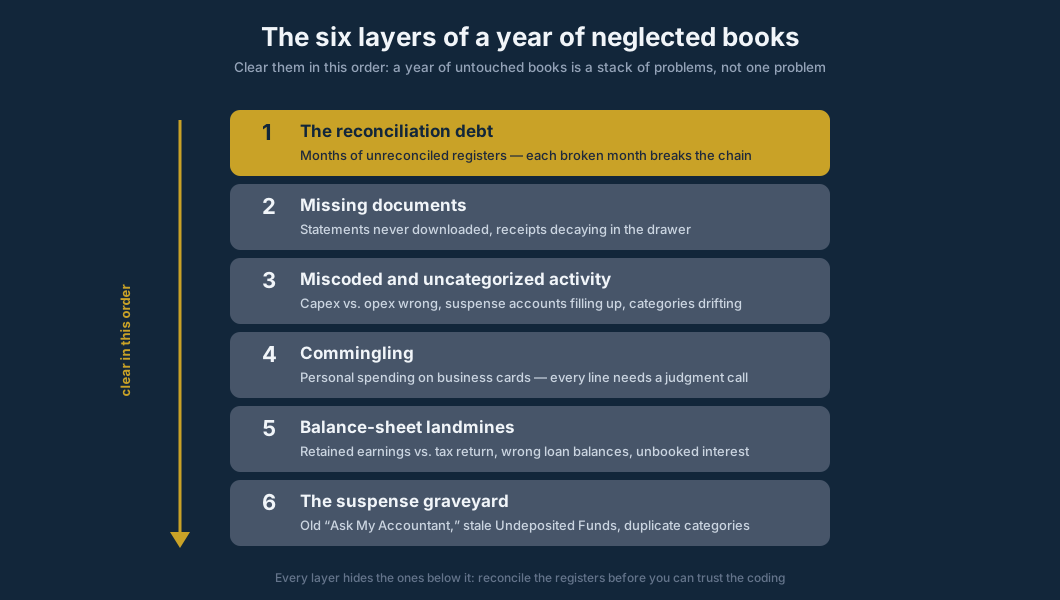
Layer 1 — The reconciliation debt. Months (or a year) of unreconciled registers. This is the defining feature of the mess, and the reason the work is chronological: each month's beginning balance must match the prior month's ending balance. An unreconciled year is twelve broken links in a chain (Rob Robinson, April 2026).
Layer 2 — Missing documents. Statements never downloaded, receipts in the drawer, processor reports (Stripe, Square, PayPal) never pulled. "By December, half of them are unreadable, missing, or filed under the wrong month" (Medium, February 2026). Note the IRS stakes: a credit card statement showing amount and merchant "is not always sufficient — especially for meals, travel, and entertainment, where the business purpose must be documented" under Publication 463 (via Medium, 2026; SDO CPA citing IRS recordkeeping rules).
Layer 3 — Miscoded and uncategorized activity. Focus CPA's September 2026 survey of the six most common bookkeeping errors reads like a cleanup manifest: inconsistent/sporadic recordkeeping, mixing business and personal expenses, not reconciling regularly, misclassifying transactions, ignoring accounts receivable, and delayed financial reporting (via EIN Presswire, September 2026). The misclassification one deserves emphasis: capex vs. opex treated differently is not a cosmetic issue — it moves money between the balance sheet and the P&L.
Layer 4 — Commingling. "Without clean books, it's nearly impossible to separate what's a legitimate deduction from what's personal" (Rob Robinson, April 2026). This is the layer that makes cleanups slow, because every ambiguous transaction needs a judgment call and a client answer.
Layer 5 — Balance-sheet landmines. Retained earnings that don't agree with the tax return. Loan balances that are wrong with interest never booked. Stale suspense and uncategorized entries. Unverified revenue. Owner-equity accounts needing journal corrections (QuickBooks Canada year-end checklist; CapActix 7-task sequence). These are the items that survive a cosmetic cleanup and detonate in the audit.
Layer 6 — The suspense graveyard. Negative bank balances (missing transactions or timing errors), old "Ask My Accountant" totals that must be researched line by line, "Undeposited Funds" months or years old, duplicate expense categories ("Staples" and "Office Depot" as separate accounts) (Rob Robinson, April 2026).
The $6,300 "Ask My Accountant" teardown is the case study that makes this concrete. A small marketing agency, 80 transactions a month: the owner spent most of three weekends sorting 2025 and still ended with $6,300 uncategorized — which the cleanup unpacked as $2,100 in duplicates from a reconnected bank feed, $1,850 of personal spending on the business card, and $2,350 of legitimate software and travel never categorized (RKube Services, Medium, September 2026). One number, three completely different diseases, each needing a different cure. The duplicates are the cautionary tale for the whole industry: reconnecting a feed without deduplicating adds mess.
What waiting costs
This is the section to hand to the client who keeps saying "we'll deal with it at year-end." The cost of waiting has three components: the catch-up bill itself, the penalty stack, and the ecosystem costs around both.
The catch-up bill. Firms publish this openly now, and the structure is consistent: a per-month-of-history price, scoped after a document review, with complexity moving the number more than time does. SDO CPA posts $320 per month of history ($299 when the books are clean enough), with industry bands of $150–$300 (low complexity), $300–$600 (medium), and $600–$1,200+ (high) — and notes that a high-complexity business six months behind ($3,600–$7,200) can cost more than a low-complexity one twelve months behind ($1,800–$3,600). Full-year bands: $1,800–$3,600 / $3,600–$7,200 / $7,200–$14,400+ (SDO CPA cost guide, September 2026). Other published lists sit in the same band: Heard (therapist bookkeeping) at $99 per month of catch-up, Xendoo from $295 per month of history, By The Code charging one monthly bookkeeping fee per month caught up ($250–$400 tiers), and Balanced Bookkeeping Co. doing prior-year cleanup at $75/hour, "starting at $2,000" (via Shoeboxed, September 2026; firm fee schedules). Books LA, a Santa Monica firm, reports observing $1,500–$5,000 for 7–12 months and $5,000–$10,000+ for a year-plus at high volume (September 2026).
Then the adjusters — one firm's published list reads like a mess-taxonomy price list: multi-state sales-tax reconstruction +$1,000–$5,000; multi-currency +30–60%; severely messy existing books +25–50%; missing source documents +$500–$2,000; rush timeline +25–50%. The reducers are the mirror image: AI tools already in place −30–50%, clean source documents ready −20–30% (CatchUpCleanup.com, 2026 — firm estimates, not measured outcomes). Their worked example: a mid-complexity Shopify store nine months behind — base $3,000–$6,500, plus $2,500 in sales-tax issues, minus 30% for AI running — estimated $3,850–$6,300.
The penalty stack. This is where "we'll deal with it at year-end" turns into five figures. The IRS penalty structure (via WizTax, 2026, sourced to IRS Topic 653; Jupid, March 2026):
- Failure to file: 5% of unpaid tax per month, capped at 25%, with a minimum $525 (or 100% of the tax, whichever is less) for returns 60+ days late on 2026-due returns.
- Failure to pay: 0.5% per month, capped at 25% (0.25% under an installment agreement). Both in one month: combined 5%/month for the first five months, then 0.5%/month — maximum combined exposure 47.5%.
- Interest: federal short-term rate + 3 points, compounded daily — 7% for Q3–Q4 2026. Interest cannot be abated.
The concrete math: owe $10,000, file and pay nothing for six months → $2,500 failure-to-file + $300 failure-to-pay + ~$200 interest ≈ $13,000 total (BestMoney, September 2026). A $5,000 debt grows to ~$5,800 in a year and ~$6,700 in two; $25,000 becomes ~$29,000, then ~$33,500. And the asymmetry that should be on every firm's wall: on a $20,000 balance over 12 months, filing on time but not paying costs ≈ $1,200 in penalties; neither filing nor paying costs ≈ $5,700 — "nearly five times more, on the identical underlying debt" (Clear Start Tax, via IBTimes, April 2026). Owing $10,000 with no filing: $500/month in penalties versus $50/month if filed but unpaid. The extension trap completes the picture: Form 4868 extends the time to file, not to pay — failure-to-pay and interest run from April 16 anyway, and the extension is void if the estimated tax shown is a placeholder (Morkel Financial, September 2026).
The penalty ladder extends beyond income tax. S-corps and partnerships that file late owe $255 per owner per month, up to 12 months — even when the entity owes zero tax (Jupid, 2026). Missed 1099-NECs: $60 per form corrected within 30 days of the January 31 deadline, $120 up to August 1, $310 after, $660 for intentional disregard — so ten missed contractor 1099s filed late cost $3,100 versus $600 if caught fast (Tax1099, 2026). State sales tax is its own regime: New York charges 10% the first month plus 1% per additional month up to 30%; Georgia ≈ 5% per month; Minnesota up to 15% — and in some states you owe filing penalties even with zero tax due (NY DOR; TaxConnex; Colorado DOR). Catch-up frequently reveals nexus, and registration back-fees run $100–$1,000+ per state (CatchUpCleanup.com).
The ecosystem stack. The catch-up engagement is usually the largest single number, but the surrounding costs stack up: back tax filings $500–$5,000+, CPA review time $300–$1,500, ongoing monthly bookkeeping $300–$1,500/month to prevent a repeat — and then, ideally, the monthly service that makes the next cleanup unnecessary (CatchUpCleanup.com, 2026 — firm figures).
Put it on one chart, and the shape of the mistake becomes obvious:
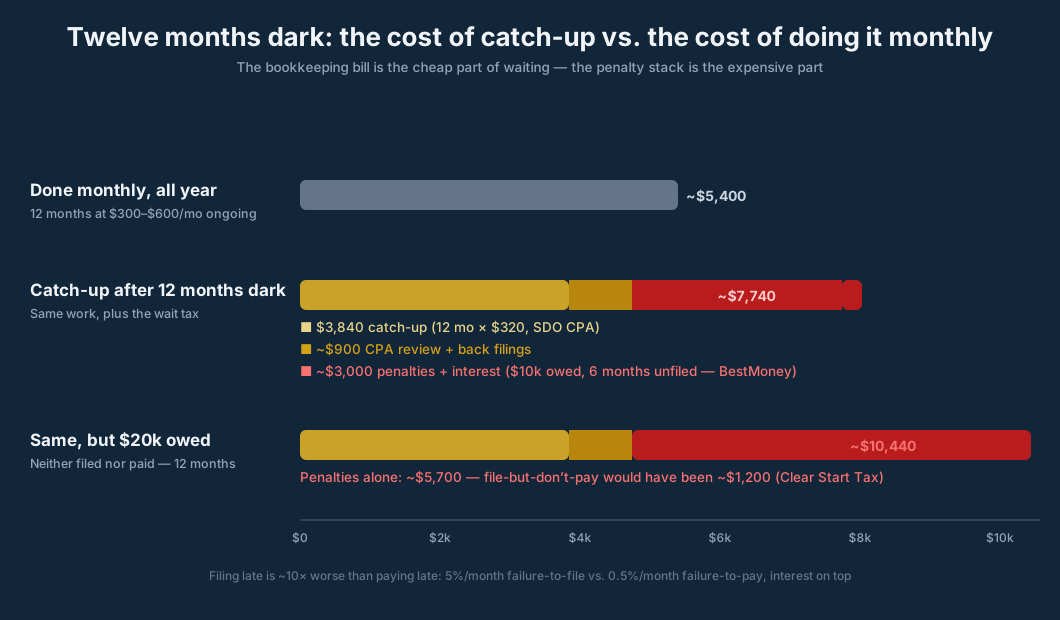
The honest read of the chart: doing it monthly isn't dramatically cheaper than the catch-up bill itself at medium complexity — the machine and the human do roughly the same work either way. What waiting buys is the penalty stack and the advisory vacuum. A year of dark books is a year of decisions made without numbers: missed deductions nobody can reconstruct, cash crunches nobody saw coming, a tax return built on estimates. One practitioner summarized the physics: "Done every month, this takes an hour or two. Done once a year, it takes weeks" (RKube Services, September 2026).
The cleanup playbook, step by step
Practitioners have converged on essentially the same sequence — Rob Robinson's six-step catch-up process (April 2026), the QuickBooks Canada year-end close checklist (the industry-standard mechanics), and CapActix's seven-task cleanup sequence all describe the same order of operations. Here it is as eight steps, with why each one sits where it does:
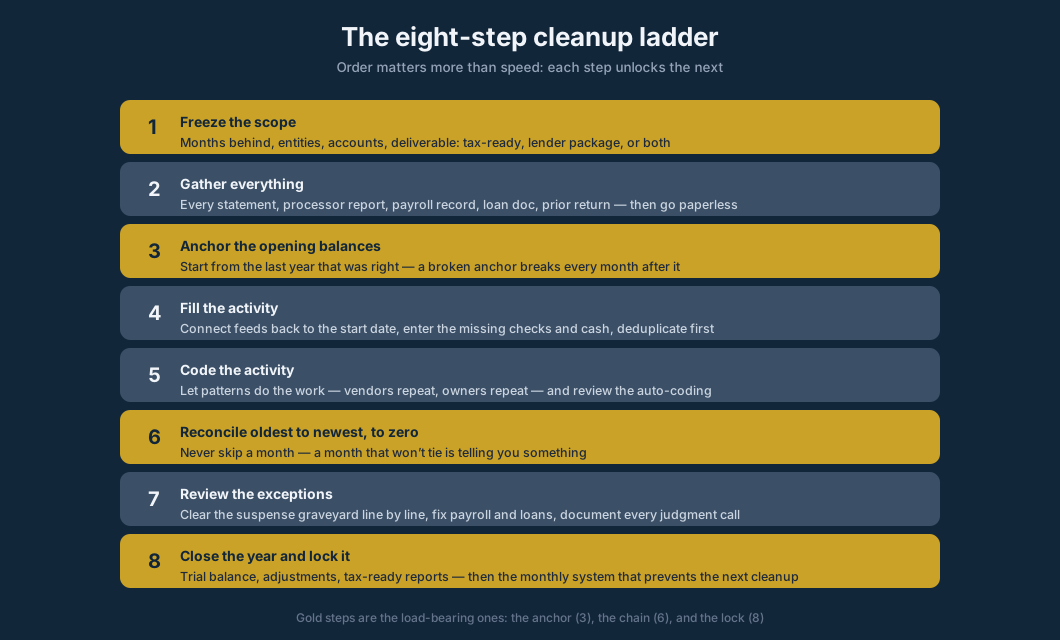
Step 1 — Freeze the scope. How far behind, which entities, which accounts, what the end deliverable is (tax-ready books? a lender package? both?). The scope decision drives the price and the timeline: CoCountant's practitioner table runs from 1–2 weeks for a simple 1–3 month backlog to 10–18 weeks for 12–24 months at 300+ transactions a month (2026) — and notes that "backlog length is the most visible factor but not always the most time-consuming — transaction volume, structural errors, and source-document availability are often more consequential than the number of months." Typical firm timelines: an 18-month cleanup takes 4–8 weeks depending on volume; a six-month medium-disorganization backlog runs about 15–30 business days (R. Robinson, Phoenix; Gondaliya CPA, Toronto, August 2026). The DIY-vs-hire breakpoint from practitioners: DIY works under 50 transactions a month and one to two months behind; hire a professional at three-plus months behind, or with employees, sales tax, multiple accounts, or a loan/investor deadline approaching (Rob Robinson, April 2026).
Step 2 — Gather everything. Bank and card statements for every account for every month behind. Processor reports (Stripe, Square, PayPal). Payroll and contractor records. Loan statements. Prior tax returns. Formation documents (SDO CPA intake list, 2026). This is the step clients stall on, and it's the step the reducers price: clean source documents ready cuts the engagement 20–30% (CatchUpCleanup.com). Go paperless as you collect — the receipt drawer is a liability (Rob Robinson, April 2026).
Step 3 — Anchor the opening balances. This is the load-bearing step, and the one cleanups most often get wrong. The rule from SDO CPA's engagement mechanics: "if a year was skipped or closed wrong, every later year can be off, so the catch-up starts from the last year that was right." The opening balance is the chain-of-custody anchor: January's beginning balance must equal the last known-good ending balance to the penny. If it doesn't, something is wrong upstream — a prior period was reopened, a statement is missing, or the wrong account was connected — and no amount of downstream coding fixes it. Verify retained earnings against the prior tax return here (QuickBooks Canada checklist).
Step 4 — Fill the activity. Connect the bank feeds back to the start date and let the machine pull what's there — on first connection, aggregation can auto-fetch up to roughly 36 months of historical statements and check/deposit images (a 2018 practitioner review of the mechanism; treat as the feed industry's practice, not a current product claim). Then manually enter what's missing: checks, cash, anything the feed didn't see. Deduplicate before you connect — the RKube teardown's $2,100 in duplicates came from a reconnected feed double-posting (Rob Robinson's DIY roadmap makes the same point: merge duplicate categories, aim for fewer than 75 active accounts; fix negative bank balances; clear stale "Undeposited Funds").
Step 5 — Code the activity. This is where patterns do the heavy lifting: vendors repeat, owners repeat, rent is rent. Review and correct the auto-categorization rather than keying everything by hand (Rob Robinson, step 4). The speed trap lives here: auto-coding garbage forward at machine speed just produces machine-speed garbage — the review is the step, not the bottleneck.
Step 6 — Reconcile each month, oldest to newest, never skip. This is the religion. Each month's register must agree with that month's statement ending balance, and each month's beginning balance must match the prior month's ending balance (Rob Robinson's catch-up process, April 2026). A month that won't reconcile to zero is telling you something: a missing transaction, a miscoded amount, a duplicate. Skip a month and the chain breaks — the difference compounds forward. This is also where the frequency dividend pays: frequent (daily/weekly) reconciliation cuts per-account reconciliation from 6–8 hours a month to ~1–2 hours — "problems caught on day 3 instead of day 30" (Rob Robinson, April 2026).
Step 7 — Review the exceptions. Once the months reconcile, the remaining uncategorized and suspense items are the whole remaining job — the modern "Ask My Accountant" teardown, line by line (RKube's $6,300 example). Scrub them against invoices and emails. Then the balance-sheet review: loan balances and interest booked, payroll/contractor records fixed before the 1099 deadline, owner-equity journals (CapActix sequence; QuickBooks Canada checklist). One practitioner's discipline worth adopting: document every judgment call (Rob Robinson's DIY roadmap). The next person to touch these books — the CPA, the auditor, you in March — needs to know why a transaction was coded the way it was.
Step 8 — Close the year and lock it. Produce the P&L and balance sheet and check accuracy against each other — "review the P&L only once the balance sheet is accurate" (QuickBooks Canada). Prepare the year-end trial balance. Post adjustments: depreciation, new fixed assets. Verify loan balances and book the interest. Then lock the period so the cleanup stays cleaned — and set up the monthly system (SDO CPA's engagement ends the same way: "then a system so books stay current"). The cheapest cleanup is the one you never need again.
One honest tension worth naming: one practitioner's advice for the overwhelmed owner is "don't try to go back to January; start now and catch up in 4-5-hour blocks until you're current" (Sabrina's Admin Services, September 2026). That's about not stalling — get this month's books clean going forward — not about reconciliation order. The reconciliation itself still runs oldest to newest. Both things are true: start now, but build the chain in order.
The numbers: a 12-month cleanup, worked
Take the RKube-shaped client: a service business, ~200 transactions a month across checking and one card — 2,400 transactions for the year, twelve months dark. Two ways to clean it.
Manual baseline. Practitioner timelines for a structural 6–12 month backlog run 6–12 weeks at a firm (CoCountant, 2026); a DIY owner typically spends 20–40 hours on 12+ months depending on volume and organization (Rob Robinson, April 2026). In dollars: at $75/hour (Balanced Bookkeeping Co.'s published cleanup rate), 40 hours is $3,000; at ProAdvisor rates of $50–$150/hour, it's $2,000–$6,000 (Possibly.com; Milestone Inc., September 2026). Or the flat way: 12 months × $320/month of history = $3,840 at SDO CPA's published rate — the two methods agree, which is a good sign the pricing is real. The error tax is the 2.41% keystroke error rate measured in routine data entry (NYU Stern, IS-90-01): on 2,400 hand-keyed transactions, that's on the order of 50+ mistyped fields by a careful operator, each a future difference to chase.
AI-assisted. The levers are the ones the prior guides on this site documented: bank feeds and statement extraction do the intake; the engine auto-codes the routine 85–95% (the practitioner rule of thumb; Lilach Bullock, September 2026); reconciliation collapses from a half-day per client per month to a 20-minute review of the exceptions. One firm's practitioner estimate puts AI tooling at a 30–50% cost reduction on a catch-up engagement (CatchUpCleanup.com, 2026 — a firm estimate, not a measured outcome). Apply this site's honesty discount from the AI-in-bookkeeping guide — roughly 40% of promised AI productivity is lost to verification and rework — and the shape is: the 2,400 routine transactions get coded by the machine, the human works the exceptions, the duplicate check, and the judgment calls.
The chart below puts the two routes on one timeline:
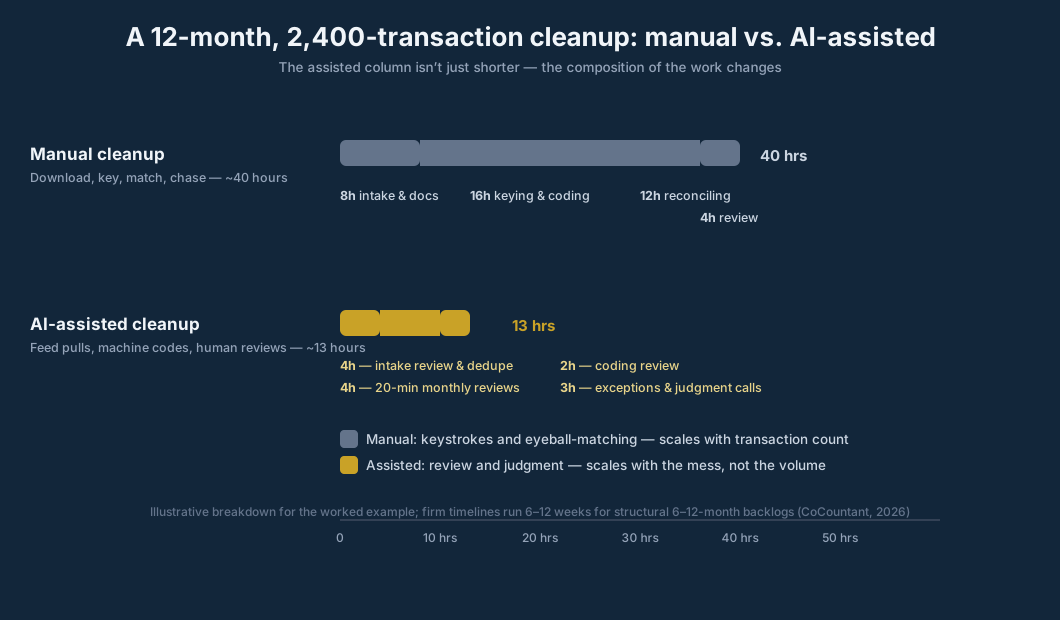
Read the chart the way the profession does: the assisted column isn't just shorter — the composition of the work changes. Manual cleanup is keystrokes and eyeball-matching, which scales with transaction count and degrades with fatigue. Assisted cleanup is intake review, exception review, and judgment calls — which scale with the mess, not the volume. The mess is the part that always needed a professional.
The deeper math is the prevention math. A simple business under 100 transactions a month needs 2–4 hours a week of bookkeeping (SDO CPA FAQ); at monthly cadence, this client's close is a few hours a month. Twelve months of that, done on time: ~30–40 hours spread across a year, receipts still legible, memories still fresh. Done once: 20–40 hours compressed into weeks, half the receipts unreadable, and a penalty stack ticking. The cleanup premium is never just the invoice — it's the invoice plus the rot.
Where cleanups still go wrong
Cleanups fail in specific, predictable ways. Knowing them is what separates a one-time cleanup from a cleanup that needs its own cleanup:
Starting at month twelve. The chain runs oldest to newest because every month's beginning balance is the prior month's ending balance. Starting at December means reconciling against an opening balance you haven't verified — twelve months of compounding unverified assumptions (Rob Robinson, April 2026).
Defending an opening balance you can't defend. If January's beginning balance doesn't match the last known-good ending balance, stop. Reconciling forward from a broken anchor produces books that tie internally and mean nothing. This is the single most common way a cleanup produces "clean-looking but indefensible" (SDO CPA: "if a year was skipped or closed wrong, every later year can be off").
Guessing instead of flagging. The $1,850 of personal spending in the RKube teardown was identifiable because someone asked. The temptation in a 12-month cleanup is to code the ambiguous ones and move on — speed feels like progress. It isn't. Flag it, ask the client, document the answer. "Document every judgment call" (Robinson's DIY roadmap) is the discipline that makes the books defensible.
Auto-coding garbage forward. The machine will happily code 2,400 transactions at 85–95% accuracy — which means 120–360 wrong ones if nobody reviews. The verification tax is real (roughly 40% of the promised saving goes to review and rework), and skipping it converts a cleanup into a bigger mess at machine speed. The rule: the human reviews what didn't tie, and a human still signs off.
Reconnecting the feed without deduplicating. The RKube teardown's single biggest line item — $2,100 in duplicates — came from a reconnected bank feed double-posting transactions that were already in the books. Connect the feed, then dedupe against what exists before anything posts. This is the cleanup-specific version of "measure twice, cut once."
The "I'll fix it at year-end" anti-pattern. Deferral is the disease; the cleanup is the symptom. The 60-day cliff is the empirical version: what takes 15 minutes at 30 days takes hours at 90 (Sabrina's Admin Services). Every cleanup should end with a system that prevents the next one — SDO CPA's engagement mechanics close the same way: "then a system so books stay current."
Client documents that can't be trusted. Extraction reads what the document says, and a forged PDF says lies fluently — the fraud chain from this site's statement-OCR guide applies double to cleanups, where the client is handing you a year's worth of PDFs at once. Kenneth Blair's 30-month sentence for altered bank statements with "vastly overstated account balances" (DOJ, September 2026) and the $7.3M FHA/VA fraud built partly on falsified statements (DOJ, September 2026) are the recent cases; Parmalat's fake $4.9B Bank of America confirmation is the classic (The CPA Journal, 2005). The profession's hierarchy holds: bank-direct evidence outranks client-provided evidence. For cleanups with lending or audit stakes, pair extraction with independent verification.
How LedgerHQ does it
The pipeline this article has been describing — feeds and statement extraction for intake, the machine coding the volume, the human on the exceptions, coverage tracking that finds the gaps before the reconciliation starts — is how LedgerHQ handles the work, and every claim below was verified against the real product or its codebase (not asserted from memory):
Tally does the volume work. LedgerHQ's pricing page states the job plainly: Tally "codes the bank activity, works the reconciliations, asks for whatever is missing, and hands you finished financial statements" — routine coding, matching, statement tracking, follow-up questions, and finished reports (ledgerhq.ai/pricing, verified September 2026). In a cleanup, that division of labor is the whole game: the 2,400 routine transactions are exactly the high-volume coding the machine does best, and the judgment calls — the ambiguous commingled ones, the missing-document flags — are exactly what Tally routes to the human.
The machine posts its best guess — and labels its uncertainty. The auto-post policy (lib/banking/ai-confidence-policy.ts on master) posts the best available category at any confidence down to 1%, with the code comment explicit that "confidence is not a quality approval gate" — only zero-signal rows, where the engine has nothing at all, stay back for human review (verified 2026-09-26). In a 12-month cleanup, that policy is load-bearing: the routine 85–95% posts, the uncertain rows queue for the professional, and nothing vanishes silently either way. Transfer legs auto-pair instead of double-counting — a payment that moves money between your own accounts books once, not twice as an expense and a deposit (verified 2026-09-26).
Statements are evidence, tracked like evidence. Statement PDFs and uploads live in the Statements workspace — Plaid-provided statements, firm uploads, client uploads — with OCR/extraction reading structured statement data when available, and coverage policies tracking which account/month periods are verified, received-unverified, mismatched, waived, or missing (ledgerhq.ai/docs/modules/banking, verified 2026-09-26). In a cleanup, the coverage tracker is the intake map: it knows which of the twelve months lack statement evidence before the reconciliation starts, not after it fails to tie. And the docs state the boundary this article kept returning to: "Statements support reconciliation and close, but they are not the reconciliation itself."
The economics. $20 a month per business, Tally's AI use included — free until January 1, 2027 (ledgerhq.ai/pricing, verified 2026-09-26). And the comparison that matters for this article's positioning: bank-statement OCR for no-touch reconciliation is one of the capabilities in the gap between LedgerHQ and the incumbents, whose workflow still starts with the human reading the statement. A cleanup is the workload where that gap is widest — it's the maximum-volume coding job a firm ever does, and it's precisely the job the machine takes.
Ten rules for a clean cleanup
- Start from the last year that was right. If a year was skipped or closed wrong, every later year is off (SDO CPA). Find the anchor first.
- Oldest to newest, no skipped months. Each month's beginning balance is the prior month's ending balance. The chain doesn't skip.
- Defend the opening balance or don't proceed. If January's beginning balance doesn't tie to the last known-good number, stop and find out why.
- Deduplicate before you connect. A reconnected feed double-posting is the most expensive duplicate in the business (RKube's $2,100).
- Flag, don't guess. Ambiguous transactions get client answers and documentation — never a confident guess.
- Document every judgment call. The CPA, the auditor, and future-you need to know why a transaction was coded the way it was (Rob Robinson's DIY roadmap).
- Reconcile to zero, not to "close enough." A month that won't tie to zero is telling you something. Listen.
- Clean the chart of accounts while you're in there. Merge duplicate categories; practitioners aim for fewer than 75 active accounts.
- Price the backlog honestly, then prevent the next one. Publish the per-month rate, scope the mess, and roll the client into monthly bookkeeping.
- File late is ten times worse than pay late. The extension buys time to file, not to pay (Form 4868). And once the cleanup is done, build the system that keeps the books current — the cheapest cleanup is the one you never need.
Frequently asked questions
How much does catch-up bookkeeping cost?
Firms publish per-month-of-history pricing: roughly $150–$300/month (low complexity), $300–$600 (medium), $600–$1,200+ (high). A full 12-month cleanup runs $1,800–$3,600 / $3,600–$7,200 / $7,200–$14,400+ by band (SDO CPA cost guide, September 2026). Published examples: SDO CPA at $320/month of history, Heard at $99/month, Xendoo from $295/month of history. Complexity moves the price more than time does. Adjusters: missing documents +$500–$2,000, multi-state sales-tax reconstruction +$1,000–$5,000, rush +25–50% (firm-published lists).
How long does a bookkeeping cleanup take?
Practitioner timelines: 1–3 months of simple backlog → 1–2 weeks; 3–6 months → 2–4 weeks; 6–12 months with structural errors → 6–12 weeks; 12–24 months → 10–18 weeks (CoCountant, 2026). A DIY owner typically spends 20–40 hours on 12+ months (Rob Robinson, April 2026). Transaction volume, structural errors, and document availability matter more than the month count.
Can I do catch-up bookkeeping myself?
Practitioners say DIY works under 50 transactions a month and one to two months behind. Hire a professional at three-plus months behind, or with employees, sales tax, multiple accounts, or a loan/investor deadline approaching (Rob Robinson, April 2026).
What's the penalty for not filing my taxes?
Failure-to-file runs 5% of unpaid tax per month (capped at 25%, minimum $525 for 2026-due returns filed 60+ days late); failure-to-pay is 0.5% per month. On a $20,000 balance over 12 months: ≈ $1,200 in penalties if you file but don't pay, ≈ $5,700 if you neither file nor pay — on the identical debt (Clear Start Tax, April 2026). Interest (7% for Q3–Q4 2026, compounded daily) accrues on top and cannot be abated. File the return even if you can't pay.
Do I really need to reconcile every month in order?
Yes. Each month's beginning balance must match the prior month's ending balance — it's a chain, and skipping a month breaks it. A month that won't reconcile to zero is telling you about a missing transaction, a miscoded amount, or a duplicate (Rob Robinson, April 2026).
What if I'm missing bank statements?
Rebuild the document set first — statements for every account for every month behind, processor reports, payroll records, loan statements, prior returns (SDO CPA intake list). Bank feeds can backfill activity on first connection; what the feed misses gets entered manually. Missing documents add $500–$2,000 to a typical engagement (firm-published adjuster) — and they're also why the coverage tracker matters: know which months lack evidence before the reconciliation starts.
How does AI change catch-up work?
It changes the composition, not the job. The machine does the volume: intake, coding the routine 85–95%, matching. The human does what always needed judgment: the opening-balance anchor, the exceptions, the ambiguous commingled transactions, the review, the sign-off. One firm's estimate: AI tooling cuts catch-up cost 30–50% (firm claim, CatchUpCleanup.com, 2026) — with the honest discount that roughly 40% of promised AI productivity goes to verification and rework. The professional stays responsible for the work product regardless of the tools (AICPA SSTS §1.4).
Sources
- SDO CPA, catch-up bookkeeping services ("established, profitable businesses that fell behind"; $320/month of history, $299 when clean; "the gap doesn't fix itself"; "if a year was skipped or closed wrong, every later year can be off"; intake document list) — https://www.sdocpa.com/catch-up-bookkeeping-services/ (checked September 2026)
- SDO CPA, 2026 catch-up cost guide (per-month bands $150–$300 / $300–$600 / $600–$1,200+; 12-month bands $1,800–$3,600 / $3,600–$7,200 / $7,200–$14,400+; hourly economics; complexity > time) — https://www.sdocpa.com/catch-up-bookkeeping-cost-guide/ (September 2026)
- Shoeboxed, bookkeeping cost roundup (Heard $99/month of catch-up; Xendoo from $295/month of history; By The Code one-monthly-fee-per-month-caught-up) — https://www.shoeboxed.com/blog/bookkeeping (September 2026)
- Possibly.com 2026 cost guide (freelance $25–$100/hr; ProAdvisor $50–$150/hr; production bookkeeping $40–$90/hr; controller $125–$200/hr; BLS median $50,670/yr) — https://possibly.com/blog/cost-guide/bookkeeping-service-costs-in-2026-what-businesses-are-actually-paying/ (September 2026)
- Milestone Inc. (ProAdvisor $50–$150/hr) — https://milestone.inc/blog/how-much-should-i-pay-someone-to-do-my-quickbooks (September 2026)
- Books LA ($1,500–$5,000 for 7–12 months; $5,000–$10,000+ for year-plus high-volume) — September 2026, via the SDO CPA cost guide
- Balanced Bookkeeping Co. services guide (prior-year cleanup "starting at $2,000" at $75/hour) — https://static1.squarespace.com/static/655521edc4083a6a5579eb9b/t/6642634416e6324405bc6cbf/1715626820596/SERVICES+%26+PRICING+GUIDE+TEMPLATE.pdf
- CatchUpCleanup.com, Shopify catch-up cost guide (adjusters: multi-state sales tax +$1,000–$5,000; multi-currency +30–60%; missing documents +$500–$2,000; rush +25–50%; reducers: AI −30–50%, clean documents −20–30%; ecosystem costs; firm estimates) — https://www.catchupcleanup.com/post/shopify-catch-up-bookkeeping-cost (2026)
- WizTax IRS penalty reference (failure-to-file 5%/month capped 25%, $525 minimum 60+ days late; failure-to-pay 0.5%/month; interest fed rate + 3 pts compounded daily; interest not abatable; sourced to IRS Topic 653) — https://www.wiztax.com/blog/irs-penalty-abatement-first-time-abatement-reasonable-cause/ (2026)
- Jupid 2026 late-filing guide (combined 5%/month first five months; 47.5% max combined; S-corp/partnership $255/owner/month up to 12 months) — https://jupid.com/blog/late-filing-penalty-guide-2026 (March 2026)
- BestMoney ($10,000 owed + 6 months of neither filing nor paying ≈ $13,000; $5,000 → $5,800 → $6,700) — https://www.bestmoney.com/tax-relief/learn-more/what-happens-if-you-dont-pay-taxes (September 2026)
- Clear Start Tax ("filing on time but not paying ≈ $1,200 in penalties; neither filing nor paying ≈ $5,700 — nearly five times more, on the identical underlying debt"; $10,000 owed: $500/month penalties vs $50/month) — via IBTimes, April 22, 2026 — https://markets.financialcontent.com/ibtimes/article/accwirecq-2026-4-22-irs-penalty-for-not-filing-is-10-times-worse-than-not-paying-clear-start-tax-breaks-down-the-math-most-taxpayers-get-wrong
- Morkel Financial (Form 4868 extends filing, not payment; void on placeholder estimates) — https://morkelfinancial.com/blog/missed-tax-extension-deadline (September 2026)
- Tax1099 2026 penalties ($60/$120/$310 per form tiers; $660 intentional disregard; small-business annual caps) — https://www.tax1099.com/blog/1099-penalties/ (2026)
- NY Department of Taxation, ST-101 instructions (10% first month + 1%/month to 30%; $50 non-filer penalty even with zero tax due) — https://www.tax.ny.gov/forms/html-instructions/2025/st/st101i-a25.htm
- TaxConnex (state sales-tax penalty regimes; Georgia ≈ 5%/month; Minnesota up to 15%) — https://www.taxconnex.com/blog-/what-happens-if-you-mess-up-sales-tax-filing
- Rob Robinson, "Behind on Bookkeeping: How to Catch Up Without Losing Your Mind" (6-step process; DIY roadmap; 20–40 hours for 12+ months; DIY breakpoint 50 txns/month and 1–2 months behind; "caught on day 3 instead of day 30"; commingling quote; merge to fewer than 75 accounts; document judgment calls) — https://medium.com/@rob_25961/behind-on-bookkeeping-how-to-catch-up-without-losing-your-mind-e13988db4b2b (April 2026)
- Rob Robinson, "Messy Bookkeeping: How Small Business Owners Can Clean Up" (DIY roadmap: oldest→newest, never skip months; fix negative balances; clear Ask My Accountant/Undeposited Funds) — https://medium.com/@rob_25961/messy-bookkeeping-how-small-business-owners-can-clean-up-73a092b190fd (April 2026)
- Rob Robinson, "Reconciling Your Accounts Shouldn't Feel Like a Monthly Puzzle" (frequent reconciliation: 6–8 hrs/month/account → 1–2 hrs/month) — https://medium.com/@rob_25961/reconciling-your-accounts-shouldnt-feel-like-a-monthly-puzzle-9d827debf5e3 (April 2026)
- R. Robinson Bookkeeping, Phoenix (discovery → diagnostic → flat-fee quote, e.g. 6–10 weeks to clean 2025 + YTD 2026; 18-month cleanup 4–8 weeks) — via the catch-up article above (2026)
- CoCountant (cleanup timelines: 1–3 mo → 1–2 weeks; 3–6 mo → 2–4 weeks; 6–12 mo structural → 6–12 weeks; 12–24 mo → 10–18 weeks; 2–3 yr → 16–24 weeks; volume/structure matter more than months) — https://cocountant.com/blog/bookkeeping/how-long-does-bookkeeping-cleanup-take/ (2026)
- Gondaliya CPA, Toronto (six-month medium-disorganization backlog ≈ CAD $3,600 incl. HST; most cleanups finish in 15–30 business days; firm self-description) — https://medium.com/@gondaliyacpa/catch-up-bookkeeping-cra-ready-t4-t4a-gst-hst-canada-2026-the-ultimate-guide-to-catch-up-ac3ffa2099f2 (August 2026)
- Sabrina's Admin Services (60-day cliff: "15 minutes turns into hours of cleanup"; ">a month behind more than once" = outsource signal; "start now in 4-5-hour blocks") — https://sabrinasadminservices.com/bookkeeping-tips-for-small-business/ (September 2026)
- RKube Services (the $6,300 Ask My Accountant teardown: $2,100 duplicates + $1,850 personal + $2,350 uncategorized; "an hour or two a month vs weeks a year") — https://medium.com/@rkubeservices/tax-season-is-over-why-late-april-is-the-best-time-to-fix-your-bookkeeping-4b02ea190452 (September 2026)
- CapActix via Nancy Todell (7-task cleanup sequence) — https://medium.com/@nancyTodell/tax-season-is-one-of-the-most-demanding-periods-for-cpa-firms-in-the-united-states-67f536177da9
- QuickBooks Canada, year-end close checklist (industry-standard mechanics: reconcile cash, verify retained earnings, trial balance, loan/interest, depreciation, balance sheet before P&L) — https://quickbooks.intuit.com/ca/resources/accounting/how-to-perform-a-year-end-clean-up-on-your-accounting-books/
- Christine Suter (5-step year-end wrap) — LinkedIn, via https://www.linkedin.com/posts/christine-suter-bookkeeping_as-the-year-winds-down-getting-your-books-activity-7390905800984276992-MoDu
- Focus CPA (six most common bookkeeping errors hurting cash flow) — https://sse.einnews.com/pr_news/942354742/focus-cpa-identifies-the-most-common-bookkeeping-errors-hurting-small-business-cash-flow (September 2026)
- QuickBooks financial-literacy survey (71% pen-and-paper/spreadsheets; low-literacy owners lose avg $118,121 in profit — vendor survey via secondary sources): via TechBullion, September 2026 — https://techbullion.com/why-growing-small-businesses-are-ditching-spreadsheets-for-professional-bookkeeping/
- Guidant Financial 2026 survey (45.6% outsource bookkeeping — survey of Guidant's own financing clients): via useCarly, checked September 2026 — https://www.usecarly.com/blog/entrepreneur-statistics/
- 2026 Intuit QuickBooks Business Owner Report (17% would trust AI to do bookkeeping/taxes perfectly) — via QuickBooks, September 2026 — https://www.globemiamitimes.com/premium/stacker/stories/the-real-cost-of-payroll-a-small-business-guide-for-2026,126411
- Intuit surveys (61% experience regular cashflow issues) — via Medium, December 2025 — https://medium.com/@virtual-employee/why-small-businesses-struggle-with-bookkeeping-and-how-to-fix-it-early-82573c1ce222
- Medium/@gideonolatunji1 ("By December, half of them are unreadable, missing, or filed under the wrong month"; IRS Publication 463 business-purpose rules) — https://medium.com/@gideonolatunji1/7-bookkeeping-mistakes-small-business-owners-make-that-cost-them-at-tax-time-7e93c57058e8 (February 2026)
- NYU Stern, working paper IS-90-01, "On Error Correction in Routine Data Entry" (2.41% keystroke error rate) — http://archive.nyu.edu/bitstream/2451/14401/1/IS-90-01.pdf
- Karbon, "State of AI in Accounting 2025" (AI-embracing firms save 18 hrs/employee/month automating routine tasks) — https://www.globenewswire.com/de/news-release/2025/02/19/3028809/0/en/Karbon-State-of-AI-in-Accounting-2025-Report-Reveals-Competitive-Advantage-for-Firms-Embracing-AI.html
- Lilach Bullock ("AI Tools for Accountants": 85–95% auto-suggest match accuracy) — https://www.lilachbullock.com/ai-tools-for-accountants-automate-bookkeeping/ (September 2026)
- Lilach Bullock ("AI Automation Month-End": half-day → 20-minute review) — https://www.lilachbullock.com/ai-automation-month-end-bookkeeping-accountancy-firms/ (September 2026)
- Financial Cents, 2026 State of AI in Accounting and Bookkeeping (n=486; 95% using/exploring AI; 20% measurable ROI; 90% no AI policy) — https://financial-cents.com/resources/guides/the-state-of-ai-in-bookkeeping-accounting/ (September 2026)
- Kenneth Blair sentencing (30 months; fictitious pay stubs and altered bank statements; $305,000 wrongful loan): DOJ Middle District of Florida, ~September 2, 2026 — https://www.justice.gov/usao-mdfl/pr/guyanese-national-sentenced-mortgage-fraud-scheme
- $7.3M FHA/VA mortgage fraud indictments (falsified bank statements; $493,499+ HUD claims paid): DOJ Northern District of Texas, September 20, 2026 — https://www.justice.gov/usao-ndtx/pr/grand-jury-indicts-4-sweeping-73-million-mortgage-fraud-scheme-targeting-fha-and-va
- Parmalat / auditor skepticism (fake $4.9B BoA confirmation): The CPA Journal, 2005 (archived) — http://archives.cpajournal.com/2007/107/essentials/p68.htm
- AICPA SSTS §1.4 (professional responsibility not absolved by tools) — via Journal of Accountancy, September 2026
- Historical bank-feed fetch on first connection (up to ~36 months of statements; mechanism via practitioner review, not a current product claim): TrustRadius Hubdoc review — https://www.trustradius.com/reviews/hubdoc-2018-01-30-07-12-41
- LedgerHQ docs, Banking & Reconciliation (Statements workspace; OCR/extraction reads structured statement data; coverage policies verified/received-unverified/mismatched/waived/missing; "Statements support reconciliation and close, but they are not the reconciliation itself") — https://ledgerhq.ai/docs/modules/banking (verified 2026-09-26)
- LedgerHQ pricing (Tally "codes the bank activity, works the reconciliations, asks for whatever is missing, and hands you finished financial statements"; $20/month per business; Tally AI use included; free until January 1, 2027) — https://ledgerhq.ai/pricing (verified 2026-09-25/26)
- LedgerHQ statement-OCR pipeline + auto-post policy:
scripts/workers/statement-ocr-worker.ts,app/api/v1/bank-statements/[statementId]/extract/route.ts,lib/banking/statement-extraction-claude.ts,lib/banking/ai-confidence-policy.ts(1% best-guess policy; "confidence is not a quality approval gate"),lib/banking/transfer-pair-auto-settlement.ts— verified against the ledgerhq-pro codebase on master, 2026-09-26