
Bookkeeping operations
Client Onboarding for Bookkeepers: The First 30 Days, Documented
A data-backed client onboarding checklist for bookkeeping firms: the economics of the first 30 days, why 43% of churn happens in the first 90, the engagement-letter liability data, a week-by-week timetable, how to price onboarding, and the document-collection bottleneck.

The short answer
The first 30 days of a bookkeeping client relationship are the most economically consequential month you will ever spend with that client — and most firms run them on vibes. 43% of all client churn happens in the first 90 days (Moxo 2026 B2B Retention Report), and the single biggest professional-liability exposure in tax and compliance work is the missing engagement letter: 56% of 2024 tax claims against firms in the AICPA Professional Liability Insurance Program lacked an engagement letter for the underlying service (CNA claim database, via the Journal of Accountancy, November 2025).
Onboarding done well takes 15–30 working days from signed letter to a real working relationship; without a written checklist it routinely takes 45–60 days (Corient Business Solutions, September 2026). Those extra weeks are not free: they delay the first invoice, burn staff hours on document chasing, and give the client six weeks of first impressions in which nothing appears to happen.
This guide documents the whole first 30 days — the economics, the week-by-week timetable, the liability data, the pricing models firms actually use, and the document-collection bottleneck that stalls almost everyone.
The economics of a bad first 30 days
Start with the money, because onboarding is usually treated as overhead and it is not. It is retention work, and retention is the whole business.
Acquiring a new client costs 5–25 times more than retaining one, and a 5% increase in retention lifts profits 25–95% (HBR/Invesp and Bain & Company research, via Ringly's 2026 churn statistics). The average cost of acquiring a customer rose roughly 60% over the five years to 2024 (Invesp). Every client who walks in the first 90 days is therefore the most expensive client you ever won.
The Moxo State of Churn and Retention in B2B Organizations 2026 Report — covering mid-market and enterprise B2B across technology, financial services, healthcare, and professional services — found that 43% of client churn occurs within the first 90 days, that 45% of companies identify onboarding as a weak point, and that roughly half estimate annual churn losses of $500,000 or more (via PR Newswire, February 2026). Onboarding is not the welcome mat; it is the front door of the retention funnel.
Speed matters, and the data is consistent across industries. Customers who reach first value within 30 days retain at 3–4 times the rate of those who take 90+ days, and top-quartile B2B companies hit first value in under 30 days (OnRamp, 2026). Best-in-class onboarding teams get there in under 14 days (OnRamp's 2026 State of Onboarding Report). The SaaS world has measured this to death — Amplitude's analysis of 2,600+ companies found a 69% correlation between strong seven-day activation and strong three-month retention — and professional services firms ignore it at their peril. A bookkeeping client's "first value" is the first clean, reconciled month delivered on schedule. Everything before that is the client wondering what they paid for.
The dissatisfaction data completes the picture. About 1 in 4 customers were dissatisfied with the onboarding experience, and customers who were dissatisfied with onboarding were 9 times less satisfied with every other aspect of the customer journey and 5 times less satisfied with ease of doing business (Customer Care Measurement & Consulting whitepaper, the "Rage Study" lineage, 2024). A bad first month does not just delay revenue — it discounts every good month that follows.
The first-30-days timetable
Every firm improvises onboarding until it writes it down. Here is the sequence that works, synthesized from how real firms do it (Future Firm's 8-phase retention checklist; Jetpack Workflow's onboarding template; XBert's four-phase model: Engagement → Connection → Configuration → Go-live). Four weeks, one order, no stage starting before the last one is signed off.
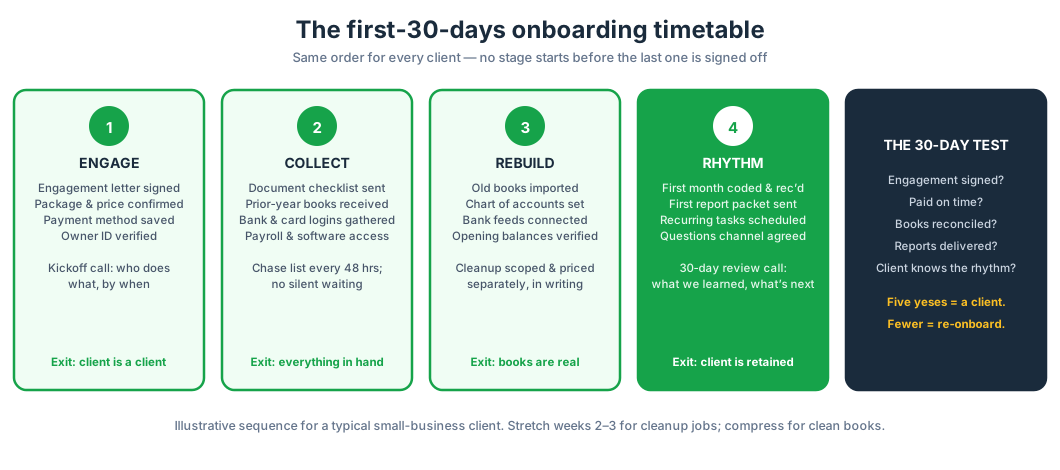
Week 1 — Engage. The engagement letter is signed and returned, the package and price are confirmed in writing, the payment method is saved, and the kickoff call sets who does what by when. Nothing starts without the signed letter. Future Firm's rule is the right one: "Do not begin any work until everything above is in place." The welcome email goes out the same day the agreement is signed — the client should never experience a gap between "yes" and "we're moving."
Week 2 — Collect. The document checklist goes out, prior-year books arrive, bank and card access is gathered, payroll and software logins are secured. This is where onboarding lives or dies (more below). The rule: chase every 48 hours, never silently wait. Unresponsiveness that feels awkward to chase in week 2 becomes a six-week stall in week 6.
Week 3 — Rebuild. Old books are imported, the chart of accounts is set, bank feeds are connected, opening balances are verified against prior statements. If there is historical cleanup, it gets scoped and priced separately, in writing — cleanup folded silently into the monthly retainer is the classic margin fight waiting to happen.
Week 4 — Rhythm. The first month is coded and reconciled, the first report packet goes to the client, recurring tasks are scheduled, the questions channel is agreed (portal, email, call — pick one and name it), and the 30-day review call closes the loop: what we learned, what's next.
The 30-day test is five yeses: engagement signed? paid on time? books reconciled? reports delivered? client knows the rhythm? Five yeses and you have a client. Fewer, and the client is still onboarding — say so out loud and finish it, because a half-onboarded client is a client quietly shopping.
The engagement letter: your first line of defense
If there is one section of this article to act on today, it is this one — because the data on missing engagement letters is the most alarming number in the entire onboarding conversation.
In the CNA Accountants Professional Liability Claim Database, as analyzed by Deborah K. Rood for the Journal of Accountancy (November 2025), 56% of tax claims asserted in 2024 against CPA firms in the AICPA Professional Liability Insurance Program lacked an engagement letter related to the underlying service. Read that again: more than half of firms that got hit had nothing in writing defining what they were engaged to do. And the failure pattern is not just "never signed one" — year after year, claims arrive where the firm had a letter for the initial year fifteen years prior but the scope had changed, or the tax-software-generated letter never defined the scope, responsibilities, and fees. The letter has to be current and specific, or it is decorative.
CAMICO, the profession's other major liability voice, calls the engagement letter "the first line of defense." Their analysis of high-exposure tax claims finds the same root cause again and again: unclear services, undocumented understanding, expectation gaps — what they describe as "the root cause of many lawsuits." Proceeding without a signed letter, they note, can be read by a court as the client never agreeing to the terms at all.
The standards agree. Under SSARS No. 21, engagement letters for preparation, compilation, and review engagements must be signed by both the firm and management (or those charged with governance) — an oral understanding is insufficient. One honest nuance for bookkeepers: pure bookkeeping with no financial statements issued is not an SSARS engagement, but the moment you prepare and present financial statements you trigger AR-C 70 and the written-understanding requirement. If your practice issues statements, the letter is not best practice; it is the rule. And under IRS Circular 230 §10.33, communicating engagement terms in writing is a listed best practice — encouraged rather than mandatory, but the kind of thing a disciplinary panel will ask about.
And yet: almost a third of tax accountants polled never use an engagement letter with clients at all (Ignition's own polling). That is the gap between the liability data and firm behavior, in one statistic. The engagement letter is also a scope-creep weapon: Ignition's 2025 customer data shows 85% of customers experienced a reduction in scope creep after putting proposals and engagement letters on the platform (vendor-reported; still, the mechanism is obvious — scope that is written down is scope that can be re-priced).
The practical takeaways for week 1:
- Every engagement gets a signed letter before work begins. No "we'll paper it next month." The 56% number is what happens next.
- Define the scope in verbs, not adjectives. "Monthly bookkeeping" is not a scope; "code all transactions, reconcile all accounts, deliver P&L and balance sheet by the 15th" is.
- Name what's excluded. Tax prep, payroll filings, advisory calls — if it is not in the letter, it is not in the price.
- Re-sign when scope changes. A 2024 letter does not cover the payroll you added in 2026. Annual re-signing is cheap insurance.
- Both parties sign. An unsigned letter is a wish, not a contract.
Document collection: the number-one bottleneck
If the engagement letter is the most dangerous thing to skip, document collection is the most common thing to stall on. This is where onboarding goes to wait.
Suralink's 2025 State of Audit Efficiency Report — audit-focused, but the collection dynamics are identical for bookkeeping — found that 95% of firms struggle with document collection, that only 36% of client requests are fulfilled correctly the first time, that 71% call assessing received documentation a major challenge, and that 87% cite client delays as a common issue. The average target realization rate was just 64%, and one in four engagements still missed that lowered target.
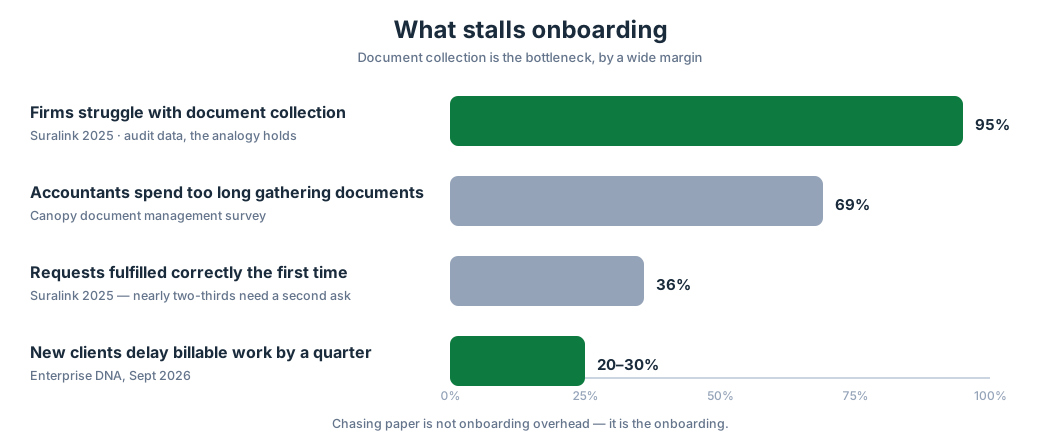
The profession's own data says the same thing from the other side: 69% of accountants say they spend too much time gathering documents from clients, and the number-one thing that speeds up document collaboration is a client portal, followed by automatic reminders for overdue documents (Canopy's document management survey of accounting firms). The first-ask completeness rate tells the story: the likelihood a client responds correctly and completely to any single request the first time is under 40% — nearly two-thirds of responses need clarification or a second ask (Accounting Today op-ed, October 2025). And it is a security problem too: 89% of clients say they feel more secure when documents sit in the firm's password-protected portal, while 58% of accountants admit accidentally sharing the wrong file with a client (same Canopy survey).
This is why "chase every 48 hours" is a rule and not a suggestion. The stall data from Enterprise DNA (September 2026) is blunt: 20–30% of new clients can delay billable recurring work by a quarter because information, setup decisions, and historical data take too long to resolve — and, tellingly, "nobody clearly marks the moment when the client moves from onboarding to recurring service." The unmarked transition is the tell of a firm without a checklist: the client is never quite onboarded, the work is never quite recurring, and the delay is never quite anyone's fault.
Three collection practices that actually move the number:
- One checklist, one channel, one deadline. The request list goes out once, complete, with named owners and a date. Drip-feeding requests ("oh, also we need…") trains the client that your asks are optional.
- Never accept passwords or financial documents over ordinary email. Jetpack Workflow's onboarding guidance is explicit on this, and the 58% wrong-file number above says why. A secure portal or password manager is not a luxury feature; it is the answer to a measured risk.
- Automate the chase. Reminders for overdue documents are the second-fastest accelerator after the portal itself (Canopy). A chase that depends on a staff member remembering is a chase that stops.
The UK's Sage Hidden Accountancy Hours survey (1,000 accountants and bookkeepers) puts the cost in time terms: 18% of the working week goes to "running the practice" — admin, billing, chasing clients — and 13% to beyond-the-brief client support, up from 9% the year before. Chasing is not a footnote in the firm's week. It is nearly a day of it.
The compliance check that changed in August 2026
One honest update for anyone whose onboarding checklist still says "verify beneficial ownership": that requirement is gone.
On August 11, 2026, FinCEN issued a final rule — effective August 14, 2026 — permanently exempting U.S. companies and U.S. persons from beneficial ownership reporting under the Corporate Transparency Act, adopting the March 2025 interim final rule permanently (reported by BDO, Ballard Spahr via JDSupra, and Greenberg Traurig, all August 2026). Previously reported U.S.-person data is being deleted. The CTA's rise and fall is now a cautionary tale: firms that built BOI collection into their onboarding flow need to take it back out, and any checklist template downloaded before August 2026 should be checked for it.
What remains is the part that was always the firm's own responsibility, not the government's: client acceptance and identity verification as best practice. Know your client, verify the owner, confirm the entity exists, check that the prior firm relationship ended cleanly (and get professional clearance where your standards require it). It is not a federal requirement for accountants — but it is the difference between onboarding a client and inheriting someone else's problem.
Pricing the onboarding itself
Here is the question firms argue about endlessly: do you charge for onboarding, or fold it into the monthly price? There are three real models in practice (Content Snare, August 2026): bake it into the price, charge a separate onboarding fee, or run a paid, creditable diagnostic that converts into the engagement.
The separate-fee model has the cleanest economics and a real-firm anchor: Patrick Accounting prices its one-time onboarding investment at roughly 2x the monthly fee — a $1,500-a-month client pays about $3,000 to onboard — covering the strategy sessions and the back work (Patrick Accounting blog). The fee does two jobs at once: it prices the unbillable-looking work, and it filters for clients who are serious. A client who balks at an onboarding fee was going to be the client who never sent the documents.
The worked math below shows why. Take a typical small-business onboarding — the kind the checklist above describes — and cost it like a project.
Example 1: the $1,500-a-month client, costed as a project
A 4-person marketing agency, ~250 transactions a month, two years of books that are "mostly done," no payroll, cash basis. The firm quotes $1,500 a month ongoing plus a $3,000 onboarding fee (2x, the Patrick Accounting rule).
| Onboarding line | Hours × rate | Cost |
|---|---|---|
| Engagement letter, kickoff call, setup | 2.0 hrs × $95/hr | $190 |
| Document collection and chasing | 6.0 hrs × $45/hr | $270 |
| Import, chart of accounts, opening balances | 5.0 hrs × $65/hr | $325 |
| First month: coding and reconciliation | 8.0 hrs × $65/hr | $520 |
| Review, first report packet, 30-day call | 1.5 hrs × $95/hr | $142.50 |
| Total cost to the firm | 22.5 hrs | $1,447.50 |
The $3,000 fee covers the $1,447.50 in direct cost and prices in the overrun risk every onboarding carries — because the "mostly done" books are never mostly done. If the firm had baked onboarding into the monthly price instead, that $1,447.50 would have to be amortized: $1,500 a month with onboarding hidden inside means the first two months run at roughly half margin before the steady state begins. And if the client churns in month three — remember, 43% of churn happens in the first 90 days — the firm ate the onboarding for nothing. The separate fee is not greed; it is the hedge against the churn statistic.
Example 2: the 21-day onboarding vs. the 60-day stall
Same client, two versions — drawn from the benchmark data. Well-organized firms with a written checklist onboard in 15–30 working days; firms without one take 45–60 days (Corient Business Solutions). Simple individual work can move in 5–7 days; multi-entity and international takes longer (acculinkcpa). A straightforward bookkeeping onboarding takes 1–2 weeks when the records are clean (Jetpack Workflow).
The 21-day version: letter signed day 1, documents in by day 7 (chased twice), books rebuilt by day 14, first month delivered day 21. First invoice: $1,500 on day 30. Collection cost: 6 staff hours.
The 60-day version: letter signed day 1, documents dribble in over five weeks (three chase rounds, one "oh, also we need…" round), the rebuild finds a missing prior-year return, the first month delivers on day 60. First invoice: $1,500 on day 60 — and per the Enterprise DNA data, 20–30% of stalled clients push billable recurring work a full quarter out. Collection cost: 14 staff hours.
The arithmetic of the stall: ~40 days of deferred revenue on a $1,500-a-month client is roughly $2,000 in cash flow pushed out, plus 8 extra staff hours at ~$55 blended — another $440 — spent chasing instead of billing. The client, meanwhile, has had two months of first impressions in which nothing appeared to happen, and per the CCMC data, a dissatisfied onboarding customer is 9 times less satisfied with everything after. The stall does not just cost the delay. It costs the relationship's ceiling.
The churn case, in four numbers
Pull the retention data together and the argument for documented onboarding makes itself:
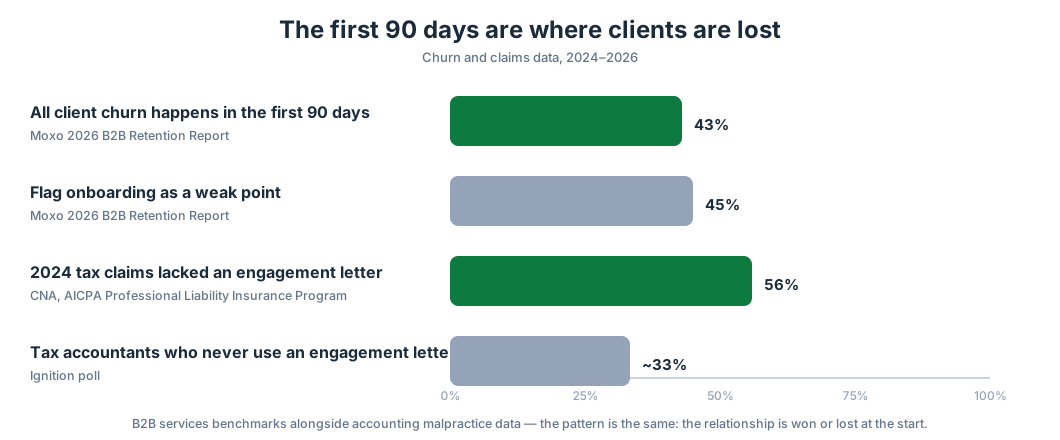
The Moxo retention data and the CNA liability data are measuring different things — one is churn, one is claims — but they point at the same 90-day window. The relationship is won or lost at the start, and the start is the part most firms improvise.
There is also a technology-adoption footnote worth keeping. In Canopy's 2021 small-business survey, 63% of small businesses said their accountant doesn't offer an online portal while 56% called it important, and 78% said they would consider changing accountants for one using the latest technology (Business Wire, October 2021 — dated, but the direction has only intensified: Canopy's 2024 data shows 66% of firms doing most business digitally, heading for 84% within three years). The CPA Practice Advisor × Canopy 2024 firm survey shows client portals at 64% adoption and e-signatures at 57% — but client proposals and engagements at only 35%. The signature, the proposal, and the onboarding flow remain the least digitized part of the firm. That is exactly the gap the churn numbers punish.
How LedgerHQ runs onboarding
This is the part of the article about the product, and it will stay inside what the product verifiably does. LedgerHQ's onboarding story is public on its own site (all claims below verified on ledgerhq.ai, September 2026):
Choose, sign, pay, start — one connected experience. The product's pricing-and-onboarding section is titled "Turn Your Services Into a Client," and its exact claim is: "Show clients exactly what you offer. They choose, sign, pay, and start onboarding in one connected experience." The firm publishes its service packages; the client picks one, signs, pays, and onboarding begins — no separate proposal tool, no side email thread, no gap between "yes" and "we're moving."
The engagement is built, signed, and billed on schedule. The engagements-and-billing section, "From Agreement to Automatic Billing," reads: "Build the engagement, collect the signature, save the payment method, and bill the right package on schedule." And the signed engagement letter is not an abstraction — LedgerHQ's own product imagery shows "LedgerHQ service packages, signed engagement letter, and client onboarding progress" as a real screen, and a second screen shows "LedgerHQ engagement letter, signature, payment method, and recurring billing" together. The 56%-of-claims problem from the liability section has a mechanical answer: the letter is signed before the work starts, the payment method is saved with it, and the package bills automatically — the scope-creep and no-letter failure modes get closed by the same flow.
The onboarding sequence is taught, not just tooled. LedgerHQ's free training academy (LedgerCraft Academy, 104 videos) includes Course 6, "The Client Onboarding Experience," whose description reads: "Onboard every client. Signup, engagement letter, bank connections, and moving their old books in." There is a dedicated walkthrough, "Set Up a New Client in LedgerHQ," under "Onboard every client." The timetable in this article maps directly onto what that course teaches: signup, engagement letter, bank connections, history moved in.
The economics underneath. LedgerHQ costs $20 a month per business — Tally's AI use included — free until January 1, 2027 (verified on ledgerhq.ai/pricing, September 2026). The site's own firm math: with AI doing the routine work, a client takes about 10 minutes a week to review — and the footnote is honest about this article's topic: "Onboarding, cleanup, and larger clients take longer." Onboarding is the human-intensive part of the practice; the platform's job is to make the signature, the package choice, the billing schedule, and the book import one connected flow so the human hours go into the kickoff call and the 30-day review — the parts that retain the client.
The engagement is built, signed, and billed inside LedgerHQ, and every business costs $20 a month, free until January 1, 2027.
The firm checklist: ten rules for the first 30 days
- No work without a signed engagement letter. The 56% claims number is the cost of skipping this. Both parties sign; scope in verbs; exclusions named.
- Confirm the package and price in writing, with the payment method saved. The letter and the billing schedule are one event, not two.
- Send the welcome email the day the agreement is signed. The client should never experience a gap between "yes" and "we're moving."
- One checklist, one channel, one deadline. The full document list goes out once, with owners and a date. Drip-feeding asks trains the client that your asks are optional.
- Chase every 48 hours. Unresponsiveness that feels awkward to chase in week 2 becomes a six-week stall in week 6.
- Never accept passwords or financial documents over ordinary email. A secure portal or password manager; 58% of accountants have sent the wrong file to a client.
- Verify the owner and the entity, and get professional clearance where required. The FinCEN BOI rule is gone; client acceptance is still yours.
- Scope and price cleanup separately, in writing. A year of backlog is a project, not a retainer. Blending them is the classic margin fight.
- Mark the moment onboarding ends. First reconciled month delivered, first packet sent, recurring tasks scheduled — then the 30-day review call. "Nobody clearly marks the moment" is how 20–30% of clients stall a quarter.
- Run the 30-day test. Engagement signed? Paid on time? Books reconciled? Reports delivered? Client knows the rhythm? Five yeses is a client; fewer means finish the onboarding out loud.
Frequently asked questions
How long should client onboarding take for a bookkeeping firm?
Well-organized practices with a written checklist complete onboarding in 15–30 working days; firms without one frequently take 45–60 days (Corient Business Solutions, September 2026). A straightforward bookkeeping onboarding with clean records takes 1–2 weeks (Jetpack Workflow). Start the compliance and authorization steps in parallel, not sequentially — sequential starts are the main reason firms drift past 45 days.
What should be in a bookkeeping engagement letter?
The scope in verbs (what you will do, by when), the price and billing schedule, what is excluded (tax prep, payroll filings, advisory calls), each party's responsibilities, and both signatures. Under SSARS No. 21, letters for preparation, compilation, and review engagements must be signed by both the firm and management — an oral understanding is insufficient. Re-sign when the scope changes; a stale letter is how "scope had changed" becomes a claim.
Should I charge a separate onboarding fee?
Three models work: bake it into the monthly price, charge a separate fee, or run a paid creditable diagnostic (Content Snare, August 2026). The separate fee — commonly around 2x the monthly retainer (Patrick Accounting) — prices the real 20+ hours of work and hedges against first-90-day churn. A client who balks at the fee is telling you about the next six months of document chasing.
What is the biggest cause of onboarding delays?
Document collection. 95% of firms struggle with it and only 36% of requests are fulfilled correctly the first time (Suralink 2025). Fix it with one complete checklist, one channel, one deadline; a secure portal (never ordinary email); and automated 48-hour chase reminders — the portal and the reminders are the two fastest accelerators (Canopy).
Do I still need to check beneficial ownership at onboarding?
No — for U.S. clients. FinCEN's August 14, 2026 final rule permanently exempted U.S. companies and U.S. persons from beneficial-ownership reporting under the Corporate Transparency Act. Remove BOI collection from your checklist if you added it, and keep client-acceptance and identity verification as your own best practice.
How do I know when onboarding is finished?
Run the 30-day test: engagement signed, first payment on time, books reconciled, first report packet delivered, client knows the rhythm (who sends what, when, through which channel). Mark the transition explicitly — the firms that never mark it are the ones where 20–30% of new clients stall a quarter before recurring work begins (Enterprise DNA, September 2026).
How does onboarding connect to client retention?
Directly. 43% of all client churn happens in the first 90 days, and 45% of companies flag onboarding as a weak point (Moxo 2026). Customers who reach first value within 30 days retain at 3–4 times the rate of those who take 90+ (OnRamp). The first clean, reconciled month delivered on schedule is your client's first value — everything before it is the client wondering what they paid for.
What does LedgerHQ's onboarding flow include?
Clients see the firm's published service packages and choose, sign, pay, and start onboarding in one connected experience. The firm builds the engagement, collects the signature, saves the payment method, and bills the right package on schedule — with the signed engagement letter as a real artifact in the product. LedgerHQ's free academy teaches the full sequence: signup, engagement letter, bank connections, and moving old books in (all verified on ledgerhq.ai, September 2026).
Sources
- Churn in first 90 days (43%; 45% flag onboarding weak; ~50% estimate $500K+ annual churn losses): Moxo, State of Churn and Retention in B2B Organizations 2026 Report, via PR Newswire, February 2026 — https://ca.advfn.com/stock-market/stock-news/97770619/moxos-2026-b2b-retention-report-finds-43-of-clien
- 56% of 2024 tax claims lacked an engagement letter (CNA Accountants Professional Liability Claim Database): Deborah K. Rood, Journal of Accountancy, November 2025 — https://www.journalofaccountancy.com/issues/2025/nov/blocking-and-tackling-engagement-letters-for-tax-compliance-services/
- Engagement letter as "first line of defense"; expectation gaps "the root cause of many lawsuits": CAMICO, "Key Steps for Tax Risk Management" (2026) — https://www.camico.com/blog/key-steps-for-tax-risk-management/ and "Documentation, Engagement Letters Key to Tax Risk Management" — https://www.camico.com/blog/documentation-engagement-letters-key-to-tax-risk-management/
- SSARS No. 21 written-understanding requirement (both parties sign; oral insufficient): SSARS Nos. 21–25 study materials — https://www.mypescpe.com/private/shared/CPEpdfs/7855BTEXT.PDF
- Circular 230 §10.33 best practices (written engagement terms): The Tax Adviser, February 2012 — http://thetaxadviser.com/issues/2012/feb/tpr-feb12/
- Almost a third of tax accountants never use an engagement letter; 85% of customers reduced scope creep: Ignition blog — https://www.ignitionapp.com/blog/3-ways-engagement-letters-can-improve-your-tax-season and EIN News, December 2025 — https://www.einnews.com/pr_news/872298178/ignition-powers-customers-revenue-growth-driving-3-1b-through-the-platform-in-2025
- Onboarding duration (15–30 working days organized; 45–60 without checklist): Corient Business Solutions, September 2026 — https://corientbs.co.uk/blog/client-onboarding-checklist-for-accounting-firms/
- 2–4 weeks from signed letter to first deliverable: Medium/@acculinkcpa, July 2026 — https://medium.com/@acculinkcpa/the-complete-guide-to-client-onboarding-for-cpa-firms-templates-checklists-best-practices-bab32b44cad9
- Straightforward bookkeeping onboarding 1–2 weeks; no passwords over ordinary email: Jetpack Workflow — https://jetpackworkflow.com/blog/bookkeeping-onboarding-checklist/
- Document collection (95% struggle; 36% first-time fulfillment; target realization 64%): Suralink, 2025 State of Audit Efficiency Report — https://www.suralink.com/news-room/suralink-state-of-audit-efficiency-report (audit data; applied by analogy)
- 69% spend too much time gathering documents; portal as #1 accelerator; 89% feel more secure in a portal; 58% shared the wrong file: Canopy, "Document Management at Accounting Firms" survey — https://www.getcanopy.com/blog/document-management-accounting-firm-study
- First-request completeness under 40%: Accounting Today op-ed, October 2025 — https://www.accountingtoday.com/opinion/closing-accounting-firms-client-readiness-gap
- 20–30% of new clients delay billable recurring work by a quarter: Enterprise DNA, September 2026 — https://enterprisedna.co/resources/insights/accounting-fix-workflows-before-agent-pilots/
- CAC 5–25x retention cost; 60% CAC rise over five years to 2024; 5% retention → 25–95% profit lift: Ringly, "67 customer churn statistics you need to know in 2026," September 2026 — https://www.ringly.io/blog/customer-churn-statistics-2026
- Time to first value (30-day first value → 3–4x retention; best-in-class under 14 days): OnRamp — http://onramp.us/blog/time-to-value
- SaaS activation/retention benchmarks (2,600+ companies; 69% correlation seven-day activation / three-month retention): Amplitude via Medium/Swapnil Biswas, June 2026 — https://medium.com/@swapbiswas/b2b-customer-onboarding-best-practices-that-drive-retention-2026-2bfe09286e7a (SaaS data; used for contrast)
- Onboarding dissatisfaction (1 in 4; 9x less satisfied with the rest of the journey): Customer Care Measurement & Consulting whitepaper, 2024 — https://customercaremc.com/wp-content/uploads/2024/09/CCMC_WhitePapers_CustomerOnboardingACXTestThatManyCompaniesFail.pdf
- Portal adoption (63% no portal; 78% would switch for technology): Canopy via Business Wire, October 21, 2021 — https://www.businesswire.com/news/home/20211021005035/en/78-of-Small-Businesses-Would-Consider-Changing-Accountants-to-One-That-is-Using-the-Latest-Technology (dated; direction confirmed by Canopy 2024)
- Hidden practice hours (18% of week on running the practice; 13% beyond-the-brief support): Sage UK, Hidden Accountancy Hours (~2025) — https://edit.sageimagine.com/master/-/media/files/sagedotcom/uk/documents/pdf/accountants/sage-hidden-accountancy-hours-infographic.pdf
- Firm tech adoption (portals 64%, e-signatures 57%, proposals/engagements 35%): CPA Practice Advisor × Canopy, September 2024 — https://www.cpapracticeadvisor.com/2024/09/15/survey-results-are-in-charting-the-future-of-accounting/110324/
- Onboarding pricing models (bake in / separate fee / paid creditable diagnostic): Content Snare, August 2026 — https://contentsnare.com/how-charge-client-onboarding/
- Onboarding fee ≈ 2x monthly retainer: Patrick Accounting — https://patrickaccounting.com/blog/one-time-investment-for-new-clients
- 8-phase retention checklist (kickoff → 30-day check-in): Future Firm, ~May 2025 — http://futurefirm.co/bookkeeping-client-onboarding-checklist/
- Four-phase model (Engagement → Connection → Configuration → Go-live): XBert — https://github.com/thirstystudios/xbert-plugins/blob/HEAD/plugins/xbert-client-onboard/skills/client-onboard/SKILL.md
- FinCEN final rule (Aug 11, 2026; effective Aug 14, 2026) permanently exempting U.S. companies/persons from BOI reporting: BDO — https://www.bdo.com/insights/tax/fincen-final-rule-permanently-relieves-us-companies-of-beneficial-ownership-reporting-obligations ; Ballard Spahr via JDSupra — https://www.jdsupra.com/legalnews/fincen-permanently-exempts-u-s-entities-8084235/ ; Greenberg Traurig — https://www.gtlaw.com/en/insights/2026/8/fincen-final-rule-permanently-ends-beneficial-ownership-reporting-requirements-for-us-companies-and-us-persons
- LedgerHQ onboarding capabilities (choose/sign/pay/start connected experience; engagement built, signature collected, payment method saved, package billed on schedule; signed engagement letter as product artifact): ledgerhq.ai — https://ledgerhq.ai (verified 2026-09-24)
- LedgerHQ Academy Course 6, "The Client Onboarding Experience" (signup, engagement letter, bank connections, moving old books in): ledgerhq.ai (verified 2026-09-24)
- LedgerHQ pricing ($20/mo per business; Tally AI included; free until January 1, 2027): ledgerhq.ai/pricing — https://ledgerhq.ai/pricing (verified 2026-09-24)
- The worked examples (marketing agency onboarding; 21-day vs 60-day timelines) are fictional and illustrative; all figures tie out arithmetically as shown.