
Firm operations
Financial Statements Clients Actually Read: P&L, Balance Sheet, and Cash Flow Explained
Half of small business owners have faced fiscal trouble from a lack of financial literacy — and 51% don't even read their monthly accounts. Here's the plain-language guide to the P&L, balance sheet, and cash flow statement, a worked $96k-profit-versus-$40k-cash example, the six numbers every owner should watch, and the monthly packet format clients actually open.

The short answer
Your clients are not reading the financial statements you send them. This is not a hunch — it is measured. In a 2026 survey of small and mid-sized business owners by Ireland's Small Firms Association, 51% said they do not read their monthly accounts on a monthly basis, 42% said they do not understand financial statements, and only 34% use the statements to make business decisions (SFA / iReach / TU Dublin, via Manufacturing & Supply Chain News, 2026). QuickBooks' financial-literacy research puts the price tag on that gap: owners with low financial literacy lose an average of $118,121 in profit, and nearly half (45%) say they have lost at least $10,000 to it (QuickBooks, 2026). Xero's research lands the same punch from a different angle: half of U.S. small businesses have encountered fiscal challenges caused by a lack of financial literacy, even though 55% of those same owners rate their financial literacy as "high" (Xero / PR Newswire, 2024).
So the monthly financial package most firms send — a P&L, a balance sheet, maybe a cash flow statement, exported straight from the accounting software and emailed with "please let me know if you have questions" — lands in a folder and dies there. Nobody reads it, nobody acts on it, and the owner keeps running the business on the bank balance and a gut feeling.
This article fixes that from both sides. For the owner: the three statements explained in plain language, with real worked numbers, so each one answers a question you actually have. For the firm: why the statements get ignored, the six numbers every owner should watch each month, and the report-packet format that turns "received" into "read." Because the firm that teaches its clients to read their numbers does not just retain those clients — it becomes the adviser they pay for, not the bookkeeper they price-shop.
Your clients don't read your reports — here's the proof
Start with the uncomfortable data, because it reframes the whole job.
The SFA survey numbers above are the headline, but the rest of the study fills in the picture: only 46% of owners rate their financial knowledge as good or expert, even though 81% say financial literacy is very or extremely important. About a quarter don't even produce basic reports like debtor/creditor lists (SFA, 2026). That is not an Ireland-only story. Xero found 39% of U.S. owners figure out financial matters on their own, while only about 16% use an accountant or advisor — and 15% of those who hit fiscal trouble from the knowledge gap say they have not yet recovered (Xero / PR Newswire, 2024). Bluevine's 2026 national survey found 72% of owners failed to update their financial statements before applying for business financing, and 75% had used personal credit to cover business expenses in the past year — the classic symptom of flying without instruments (Bluevine, via Business Journal Daily, 2026).
QuickBooks adds the self-taught detail: 1 in 5 owners taught themselves financial literacy, only 13% learned it in school, and 28% started their business lacking confidence in their financial knowledge (QuickBooks, 2026). And here's the number that should change how firms think about their monthly deliverable: 32% of owners say better financial literacy would directly improve their budgeting and cash flow (QuickBooks, 2026). They are not asking for more statements. They are asking for statements they can understand.
The Institute of Certified Bookkeepers' 2026 member research (n=349, supported by Dext) shows the other side of the same coin: 57% of bookkeepers see themselves as trusted business advisers, 59% say clients come to them for guidance beyond basic bookkeeping, and 84% proactively share insights. But 64% spend at least an hour a month giving that guidance unbilled — and only 27% believe clients fully recognize the value of it (ICB / Dext, via IFA Magazine, 2026). The guidance is happening. It is just invisible, unpriced, and — because the reports it is based on never get read — half-wasted.
Why the PDF graveyard exists
Reach Reporting, a financial-reporting platform, named the mechanism precisely: most reporting becomes "something clients receive instead of something they use." A P&L that shows revenue up 5% sounds like good news until expenses are up 8% — and without that comparison made explicit, the client reads the top line, feels fine, and closes the file. "Financial reports don't just need to show what happened. They need to explain why it matters," the firm's piece argues, and the fix is reports that combine data with visual charts, KPIs, and written commentary — because clients who understand their information ask better questions and start seeing reporting as a decision tool, not a monthly requirement (Reach Reporting, 2026).
Three structural reasons the standard package fails:
1. It is written in accounting, not in the owner's language. "Accounts receivable, net of allowance" means nothing to someone who thinks of it as "the $88,000 customers owe me." Every unexplained term is a small reason to stop reading.
2. It has no story. Numbers without narrative are a puzzle the owner didn't ask to solve. A P&L needs a headline: "Revenue up 12% on the new commercial contracts; margins held because material costs came in under quote." One sentence does more than four pages of statements.
3. It arrives without a decision. Reports that end at the numbers ask the owner to do the hardest part — figure out what to do — with the least context. The packet that gets read ends with a page the owner can't delegate: "Here are the two decisions in front of you this month."
None of this is the software's fault. The software produces the statements; the firm produces the reading of them. Which brings us to the statements themselves — in the language your clients actually speak.
The three statements in plain language
Every business has three financial statements, and each answers one question the owner already asks. Learn the question and the statement stops being homework.
The profit & loss statement (the movie). "Did we make money this period?" It covers a span of time — a month, a quarter, a year — and shows revenue minus expenses equals net income. Think of it as the movie of the business: the plot of everything that happened. The equation is one line: Revenue − Expenses = Net Income.
The balance sheet (the snapshot). "What do we own, what do we owe, and what's left over — right now?" It covers a single date, like June 30. Assets on one side, liabilities on the other, and equity as the difference. Think of it as a freeze-frame. The equation that always holds: Assets = Liabilities + Equity. If it doesn't balance, something is booked wrong — that self-checking property is what makes the balance sheet the most trustworthy of the three.
The cash flow statement (the truth about the cash). "Where did the cash actually go?" It reconciles the gap between the P&L's profit and the bank balance over the period, in three buckets: operating (the business itself), investing (equipment, assets), and financing (loans, owner draws, capital in). This is the statement that explains why a profitable month can end with an empty account.
The three are wired together, and the wiring is what most explanations skip:
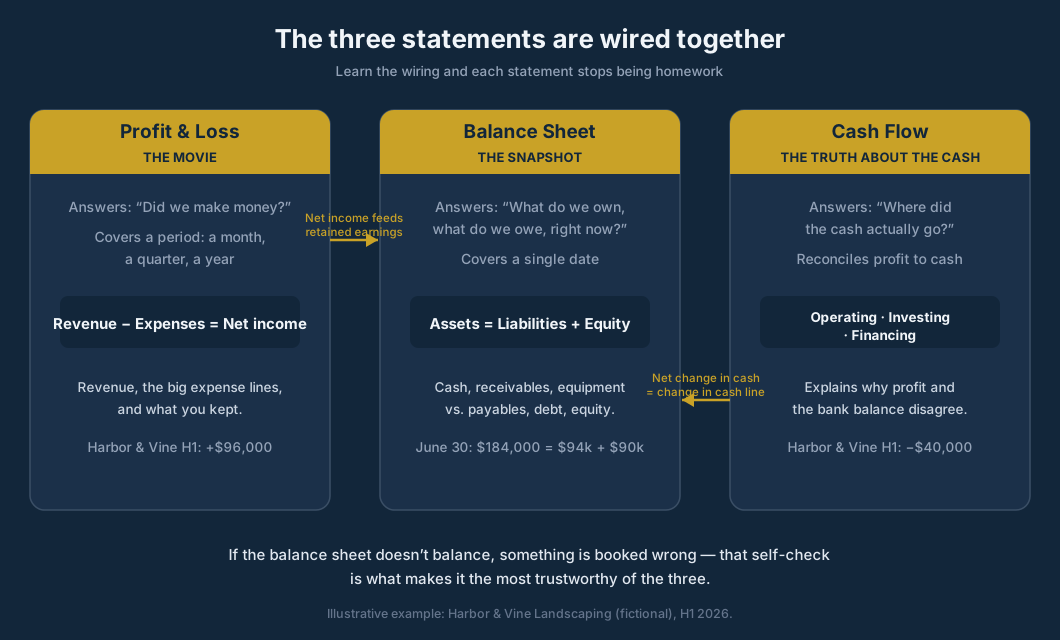
Two connections to memorize. First: the P&L's net income flows into the balance sheet — it accumulates in retained earnings (inside equity) every period, which is why a year's profits show up as owner wealth on the balance sheet. Second: the cash flow statement's bottom line must equal the change in cash on the balance sheet. If the cash flow statement says cash fell $40,000 and the balance sheet's cash line fell $40,000, the books agree with each other. That agreement is what "the books are right" actually means.
Worked example: $96,000 of profit and $40,000 less cash
This is the single most valuable thing a bookkeeper can teach a client, because it is the moment the statements stop being abstract. Take a fictional service company — call it Harbor & Vine Landscaping. First half of 2026: net income of $96,000. The owner's bank balance over the same period: down $40,000. He is not being robbed. Nobody made an error. Here is the entire bridge, line by line:
| Amount | |
|---|---|
| Net income (from the P&L) | +$96,000 |
| + Depreciation (an expense with no cash behind it) | +$12,000 |
| − Growth in accounts receivable (revenue booked, not yet collected) | −$80,000 |
| − Growth in inventory (cash spent on materials sitting in the yard) | −$45,000 |
| + Growth in accounts payable (bills received, not yet paid) | +$20,000 |
| = Cash from operations | +$3,000 |
| − Loan principal repaid | −$28,000 |
| − Owner draw | −$15,000 |
| = Net change in cash | −$40,000 |
(Check: 96,000 + 12,000 − 80,000 − 45,000 + 20,000 − 28,000 − 15,000 = −40,000. ✓)
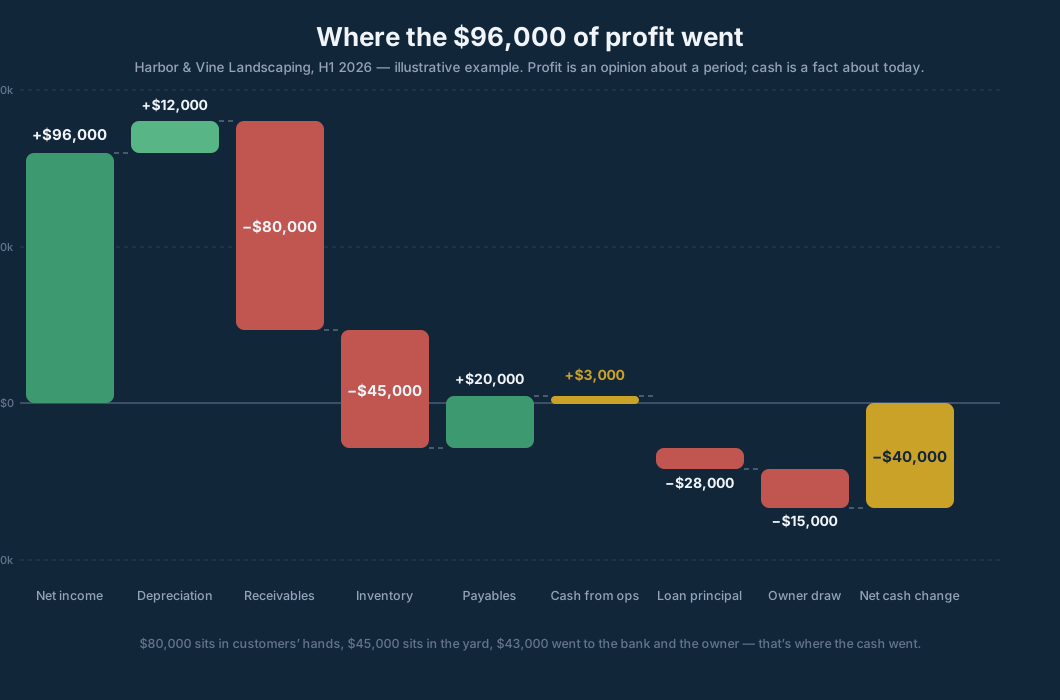
Walk the owner through what each line means in his life:
- Depreciation (+$12,000): the trucks were paid for years ago, but accounting spreads the cost across their useful life. It reduces profit every month without a dollar leaving the account. Profit understates cash here.
- Receivables (−$80,000): he invoiced $80,000 more than he collected. On the P&L that is revenue — it happened, it counts. In the bank account it is a promise. Every growing business lends its customers money without signing a loan document; this line is the size of that loan.
- Inventory (−$45,000): materials bought for jobs not yet done. Cash left; profit hasn't noticed yet.
- Payables (+$20,000): suppliers are lending him money — bills received but not yet paid. This one helps cash, which is why stretching payables (within terms) is a legitimate cash strategy and paying early without a discount is a quiet cash leak.
- Loan principal (−$28,000): only the interest on a loan hits the P&L. The principal repayment is pure cash out the door with zero effect on profit. Owners who watch only the P&L never see their debt paydown coming.
- Owner draw (−$15,000): not an expense at all — it reduces equity directly. The P&L never shows it, but the bank account does.
The lesson the owner keeps: profit is an opinion about a period; cash is a fact about today. RelayFi's worked example makes the same point at larger scale — a business posting $250,000 in net income while its bank balance falls $200,000, driven by the same timing gaps (RelayFi, 2026). And the stakes are not academic: roughly 82% of small business failures trace back to cash flow problems, and a business can be profitable on paper and still fail if it cannot pay its bills when they come due (Crestmont Capital, 2026, citing U.S. Bank research).
The bookkeeper's line for the client meeting: "You made $96,000. You spent $125,000 growing — $80,000 is sitting in your customers' hands and $45,000 is sitting in your yard — and you sent $43,000 to the bank and yourself. That's where the cash went, and here's the plan to get the receivables back." That is a thirty-second explanation worth more than the whole statement package it came from.
The balance sheet in one sitting
Owners fear the balance sheet because it looks like a wall of accounts. Teach it as three buckets and one equation, using Harbor & Vine's numbers as of June 30:
What we own (assets — $184,000): Cash $52,000 · Accounts receivable $88,000 · Equipment (net of depreciation) $44,000. What we owe (liabilities — $94,000): Accounts payable $31,000 · Line of credit drawn $22,000 · Term loan $41,000. What's left (equity — $90,000): Paid-in capital $30,000 · Retained earnings $60,000 (every kept dollar of profit since day one).
$94,000 + $90,000 = $184,000. It balances — and the fact that it balances is the first thing to check, because an out-of-balance sheet means something is booked wrong before you read another number.
Three checks, in order, that take five minutes and catch 90% of problems:
- Receivables against revenue. The company is owed $88,000. If monthly revenue is $60,000, that's about 45 days of sales sitting in customers' hands. Was it 30 days last quarter? Then customers are paying slower, and the trend hits the bank account months before it shows up on the P&L. Days-sales-outstanding is the single best early-warning number in a service business.
- Working capital. Current assets ($140,000) minus current liabilities ($53,000) = $87,000 — the cushion funding day-to-day operations. Watch the trend, not the level: a shrinking cushion while revenue grows means growth is eating cash (see the bridge above).
- Debt against equity. $63,000 of interest-bearing debt ($22,000 line + $41,000 term loan) against $90,000 of equity. Not alarming — but the owner should know the number, because lenders certainly do. Remember Bluevine's finding: 72% of owners walked into financing applications without updated statements (Bluevine, 2026). The balance sheet is the loan application.
The six numbers every owner should watch monthly
If the full statements are the textbook, these six are the dashboard. A firm that puts these on one page, every month, with one line of commentary each, will have clients who read:
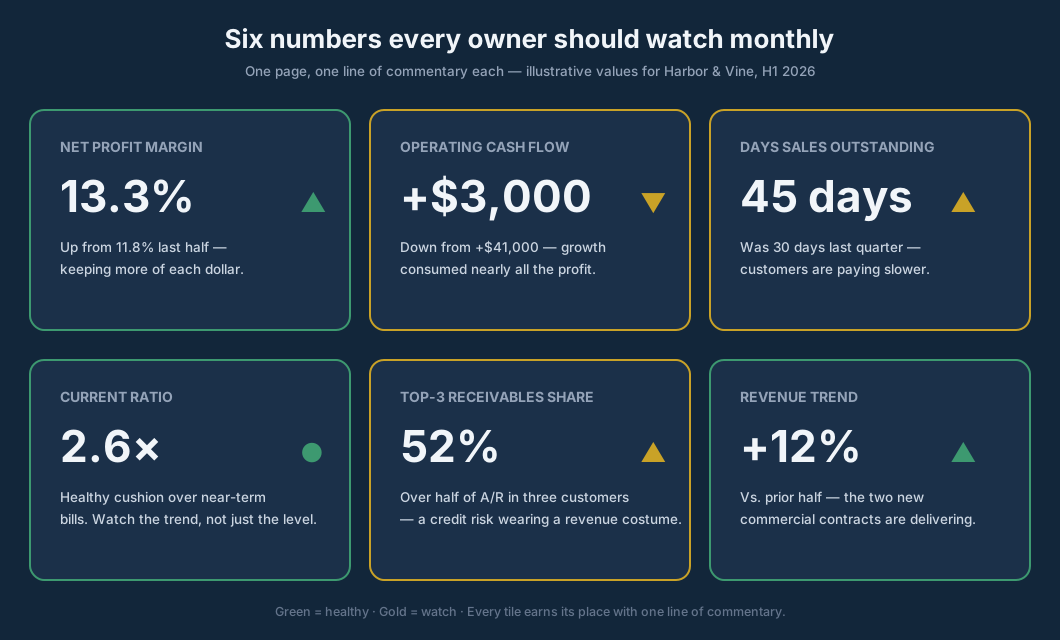
- Net profit margin — net income ÷ revenue. Are we keeping more of each dollar than last month? Margin compression is the quietest problem in the book.
- Operating cash flow — the bridge's subtotal (+$3,000 in our example). This is the business's own cash engine, before loans and draws. Just $3,000 of cash from $96,000 of profit means growth consumed nearly all of it.
- Days sales outstanding — receivables ÷ (revenue ÷ 365). Collection speed in days. The number the owner can actually move by calling customers.
- Current ratio — current assets ÷ current liabilities (2.6× in our example). The cushion expressed as a multiple. Below 1.0 means the business technically can't cover its near-term bills.
- Receivables concentration — the share of A/R in the top 3 customers. One customer at 40% of receivables is a credit risk wearing a revenue costume.
- Revenue trend vs. prior month and vs. last year — with the reason attached. Numbers without reasons are trivia; "up 12% on the two new commercial contracts" is intelligence.
Notice what is not on the list: total revenue alone, total expenses alone, the bank balance alone. Each of those misleads without its partner. The six together take one page and answer every question an owner actually asks in a month.
Building the packet clients actually read
Here is the format. Five parts, in this order, sent the same week every month, with a standing 20-minute call to walk through it. The order matters — story first, statements last:
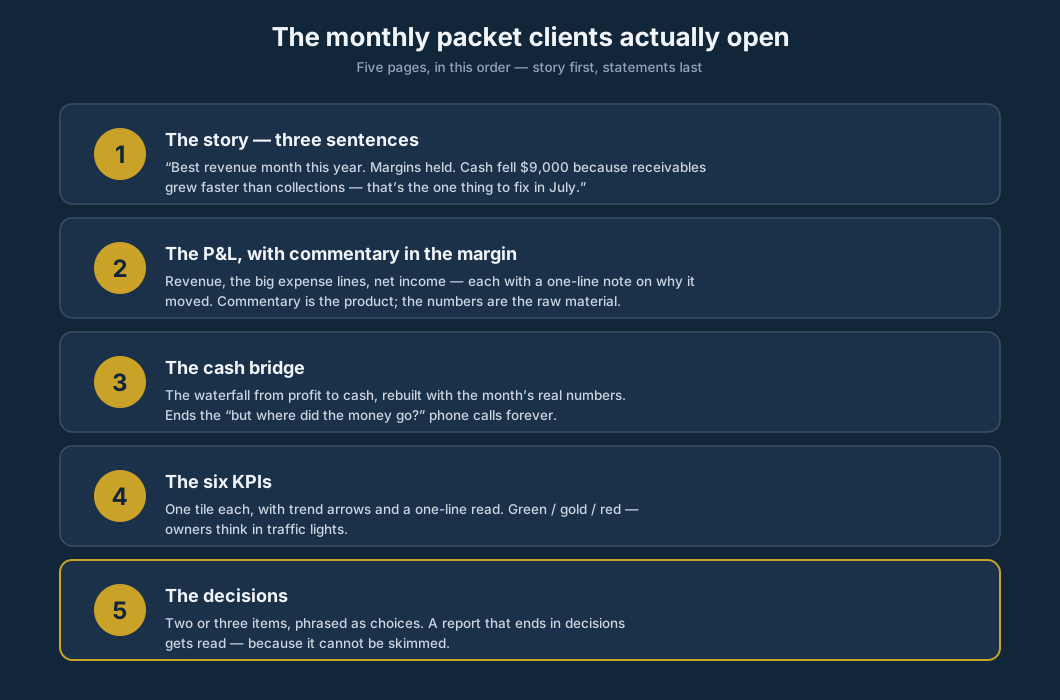
Page 1 — The story (three sentences). "June was your best revenue month this year at $64,000, up 12% on the two commercial contracts. Margins held at 17% because material costs came in under quote. Cash fell $9,000 because receivables grew faster than collections — that's the one thing to fix in July." If the owner reads nothing else, they got the month.
Page 2 — The P&L, with commentary in the margin. Revenue, the big expense lines, net income — each with a one-line note on why it moved. "Labor up 8%: the new crew's first full month." Commentary is the product; the numbers are the raw material. As Reach Reporting puts it, clients need the story behind the numbers, not just the numbers (Reach Reporting, 2026).
Page 3 — The cash bridge. The waterfall from the worked example, rebuilt with the month's real numbers. This is the page that ends the "but where did the money go?" phone calls forever.
Page 4 — The six KPIs. One tile each, with trend arrows and a one-line read. Green/yellow/red is fine — owners think in traffic lights, and there is no shame in meeting them where they are.
Page 5 — The decisions. Two or three items, phrased as choices: "Customer X owes $31,000 at 61 days — do you want us to start weekly follow-up?" "The line of credit is at $22,000 of $50,000 with the slow season ahead — do you want to hold draws until September?" A report that ends in decisions gets read because it cannot be skimmed.
The economics of this for the firm are straightforward. The ICB research says 59% of clients already come to their bookkeepers for guidance beyond the books, and 64% of bookkeepers give that guidance away unbilled (ICB / Dext, 2026). The monthly review packet is how you stop giving it away: it makes the advisory visible, regular, and obviously valuable — which is what lets you put a price on it. The firms winning the advisory game did not start by selling "advisory services." They started by sending a packet clients opened.
Where LedgerHQ fits
The packet above only works if the underlying books are finished, reconciled, and on time — which is the part LedgerHQ exists to handle. The claims, kept to what the product actually says about itself:
Tally, the AI bookkeeper inside LedgerHQ, "codes transactions, works reconciliations, follows up for missing information, and prepares the financials" — and the promise to the firm is explicit: "You get finished financials. Review the judgment calls, then use the reports while the numbers still matter" (ledgerhq.ai homepage). The product's own walkthrough of the reporting step reads: "Accurate tax-ready financial statements. Revenue, expenses, cash, margins, vendors, trends, and the financial statements arrive in one review that is ready to share" — an "Income Statement, Balance Sheet, and monthly review, built from the books Tally just finished" (ledgerhq.ai homepage).
Two specifics from the product documentation matter for this article's workflow. First, the docs describe "Reports: run posted-ledger financial reports in Cash or Accrual basis and export polished statements from LedgerHQ" — so the P&L the client sees can match the basis the client thinks in. Second, and most directly: "Prepare and send monthly financial reviews: review a company's monthly packet, choose its presentation, and send it to an owner or tax preparer" (ledgerhq.ai/docs/help/collections/accounting-and-reports). The monthly packet this article describes is a named workflow in the product, not a workaround.
The honest boundary, as always: LedgerHQ finishes the books and produces the statements; the explanation layer — the story page, the margin commentary, the decisions — is the firm's craft and the firm's pricing power. Software that does the routine work runs $20 per client per month, under the Free Preview until January 1, 2027 (start with a card today, pay nothing until then, no contracts; ledgerhq.ai).
FAQ
My client only looks at the bank balance. Where do I start? Start with the cash bridge, not the P&L. The bank balance is the number they trust; the bridge explains why it moved in their own terms (customers owe us $X, we owe suppliers $Y). Once they see the bridge explain a confusing month, they will let you show them the rest.
Cash or accrual — which should the client see? Whichever matches how they think, but tell them which it is. Most small service businesses think in cash; accrual is the truer picture of performance. The trap is mixing them — comparing this month's cash-basis revenue to last month's accrual-basis revenue. Pick one for the monthly packet and label it.
How often should owners review statements? Monthly, minimum — the SFA finding that 51% of owners don't read monthly accounts monthly is a competitive advantage for the firms whose clients do (SFA, 2026). Weekly for cash: a 13-week cash view is the standard tool for businesses with lumpy receivables.
What's the one ratio if the client will only learn one? Days sales outstanding. It is the number most directly connected to the owner's daily anxiety (cash), the most actionable (call customers), and the earliest warning of trouble.
Should I send the full general ledger too? No. The ledger is your workpaper, not the client's reading material. Send the story, the statements with commentary, the KPIs, and the decisions. Everything else is available on request — which almost never comes, and that's fine.
How do I price the monthly review? As its own line item or package tier, not as free goodwill. The ICB data says most bookkeepers already give this guidance away (ICB / Dext, 2026); packaging the review is how the invisible becomes billable. Price it on the value — a client who understands their cash flow borrows less, fails less, and stays longer.
Sources
- QuickBooks, "20 Small Business Financial Literacy Statistics," quickbooks.intuit.com, 2026 — https://quickbooks.intuit.com/r/small-business-data/financial-literacy-statistics/?cid=psoc_IG-ReelsVideo_qbb_US_na_hhm_All_atcl
- Xero, "Survey: Half of US small businesses encounter fiscal challenges due to a lack of financial literacy," PR Newswire, October 2024 — https://pr.murrayjournal.com/article/Survey-Half-of-US-small-businesses-encounter-fiscal-challenges-due-to-a-lack-of-financial-literacy/66fd44aecb9a7b2afac009e3
- Small Firms Association / iReach / TU Dublin, "Financial literacy amongst Irish micro, small and medium-sized businesses," 2026, via Manufacturing & Supply Chain News — https://www.manufacturing-supply-chain.com/only-46-of-small-business-owners-perceive-themselves-to-have-good-or-expert-knowledge-of-financial-literacy/
- Bluevine national small-business financing survey, 2026, via Business Journal Daily — https://businessjournaldaily.com/survey-75-of-small-business-owners-tap-personal-credit/
- Institute of Certified Bookkeepers / Dext member research (n=349), September 2026, via IFA Magazine — https://ifamagazine.com/over-half-of-bookkeepers-act-as-trusted-advisers-but-two-thirds-give-advice-away-for-free/
- Reach Reporting, "Your Clients Don't Need More Numbers," reachreporting.com, 2026 — https://reachreporting.com/blog/your-clients-dont-need-more-numbers
- Xero, "Cash flow statement" glossary, xero.com, 2026 — https://Www.Xero.com/my/glossary/cashflow-statement/
- RelayFi, "Cash flow vs. income statement: key differences," relayfi.com, 2026 — https://www.relayfi.com/blog/cash-flow-statement-vs-income-statement/
- Crestmont Capital, "Why Small Businesses Fail: Top Reasons and How to Avoid Them" (citing U.S. Bank research), crestmontcapital.com, 2026 — https://www.crestmontcapital.com/blog/what-is-the-biggest-cause-of-business-failure
- LedgerHQ homepage and help-center docs (Accounting and Reports collection), ledgerhq.ai, verified October 2026 — https://ledgerhq.ai/ and https://ledgerhq.ai/docs/help/collections/accounting-and-reports