
Bookkeeping operations
How Much Should Bookkeeping Cost? A Data-Backed Pricing Guide for Firms and Clients
What does bookkeeping cost in 2026? Real data on hourly rates, monthly retainers by business size, the five things that move your price, two worked pricing examples with real numbers, the catch-up premium, and how the industry is pricing the AI era.

The short answer
Most small businesses pay $400 to $2,500 a month for outsourced bookkeeping, with solopreneurs landing around $200–$400 and mid-size businesses with payroll and complexity running $1,800–$4,000. Hourly rates run $25–$90 for freelance bookkeepers, $30–$80+ for bookkeeping firms, and $150–$450 for CPA-led work. A full-time in-house bookkeeper costs $3,000–$4,500 a month before benefits.
And the industry is leaving the hourly model behind: 79% of US accounting firms now use fixed-fee or value-based pricing for bookkeeping, and only 8% still charge by the hour (Ignition 2024 US Pricing Benchmark, 345 firms). If you are shopping for bookkeeping or pricing it for clients, this guide gives you the data, the math, and the decision framework.
The three ways to buy bookkeeping
Every bookkeeping engagement in America is one of three shapes: buy hours, buy a monthly outcome, or hire a person.
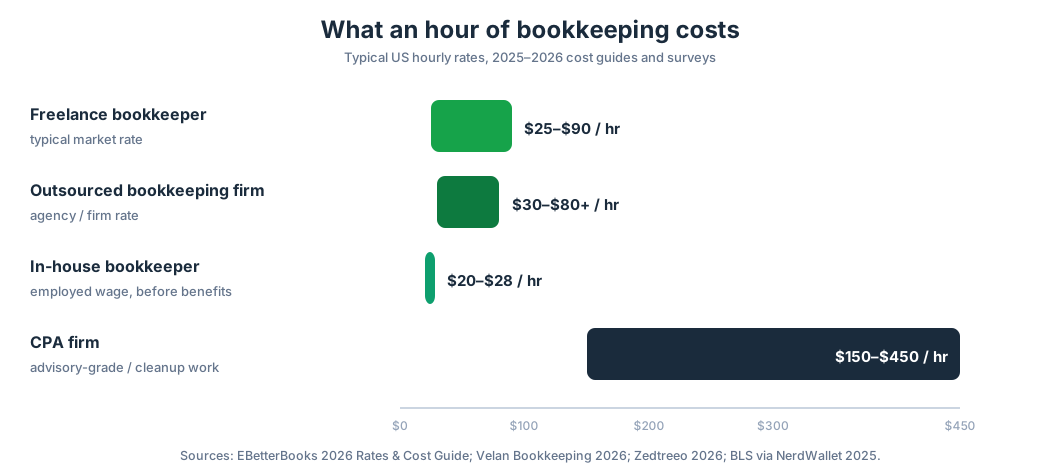
Hourly is the oldest shape. You pay for time, the bookkeeper bills in tenths or quarters, and the invoice moves with the workload. Freelance bookkeepers typically charge $25–$90 an hour (Zedtreeo, 2026), bookkeeping firms run $30–$80+ an hour, and CPA firms charge $150–$450 an hour for advisory-grade or tax-sensitive work (EBetterBooks, 2026 Rates & Cost Guide). The wage sitting underneath: the Bureau of Labor Statistics median for bookkeeping clerks is $23.66 an hour, with the 10th–90th percentile spanning $16.64–$34.94 (NerdWallet 2025 synthesis, via Profitjets 2026). So when a freelancer quotes $55 an hour, roughly $24 is the wage and the rest is taxes, insurance, software, downtime, and profit — the multiplier every self-employed professional carries.
Monthly retainer (fixed fee) is now the dominant shape. One price covers the month's work: the coding, the reconciliations, the reports, the questions answered. The industry standard firms cite is 1–3% of the client's gross income for monthly bookkeeping (FinePoints, 2025). A $400,000-revenue business at 1% pays about $4,800 a year — $400 a month — which sits squarely in the market's middle band. The retainer transfers the efficiency risk to the firm: if the firm finishes faster, the firm keeps the margin. That is precisely why firms prefer it now.
In-house hire is the third shape: a full-time bookkeeper at $3,000–$4,500 a month in salary (EBetterBooks 2026), or a part-timer at $21–$23 an hour (Velan Bookkeeping 2026). The salary is only the headline — add payroll taxes (~8–10%), benefits, workers' comp, the software seat, the desk, and the coverage problem when they are sick or quit. For a business under roughly $1M in revenue, in-house bookkeeping is usually the most expensive option per transaction processed.
What a monthly retainer buys: the size bands
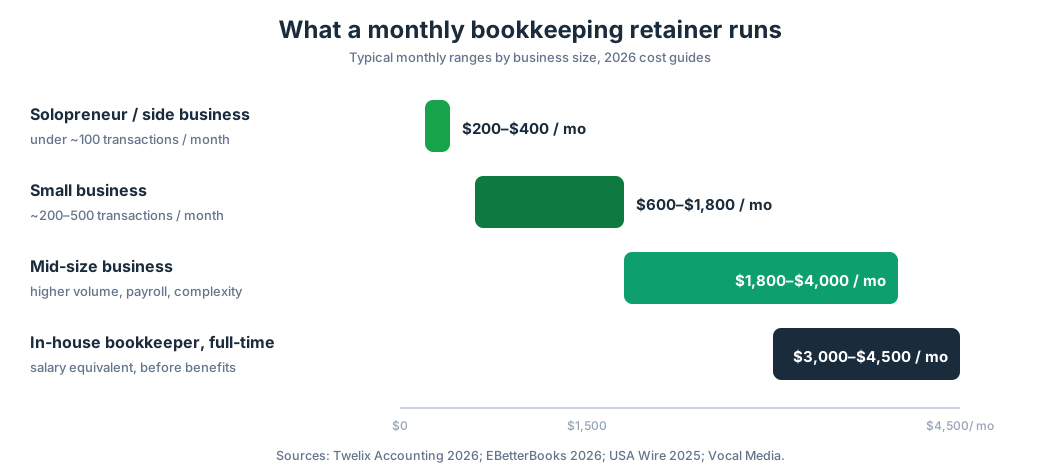
Retainers scale with one thing above all else: transaction volume. Here are the market's working bands for 2026:
| Business profile | Typical monthly transactions | Monthly retainer |
|---|---|---|
| Solopreneur / side business | Under ~100 | $200–$400 |
| Small business | ~200–500 | $600–$1,800 |
| Mid-size business | 500+ plus payroll | $1,800–$4,000 |
| In-house full-time equivalent | — | $3,000–$4,500 |
These are ranges from Twelix Accounting's 2026 cost guide, EBetterBooks' 2026 guide, and USA Wire's 2025 pricing survey — the market is remarkably consistent across sources. A freelancer's version runs cheaper ($400–$800 a month) than a bookkeeping firm's ($500–$2,500 a month), which reflects staffing depth, review layers, and who answers when something goes wrong.
Per-transaction pricing also exists as a bridge model: $1.50–$2.50 per transaction (USA Wire, 2025). Two hundred transactions at $2 a pop is $400 a month — a useful way to sanity-check a retainer quote against the actual workload.
The five things that move your price
Two businesses with the same revenue can pay wildly different prices. Here is what the quote actually depends on:
1. Transaction volume. This is the dominant variable. A consultant with 60 transactions a month and a restaurant with 900 are not buying the same service, and any honest quote starts here.
2. Complexity beyond the count. Inventory, multi-entity structures, job costing, accrual books, and foreign currency all multiply the work. Cash-basis bookkeeping runs 25–35% cheaper than accrual (Twelix Accounting, 2026) — one of the cleanest price differentials in the data, because accrual work means reconciling receivables, payables, prepaids, and deferrals every month instead of just following the cash.
3. Current books vs. catch-up. Cleanup is priced separately from ongoing work — always. A year of neglected books is a project, not a retainer. Typical catch-up pricing: $300–$500 for 1–3 months behind, $500–$1,500 for 4–6 months, $1,500–$3,500 for 7–12 months, and $3,500–$8,000+ beyond a year (SDO CPA, 2026 guide). Firms bill catch-up hourly at $75–$150 and CPAs at $150–$300 for tax-sensitive cleanup. Any quote that folds a year of backlog into the monthly retainer is either losing money or not really cleaning up.
4. Payroll. Payroll processing is the most common add-on, and it is priced per employee: $12–$30 per employee per month on top of the retainer (USA Wire, 2025). A 12-person staff adds roughly $240 a month at $20 a head. (For comparison, standalone payroll services run $39–$200 a month base plus $4–$15 per employee, per PriceItHere's 2026 data — and about 40% of small businesses incur at least one IRS payroll tax penalty a year, averaging $850–$1,000 each. The add-on is cheap insurance.)
5. The service layer. Does the price include a reviewed close, or just coded transactions? Monthly financial statements with a cover note? A human who answers questions? The bottom of the market sells transaction coding; the top sells assurance the numbers are right. Price follows the promise.
Two worked examples, with real numbers
Enough ranges. Here is what pricing looks like on two fictional clients — the kind of math a firm runs when quoting.
Example 1: Marta's design studio — the clean monthly retainer
Marta runs a 3-person interior design studio. 130 transactions a month, current books, no payroll, accrual basis, one operating account and one card.
| Cost line | Math |
|---|---|
| Coding + matching | 4.5 hrs × $65/hr = $292.50 |
| Review + monthly packet | 0.5 hrs × $95/hr = $47.50 |
| Cost to the firm | $340.00 |
| Retainer quoted | $400/mo (18% margin) |
The client compares this against the alternative: a part-time in-house bookkeeper at $22/hr × 20 hrs/mo = $440/mo before payroll taxes and admin — more expensive for less expertise. And at 1% of Marta's ~$480,000 revenue, the rule-of-thumb check says $400 a month. The quote is defensible three ways.
Example 2: Harbor Diner — the catch-up project plus ongoing
A 12-person diner, 8 months behind, ~700 transactions a month, payroll for 12, cash basis books that need converting to accrual.
The cleanup project (priced separately, per the market): 8 months of backlog lands in the 7–12 month band ($1,500–$3,500, SDO CPA 2026). The firm quotes a flat $2,800 — scoped, with a defined end: reconciled, reviewed, converted to accrual.
The ongoing retainer (starts when the cleanup ends):
| Cost line | Math |
|---|---|
| Monthly retainer (mid-size band) | $1,800/mo |
| Payroll add-on | 12 employees × $20 = $240/mo |
| Ongoing monthly | $2,040/mo |
First-year total: $2,800 + 12 × $2,040 = $27,280. The owner had been spending ~10 hours a month on the books herself at an effective $75 an hour — $750 a month of owner time producing books she didn't trust, eight months behind, one IRS payroll penalty ($900 average) away from the cleanup paying for itself. The number that closes this sale is not $27,280; it is what the owner gets back: the hours, the penalties avoided, and financials a bank would accept.
The industry is leaving hourly behind
This is the most important trend in the data, and it changes what "bookkeeping cost" even means.
Ignition's 2024 US Accounting and Tax Pricing Benchmark — a survey of 345 US firms conducted in August 2024 — found that 79% use fixed-fee or value-based pricing for bookkeeping and accounting, 61% charge $250–$749 a month, and only 8% still charge by the hour for it. The billable hour, as a way to sell bookkeeping, is nearly dead among firms.
The trend is accelerating, not stabilizing. The 2025/2026 Ignition benchmark (published April 2026) found 78% of firms planned to raise fees again in 2026 — and the motive shifted: 17.7% cited improving profit margins, up from 12% the prior year. Firms are not just covering rising costs anymore; they are pricing up on purpose.
The AICPA's 2025 National MAP Survey confirms it from the profession's own data: the median net hourly billing rate rose 6.9% over two years to $170 (up 24% since FY2020), value billing is up 5 percentage points since 2022 (now 30% of firms), and fixed pricing is up 4 points (29%). One nuance worth keeping straight: 63% of firms still use hourly billing somewhere — that is across all services, and tax and advisory skew it. For bookkeeping specifically, the 8% number is the one that matters.
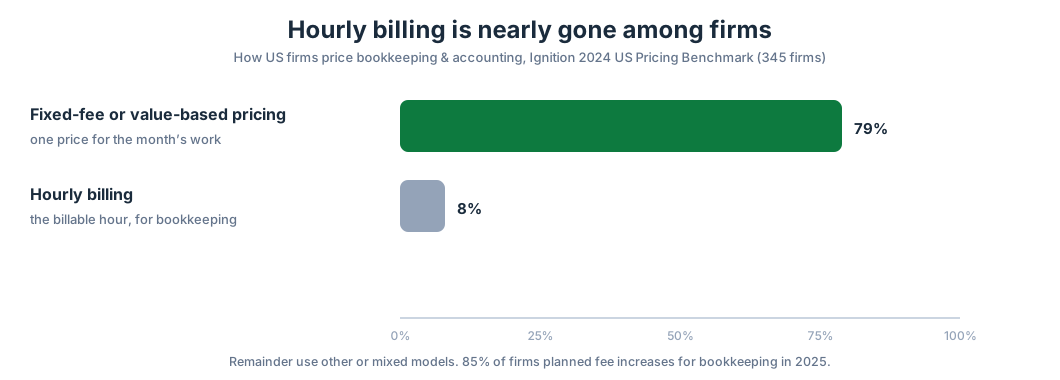
Why does this matter for pricing? Under hourly billing, efficiency gains went to the client — finish faster, bill less. Under fixed-fee pricing, efficiency gains go to the firm. Every hour of bookkeeping work the firm automates is margin it keeps. That single incentive shift is the economic engine behind the AI bookkeeping wave: firms that adopt automation don't lower prices, they raise capacity and take more clients. Hold that thought — it comes back in the last section.
The catch-up premium
Catch-up bookkeeping deserves its own section because it is the single most misunderstood line item in bookkeeping pricing — by clients and by firms.
Clients hear "bookkeeping is $600 a month" and assume a year of backlog costs $7,200. It does not. Catch-up is priced as a project against the size of the hole: $300–$500 for 1–3 months behind, up to $3,500–$8,000+ for more than a year (SDO CPA, 2026). Some firms price it per month of backlog ($200–$500 per month behind; Steven Jackman, 2026), and QuickBooks-specialized cleanup runs about $150 per month of backlog on flat-rate plans (RemoteBooksOnline, 2025).
Three rules for firms quoting cleanup:
- Price it separately from the retainer, in writing. The retainer starts when the cleanup ends. Blending them guarantees a margin fight in month four.
- Scope the end state. "Reconciled through December 31, reviewed, on accrual" is a scope. "Clean up the books" is a lawsuit.
- Charge for the archaeology. Reconstructing a year of missing receipts, unreconciled deposits, and mystery transfers is forensic work. The $75–$150/hr firm rate and $150–$300/hr CPA rate for catch-up exist because the work is harder than monthly coding — price it like it.
For clients: if a firm quotes your cleanup in the same breath as your monthly price without asking how far behind you are, keep shopping.
What $20 a month buys
Here is the pricing story that changes the arithmetic above.
LedgerHQ costs $20 a month per business — Tally's AI use included — and it's free until January 1, 2027 (verified on ledgerhq.ai/pricing, September 2026). The first six bank and credit-card accounts are included; each one after that is $1 a month. For context, that same pricing page lists the competition's regular monthly prices: QuickBooks Essentials $85, Plus $140; Xero Growing $55, Established $90 — and at those prices, you still do the coding and reconciling yourself.
Run the firm's math on Example 1 again with AI doing the routine work. The 4.5 hours of coding and matching that cost $292.50 in staff time compresses to review work — the human checks Tally's output, works the exception list, and writes the packet. The cost line that used to be $340 a month drops toward the review hour. The firm can hold the $400 retainer and take the margin, or price at $250 and win twice the clients. That is exactly the thesis: lower prices, more clients, AI leverage — a 200-client firm at $100–$200 a month working less, instead of 20 clients at $200–$500 a month.
Software was never the biggest line in a firm's cost structure; labor was. A platform priced at $20 a month per business — less than one hour of a freelancer's time — changes who can afford to be a client. The solo consultant who couldn't justify $600 a month for bookkeeping can justify $200. The price floor of the market moves down, and the addressable market moves up. Every data point in this guide describes the world as priced by human hours. The next pricing survey will describe a different one.
Tally does the routine work inside LedgerHQ — coding, reconciliations, follow-up, finished financials, and every business costs $20 a month, free until January 1, 2027.
The firm checklist: price this right
Ten rules for firms setting (or resetting) bookkeeping prices:
- Quote by transaction volume, not by revenue. Revenue is a vanity input; 60 transactions and 900 transactions are different services.
- Use the 1–3% of gross income rule as a sanity check, not a quote. It validates the price; it does not set it.
- Price catch-up separately, in writing, with a scoped end state. Every blended cleanup quote ends in a margin fight.
- Charge payroll per employee. $12–$30 a head is the market; bundle it into the retainer and you will eat every hiring spree.
- Know your cost per client. Hours × blended rate, by client, every quarter. You cannot price what you do not measure.
- Move new clients to fixed-fee. The 8% still billing hourly for bookkeeping are subsidizing their clients' inefficiency.
- Name what the retainer includes. Coded transactions? Reviewed close? Monthly packet? Answered questions? Price follows the promise — write the promise down.
- Discount cash-basis clients explicitly. 25–35% cheaper is the market differential; showing it makes the accrual clients feel fairly priced.
- Raise fees annually. 78% of firms are doing it in 2026. Standing still is a pay cut with extra steps.
- Price the AI margin on purpose. If automation cuts your cost per client, decide in advance whether it becomes margin, capacity, or lower prices to win share — don't let it happen by accident.
Frequently asked questions
How much does bookkeeping cost per month?
Most small businesses pay $400–$2,500 a month for outsourced bookkeeping. Solopreneurs run $200–$400, small businesses with a few hundred monthly transactions run $600–$1,800, and mid-size businesses with payroll and complexity run $1,800–$4,000 (Twelix Accounting 2026; EBetterBooks 2026).
How much do bookkeepers charge per hour?
Freelance bookkeepers charge $25–$90 an hour, bookkeeping firms charge $30–$80+ an hour, and CPA firms charge $150–$450 an hour for advisory or cleanup work. But hourly billing is fading: only 8% of firms still charge by the hour for bookkeeping (Ignition 2024).
Is it cheaper to hire a bookkeeper in-house?
Usually not, for small businesses. A full-time in-house bookkeeper costs $3,000–$4,500 a month in salary before benefits, taxes, and software — more than most outsourced retainers, for a single skill set and no coverage when they are out.
What does catch-up bookkeeping cost?
Priced separately from the monthly retainer: $300–$500 for 1–3 months behind, $500–$1,500 for 4–6 months, $1,500–$3,500 for 7–12 months, and $3,500–$8,000+ beyond a year (SDO CPA, 2026). Always get the cleanup scoped and quoted as its own project.
How much extra is payroll processing?
Typically $12–$30 per employee per month added to the bookkeeping retainer. A 12-person staff adds roughly $240 a month at $20 a head — cheap compared to the average $850–$1,000 IRS penalty that about 40% of small businesses incur each year.
Should bookkeeping be priced hourly or as a fixed monthly fee?
The market has answered: 79% of firms use fixed-fee or value-based pricing for bookkeeping. Fixed fees give the client a predictable bill and the firm the margin from its own efficiency. Hourly survives mainly for cleanup projects and advisory work.
What percentage of revenue should bookkeeping cost?
The industry rule of thumb is 1–3% of gross income for monthly bookkeeping (FinePoints, 2025). A $400,000-revenue business at 1% pays about $400 a month — a useful check that a quote is in the right neighborhood.
Why are bookkeeping prices rising?
Costs first, margins second. Firms cite rising business costs as the top reason (48.6% in the 2025/2026 Ignition benchmark), but 17.7% now cite improving profit margins, up from 12% — pricing is rising faster than cost recovery alone explains.
Sources
- Hourly rates ($25–$90 freelance; $20–$28 in-house; $30–$80+ outsourced; $150–$450 CPA): EBetterBooks, 2026 Rates & Cost Guide — https://ebetterbooks.com/services/bookkeeping/how-much-do-bookkeepers-charge/
- Hourly rates ($25–$90 freelance; $20–$28 in-house; $30–$80 outsourced; $10–$20 offshore) and BLS May 2025 median ($25.75): Velan Bookkeeping, 2026 — https://www.velan-bookkeeping.com/blog/hourly-rates-for-bookkeeping-complete-guide/
- BLS/O*NET median wage $23.66/hr (10th–90th percentile $16.64–$34.94); NerdWallet 2025 synthesis ($43/hr listed average vs $23.66 wage): Profitjets, 2026 — https://profitjets.com/blog/bookkeeper-hourly-rates/
- Monthly ranges (flat $300–$1,500; solopreneurs $200–$400; 200–500 txns $600–$1,800; mid-size $1,800–$4,000; cash-basis 25–35% cheaper; catch-up $1,000–$5,000): Twelix Accounting, 2026 — https://www.twelixaccounting.com/resources/blog/how-much-does-bookkeeping-cost
- Monthly ranges (freelance $400–$800; firm $500–$2,500; in-house $3,000–$4,500): EBetterBooks, 2026 — https://ebetterbooks.com/services/bookkeeping/how-much-do-bookkeepers-charge/
- 1–3% of gross income rule of thumb: FinePoints, updated ~Sept 2025 — https://www.finepoints.biz/blog/how-much-to-charge-as-a-bookkeeper
- Monthly bands ($250–$500 under 100 txns; $600–$2,500+ larger; $1.50–$2.50 per transaction; payroll add-on $12–$30/employee/mo): USA Wire, 2025 — https://usawire.com/how-much-to-charge-for-bookkeeping-services/
- Pricing models (79% fixed/value, 8% hourly, 61% at $250–$749/mo, 85% planning increases for bookkeeping in 2025; 345 firms, Aug 2024): Ignition 2024 US Accounting and Tax Pricing Benchmark, via CFO Brew, Nov 2024 — https://www.cfobrew.com/stories/2024/11/13/more-than-half-of-accounting-firms-will-raise-prices-in-2025
- Pricing models cross-service (79% bookkeeping, 75% CFO/controller): CPA Practice Advisor, Nov 2024 — https://www.cpapracticeadvisor.com/2024/11/20/survey-over-half-of-accounting-firms-plan-to-increase-fees-in-2025/113556/
- 2026 fee-increase plans (78%; margin motive 17.7% vs 12%): Ignition 2025/2026 US Pricing Benchmark, April 2026 — https://info.ignitionapp.com/hubfs/2508-AMER-PricingBenchmarkReport-USLettersize-v5.pdf
- AICPA National MAP Survey 2025 ($170 median net billing rate; value billing 30%, up 5 pts; hourly still used by 63%): TXCPA-hosted PDF — https://www.tx.cpa/docs/default-source/about-tscpa-documents/2025-national-map-survey-executive-summary.pdf
- Catch-up costs ($300–$8,000+ by backlog; freelancer $50–$75/hr; firm $75–$150/hr; CPA $150–$300/hr): SDO CPA, 2026 — https://www.sdocpa.com/catch-up-bookkeeping-cost-guide/
- Catch-up ($200–$2,500+ per month of backlog): Steven Jackman, Medium, 2026 — https://medium.com/@stevenjackman44/catch-up-bookkeeping-what-it-is-when-you-need-it-and-how-much-it-costs-0eb317878cf7
- QuickBooks cleanup ($150/mo of backlog flat; $40–$70/hr freelance; $80–$120/hr firms): RemoteBooksOnline, 2025 — https://www.remotebooksonline.com/blog/quickbooks-catch-up-bookkeeping-cost
- Payroll service pricing ($39–$200/mo base; $4–$15/employee; 10-employee business $80–$140/mo): PriceItHere, 2026 — https://priceithere.com/online-payroll-cost/
- Payroll penalties (~40% of small businesses, $850–$1,000 avg): Medium, 2026 — https://medium.com/@soluteconstruct2/small-business-payroll-processing-costs-methods-and-how-to-avoid-the-penalties-most-owners-d8e0f4b92cfee
- SCORE small-business accounting cost data (cited via Polaris Tax & Accounting, ~2020): https://polaristaxandaccounting.com/bookkeeping-services-for-small-business/
- LedgerHQ pricing ($20/mo per business; free until Jan 1, 2027; first 6 bank accounts included, $1/mo after; Tally AI included; QBO Essentials $85 / Plus $140; Xero Growing $55 / Established $90): ledgerhq.ai/pricing — https://ledgerhq.ai/pricing (verified 2026-09-23)
- The worked examples (Marta's design studio; Harbor Diner) are fictional and illustrative; all figures tie out arithmetically as shown.