
Firm growth
Payroll for Bookkeeping Clients: What Firms Need to Know Before Offering It
Should your bookkeeping firm offer payroll? The compliance burden, the §6672 personal-liability exposure every bookkeeper should understand, the real economics of a 10-employee client, and the honest case against — worked out in plain numbers.

The short answer
Payroll is the most common upsell from bookkeeping: 71% of accounting and bookkeeping firms already offer it (Financial Cents, September 2026). Clients ask for it — most of them would rather have one provider handle the books and the payroll, and a bookkeeping firm is the natural first call. It is recurring revenue on top of a recurring client, and it deepens a relationship that's already about trust with the company's money.
But payroll is not bookkeeping with different line items. It's a different business: daily deadlines, zero margin for error, a penalty ladder that escalates on a calendar-day clock, and — the part almost nobody prices in — personal liability. The Trust Fund Recovery Penalty under IRC §6672 lets the IRS assess 100% of unpaid payroll taxes personally against "responsible persons," and the Tax Court has held that net wide enough to catch a part-time bookkeeper with no ownership interest and no check-signing authority. This month, a Kansas bookkeeping-firm owner pleaded guilty to stealing more than $1 million in client payroll-tax funds; a Wyoming bookkeeper got 46 months for a $1.48 million embezzlement run through payroll.
This article works the whole decision in numbers: the compliance burden (deposit tiers, deadlines, the worked penalty math), the liability exposure that should shape every firm's engagement letter, the demand data, the software economics, a real 10-employee cost comparison, and — because the decision deserves it — the honest case against offering payroll at all. No feature-parity tables, no vendor pitch until the end. Plain numbers first.
The compliance burden: what payroll really asks a firm to run
Start with the calendar, because payroll is a calendar business. Every pay period, the firm (or the client) must calculate wages, withhold federal and state income tax and the employee's share of Social Security and Medicare, deposit those funds on the IRS's schedule, and file returns that reconcile everything. Miss a beat and the penalties start on a day-count clock:
- 1–5 calendar days late: 2% of the unpaid deposit
- 6–15 days late: 5%
- More than 15 days late: 10%
- Unpaid more than 10 days after the first IRS notice: 15%
These tiers are IRS rules (the IRS's own failure-to-deposit page, current) quoted verbatim by CPA firms in September 2026 write-ups — they're the most reliable numbers in this whole article. Note what the chart below makes visual: the tiers do not stack. Each late deposit gets one rate, the one matching how late it is. That's the one mercy in the system. The late-filing penalty is a separate 5% of unpaid tax per month, capped at 25%.
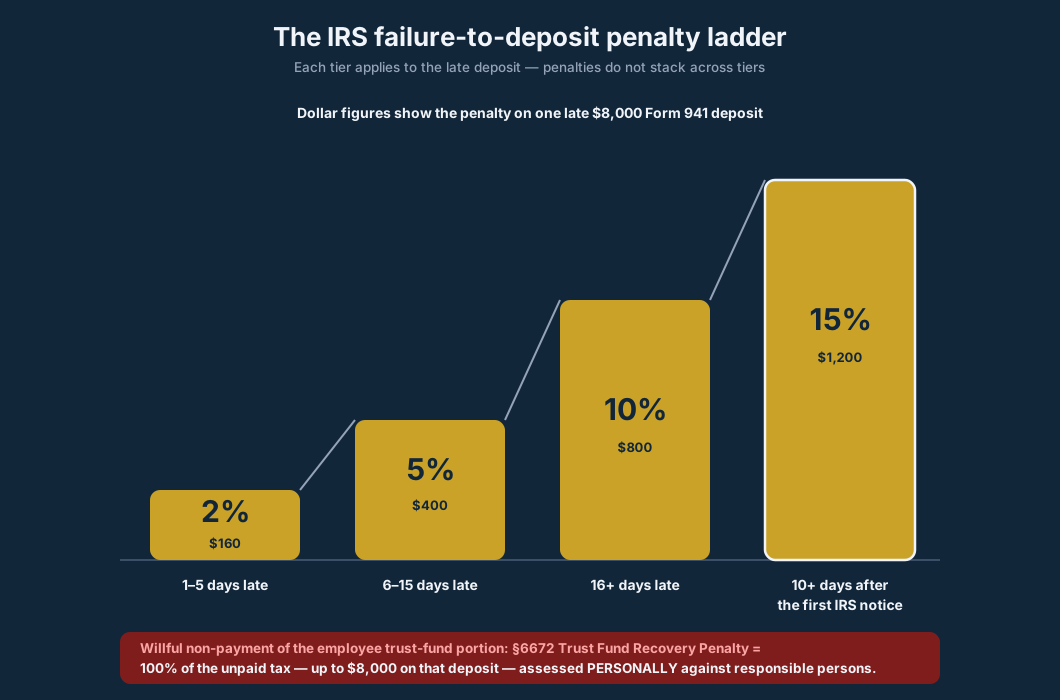
Make it concrete. One late $8,000 Form 941 deposit:
- 3 days late: $160
- 10 days late: $400
- 20 days late: $800
- Ignored until after the IRS notice: $1,200
- Willful non-payment of the employee trust-fund portion: up to $8,000 — assessed personally (see the next section)
Now layer on the cadence the firm is actually buying. Deposit frequency is set by the client's "lookback period" liability: $50,000 or less means monthly deposits (due the 15th of the following month); over $50,000 means semiweekly — Wednesdays-through-Fridays paydays deposit the following Wednesday, Saturdays-through-Tuesdays the following Friday. New employers start monthly. And there's a tripwire: any single day's liability of $100,000 or more triggers a next-business-day deposit and flips the client to semiweekly for the rest of the year (Wisemonk, September 2026).
Then the filing calendar, which runs on quarters and Januaries:
- Form 941 (quarterly payroll return): April 30, July 31, October 31, January 31 — with a 10-day grace period if every deposit was timely and in full (IRS Instructions for Form 941, March 2026 revision)
- Form 940 (FUTA, federal unemployment): due January 31 each year; deposits go quarterly whenever cumulative FUTA liability tops $500 (IRS Topic 759, current)
- Forms W-2/W-3: January 31 to both employees and the Social Security Administration, no agency-filing grace period. Late-filing penalties: $60 per form (within 30 days), $130 (after 30 days, before August 1), $340 (after August 1 or never filed) (Wisemonk, September 2026)
The unemployment-tax layer is where multi-state payroll gets its teeth. FUTA is 6.0% on the first $7,000 of each employee's wages, dropped to an effective 0.6% by the 5.4% credit for timely state payments — but state unemployment (SUTA) wage bases for 2026 run from $7,000 (Arkansas, California, Florida, Louisiana, Tennessee) to $78,200 in Washington — an 11x spread (StatsAmerica 2026 ranking; Nextep, November 2025). For context on the scale: the 2026 Social Security wage base is $184,500 (a cap of $11,439 per side), with Medicare's 1.45% uncapped (Wisemonk, September 2026, citing SSA).
There's also the statistic everyone quotes: roughly 40% of small businesses incur payroll errors each year, averaging about $845 in penalties. You'll find it everywhere in payroll marketing, attributed to "an IRS report." It is widely reported (Milestone Inc., current; NextGen Tax & Accounting, August 2025) — but the original IRS publication could not be located, and this article does not attribute it to the IRS. Treat it as what it is: a number the industry repeats, not a number the IRS published.
One more exposure a bookkeeping firm inherits the moment it touches payroll: worker misclassification. When a firm runs payroll, it becomes the party expected to know whether the client's "contractors" are contractors. Michigan's unemployment agency feeds IRS 1099 data to field auditors, and if misclassification continues after a finding, penalties quadruple the taxes owed (State of Michigan). California's willful-misclassification penalties run $5,000–$15,000 per violation, $10,000–$25,000 for a pattern (Mesriani Law Group, 2026).
The part that should keep every firm owner up at night
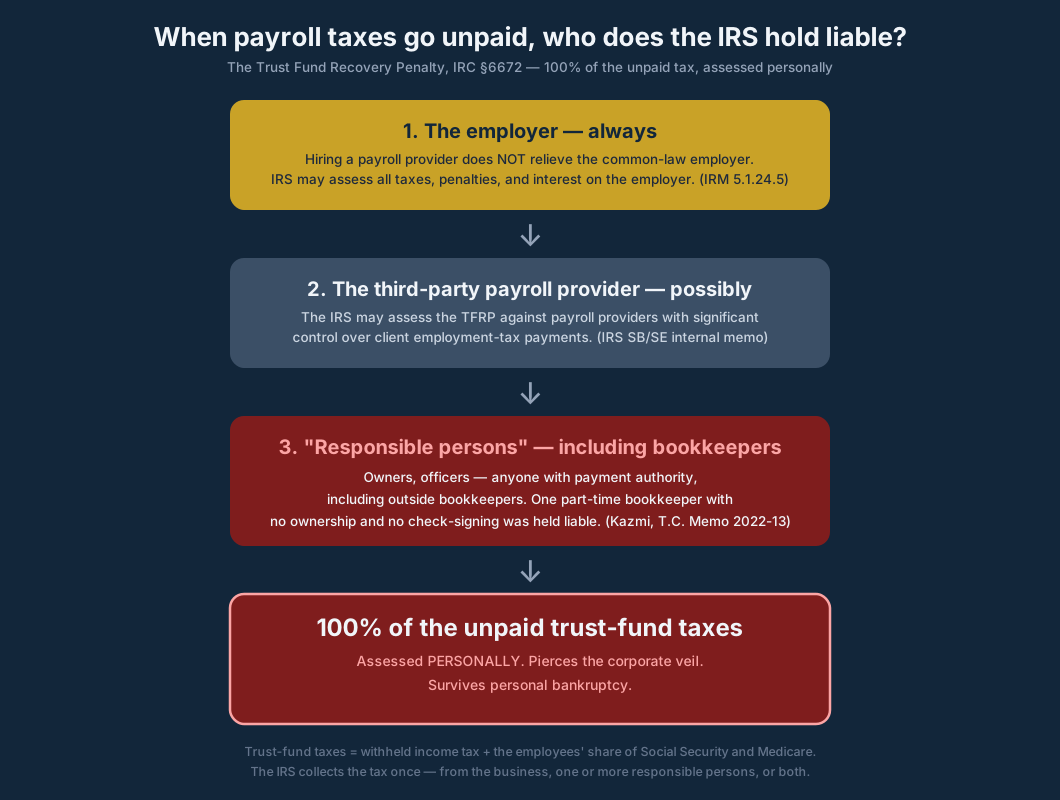
Here's the piece of this article that matters more than the pricing math. When a firm runs a client's payroll, it steps into a personal-liability regime that has no equivalent in monthly bookkeeping. The statute is IRC §6672, the Trust Fund Recovery Penalty, and the IRS's own manual states its purpose plainly: to make the responsible person liable for 100% of the unpaid trust-fund taxes — the withheld income tax and the employees' share of Social Security and Medicare, money the employer holds in trust for the United States (IRS Internal Revenue Manual 5.17.7; IRS.gov, current).
Two triggers, both broad. The person must be a "responsible person" — someone with the duty to collect, account for, and pay over the taxes — and the failure must be "willful," which in this context includes reckless or knowing disregard, not just deliberate theft. The penalty pierces the corporate veil and survives personal bankruptcy. And the IRS collects the tax once — from the business, from one or more responsible persons, or from both (IRS IRM 5.17.7).
Now the part bookkeepers underestimate: how wide the "responsible person" net is.
A part-time bookkeeper with no ownership interest, no officer or director role, and no check-signing authority was held personally liable. In Kazmi (T.C. Memo 2022-13), Mr. Kazmi handled all payroll functions for an urgent-care practice. He transmitted the payroll tax returns and made the federal tax deposits while knowing the withheld taxes hadn't been remitted — and the Tax Court found him a responsible person (North Carolina Bar Association blog, Federal Income Tax Update, 2026 installment). A freelance bookkeeping firm running a client's payroll is squarely in this fact pattern: the person who runs payroll, transmits returns, and knows the money didn't move is exactly who the statute is pointed at.
IRS internal policy extends the exposure to third-party payroll providers themselves. An IRS Small Business/Self-Employed Division internal memorandum holds that the TFRP "may be imposed against third-party payroll service providers as well as the employer" where the provider had significant control over the client's employment-tax payments (Chamberlain Hrdlicka, tax-law analysis of the IRS memo). The client hiring the firm doesn't shield the firm; it barely shields the client — IRM 5.1.24.5 states the common-law employer "remains liable unless the third party is the section 3401(d)(1) employer or a CPEO," and "the employer is liable for all taxes, penalties and interest due" even when it forwarded the money to a third party (IRS IRM 5.1.24.5, dated May 20, 2026). In the Taylor case, the owner argued his bookkeeper's $1–2 million embezzlement caused the unpaid employment taxes; the IRS assessed the TFRP against him personally anyway, and the Tax Court rejected his defenses (Missouri Bar news).
And then there's the criminal side — recent, and worth reading without sensationalism, because these are the cases clients will hear about.
September 2, 2026: a Kansas bookkeeping-firm owner pleaded guilty to stealing client payroll-tax funds. Nicole Clem, owner of Bookkeeping N Beyond in Augusta, Kansas, used ACH transfers to withdraw funds from client bank accounts designated for employment taxes and spent them personally — more than 20 clients, losses over $1 million, plus $35,222 of her own business's employment taxes unpaid from 2017 to 2023. She pleaded to wire fraud and failure to pay employment taxes, with sentencing set for December 2026 (IRS Criminal Investigation, September 2, 2026; U.S. Department of Justice). IRS-CI notes a roughly 90% federal conviction rate (IRS-CI, January 2026).
Also September 2026: a Wyoming bookkeeper sentenced to 46 months in federal prison. Laura Marie Means, bookkeeper for a Jackson family business with sole control over employee payroll, bank accounts, and tax reporting, siphoned nearly $1.5 million from 2019 to 2025. Restitution: $1,484,104.80 to the employer plus $355,875.32 to the IRS (U.S. Department of Justice, District of Wyoming, September 2026).
The broader context: the ACFE's newly released Occupational Fraud 2026 covers 2,402 real cases across 143 countries — $3.4 billion in losses, a $104,000 median loss per case, a typical 12-month detection lag — with payroll schemes at 9–10% of cases and a $63,000 median loss (ACFE, 2026). The prior edition found payroll schemes had the longest detection lag of any asset-misappropriation scheme — 18 months (Walz Group CPAs, 2024, summarizing ACFE 2024). A firm that runs payroll stands between the client and exactly this kind of scheme — which is both the service's value and its risk.
The engagement-letter lesson, before we get to the economics: any firm offering payroll needs the engagement to specify who signs what, who verifies deposits, and who owns the EFTPS credentials. The IRS's standing public guidance for outsourced payroll is three sentences firms should read twice: (1) the employer is ultimately responsible — "you, the employer, are the responsible party"; (2) don't change the IRS address of record to the provider's address; (3) enroll in EFTPS and verify deposits under your own EIN (IRS Special Edition Tax Tip, 2011 — old, still the standing guidance). Required deposits must be made electronically; required deposits not paid by EFT carry a 10% penalty tier (IRS IRM 20.1.4.7.1).
The demand case: why 71% of firms offer it anyway
With all of that on the table, here's why most firms do it. In Financial Cents' 2026 survey of firms (mostly small — 67% are 2 to 30 people; 68% owners/partners), 71% offer payroll, alongside bookkeeping (94%), CAAS/fractional CFO (60%), and tax prep (58%) (Financial Cents, 2026 State of AI in Accounting and Bookkeeping, September 2026 — an industry survey, read accordingly). It's the most common service line after the books themselves. The NSA's 2016–17 Income & Fees survey put payroll at 8.9% of firm gross income — dated, but it's the only public number on the revenue split (CPA Practice Advisor, January 2017).
How firms package and price it:
- As tiered packages. Thomson Reuters' 2025 Tax Pricing Survey documents Basic/Standard/Premium package structures in the wild, averaging $1,000/$2,000/$4,000, with payroll appearing as an included service line (Thomson Reuters, 2025).
- As a standalone line item. Indicative 2025 guides price payroll processing at $12–$30 per employee per month standalone; as an add-on, a fixed per-pay-run fee ($50–$150+) plus $5–$10 per employee (USAWire, illustrative 2025; PricingLink knowledge base, illustrative 2025). Treat these as guide rails, not benchmarks.
- Real firm price cards. One CPA firm's published sheet: monthly bookkeeping without payroll $185; with full-service payroll $265 — a clean $80/month payroll add-on. Standalone: $85/month (1–3 employees), $195/month (4–8 employees); Form 941 filings $75/quarter; W-2/W-3 package from $85; Form 940 $85 (Texas accounting firm fee schedule, hosted PDF — one firm's prices, not a national benchmark).
- Fixed fee leads. In Intuit's 2021 rate survey, fixed-fee billing was the most popular way firms billed payroll (43%) — older, but the most recent Intuit rate survey found (Intuit Accountants, 2021).
The automation data backs the "why": in Intuit's 2025 QuickBooks tech survey, 95% of firms adopted automation in the past year, and the #1 use case was payroll processing (47%), ahead of AP/AR (Intuit QuickBooks, 2025 — vendor survey). On the demand side, the National Small Business Association figure is that 45% of small businesses outsource payroll (via Milestone Inc., current), and a 2026 SurePayroll survey found 42% of owners said time spent on payroll was a primary reason they switched to an online provider (SurePayroll, 2026 — vendor).
The software economics
The pricing layer firms can't avoid is the payroll software itself — either what the client pays without the firm, or what the firm runs under the hood. All figures below are vendor list pricing for 2026, monthly billing, from vendor pages and 2026 reviews (labeled as such throughout):
- Gusto (per 2026 reviews of Gusto's public pricing): Simple $49/mo + $6/person; Plus $80/mo + $12; Premium $180/mo + $22; contractor-only $35/mo + $6 (Sonary, September 2026; Tech.co, 2026; Business.com, 2026). Gusto also runs an Accountant Partner Program with a client dashboard and advertised a free firm payroll subscription for partners (Gusto, 2026 — vendor).
- QuickBooks Payroll (2026): Core $50/mo + $6.50/employee; Premium $88 + $10; Elite $134 + $12; Elite includes up to $25,000 in tax penalty protection (MyPayrollFreedom, September 2026; QuickBooks Community — Intuit staff reply). Intuit restructured these tiers effective mid-2026 per third-party analyses.
- Patriot Software: Full Service $37/mo + $5/worker, filings and deposits included (Patriot Software, current — vendor).
- OnPay: $49/mo + $6/employee, single tier (Medium, January 2026; Trusted Product Scout, 2026 — vendor pricing).
Now work the 10-employee client three ways — assumptions flagged, because this is where most "payroll is easy margin" talk falls apart:
| Option | Math | Annual cost |
|---|---|---|
| Client runs it in-house (ILLUSTRATIVE: 1.5 hrs per biweekly run × 26 runs = 39 hrs/yr, bookkeeper time at $50/hr, within the published $30–$100/hr range) | 39 × $50 | $1,950/yr (+ all error and penalty exposure) |
| Outsource to Gusto Simple or OnPay (vendor list pricing) | $109/mo × 12 | $1,308/yr |
| Firm offers payroll as a service (ILLUSTRATIVE: $250/mo to a 10-employee client — between the published $195/mo 4–8-employee example and premium pricing) | $250/mo × 12 | $3,000/yr to the client |
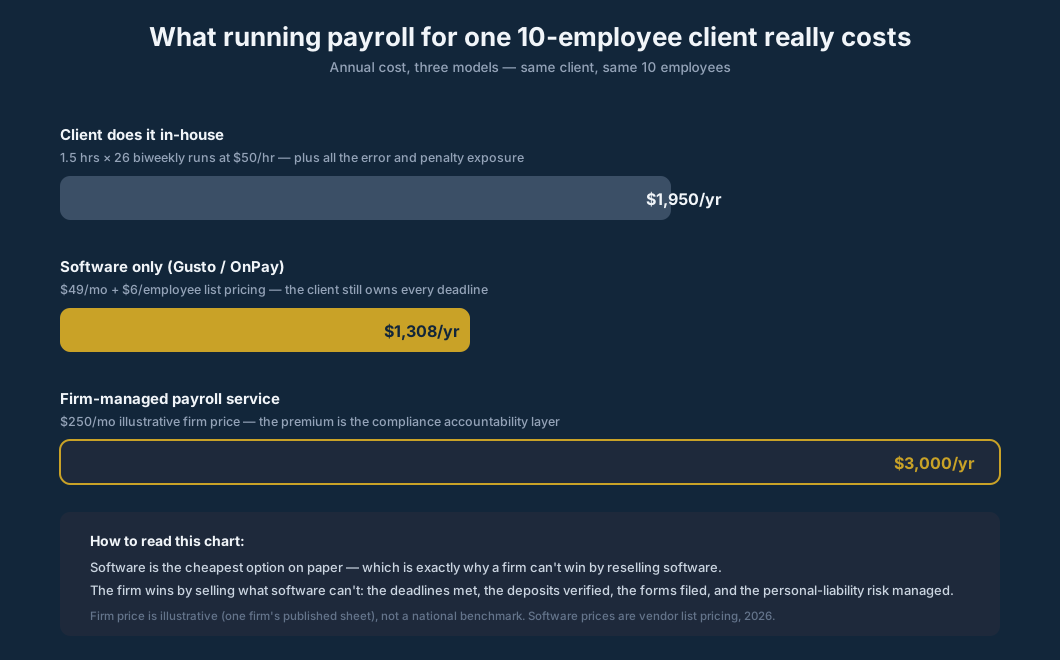
The read: software is the cheapest option on paper — which is exactly why a firm can't win by reselling software. The firm's $3,000-a-year price is a $1,700 premium over Gusto, and that premium is the entire service: the deadlines met, the deposits verified, the forms filed, and the §6672 liability managed through a proper engagement and credential structure. A firm that prices payroll as "Gusto plus a markup" is selling keystrokes. A firm that prices it as the compliance accountability layer is selling what the software can't do.
And the firm's own margin math, with firm prices treated as illustrative (extrapolated from one firm's published sheet, not a national benchmark):
| Scenario | Employees | Platform cost (vendor pricing) | Firm price (assumption) | Monthly margin |
|---|---|---|---|---|
| Micro client | 3 | $49 + $6×3 = $67 | $85 | $18 (21%) |
| Small client | 6 | $49 + $6×6 = $85 | $195 | $110 (56%) |
| 10-employee client | 10 | $49 + $6×10 = $109 | $295 | $186 (63%) |
Labor cost is excluded from this table, and that's the tell — the margin is real only if delivery is systematized. One practitioner's example (attributed as such): a 15-staff firm managing payroll for 30 small-business clients had two senior accountants spending ~25% of their time on it; moving to an outsourced platform cut delivery time to under 5% and freed roughly $35,000 in labor capacity (Medium, Nancy Odell, April 2026 — a hypothetical-firm practitioner piece). The platform costs ~$109 a month; the labor is the business. This is exactly why the next section exists.
Why a firm should NOT offer payroll — the honest objections
This article's thesis would be dishonest if it stopped at the margin table. There is a serious, practitioner-grounded case against offering payroll, and it starts with the people who sell payroll software.
The margins are often too thin to justify it. "Many firms feel that payroll can be resource intensive and that profit margins often are too low to justify offering this service to clients" — and some keep it only because clients expect an A-to-Z service range (CPA.com, Profitable Machine: Payroll Outsourcing white paper — CPA.com is the AICPA's business-and-technology arm, writing with an outsourcing thesis, not a neutral survey). A payroll provider making the anti-DIY argument puts it more sharply: "It's difficult to command advisory fees when you're solving clerical problems." Payroll offers no differentiation — "it's the same across industries" — and the better a firm gets at it, the more invisible the work becomes: the opposite of advisory, where better work earns more praise (ConnectPay, 2026 — a payroll company arguing firms shouldn't do payroll themselves; note the irony, weigh the argument on its merits).
The accounting-service business model fails in payroll. This is the strongest operational objection, and it comes from a company that sells the white-label middle path: "The business model that works beautifully for your accounting services will probably fail in payroll." Monthly accounting at $1,500–$2,000 per client has margin for special requests; "payroll operates on daily deadlines with zero margin for error. You need scalable, repeatable processes to deliver it efficiently. The problem is that most firms try to compete on price with traditional payroll providers while still offering that premium, highly customized service. And unfortunately, that math doesn't work" (Whirks, payroll provider for accounting firms, 2026 — a vendor with a product in this space, but the operational point stands on its own).
The anxiety is real and independent of the revenue. Payroll's cadence never sleeps — weekly and biweekly deadlines versus the monthly close — and the anxiety is specifically "around error prevention": payroll errors "can also lead to a loss of trust from clients, who expect their CPA firms to manage these operations flawlessly." That error-anxiety "acts as a strong deterrent against the adoption of payroll services for many CPA firms, regardless of the promise of new revenue streams" (AccountantsWorld/IRIS Global Payroll Guide, 2025 — vendor-adjacent).
CPA independence is a real compliance layer. For firms with attest clients, payroll is a nonattest service that can impair independence: under AICPA ethics rules, providing payroll to an attest client creates independence threats, and the engagement requires the client to designate an individual with suitable skill, knowledge, and experience to oversee the service and accept responsibility for results. One CPA principal reported having to disclose non-independence where the firm held signature authority or managed employee payroll information (Journal of Accountancy, March 2005 and November 2016 — dated on the 2005 piece, but the profession's flagship journal, and the independence framework still stands).
There are middle paths. Building means "people, technology, and compliance liability, in exchange for full control and all the revenue"; referring means "a hands-off revenue share, with less control and some reputational exposure"; and there's a white-label middle where the firm runs payroll under its own brand on a partner's platform. "The right choice depends on your capacity, your appetite for risk, and how much control you want, not on whichever option shows the biggest number" (Whirks, September 2026 — vendor, framed accordingly).
A four-partner firm reported payroll had been ~10% of revenue "for 25 or 30 years," with clients valuing "confidentiality and personalized service" and dealing with "only one provider" (Journal of Accountancy, March 2005 — dated; flagged). Payroll can be a decades-long, client-retaining service line — for firms that systematized the delivery and priced the accountability instead of the keystrokes.
How LedgerHQ fits
The standing rule for this site's comparisons: lead only with what LedgerHQ has that competitors don't, and verify every capability claim against the real product before printing it. This section was verified against the public ledgerhq.ai site in September 2026.
Payroll is a service line, not a software category — and a service line runs on client machinery: the engagement, the package, the billing, the relationship, and the books the payroll postings flow into. The payroll engine itself (Gusto, QuickBooks Payroll, OnPay — vendor list pricing cited above) is a commodity the firm picks once. The parts around it are where LedgerHQ's verified stack applies:
- The full Client Onboarding module. Packages, the engagement letter, the signature, the saved payment method, recurring billing on schedule — "they choose, sign, pay, and start onboarding in one connected experience" (ledgerhq.ai, verified September 2026). A payroll service line at $195–$295 a client only works if adding a payroll client is a process, not a project.
- The full Client CRM. A payroll service line is dozens of quarterly filings, annual W-2s, and deadline conversations — a database problem, not a memory problem (standing verified LedgerHQ capability).
- Tally, the AI bookkeeper. Tally codes the bank activity, works the reconciliations, follows up for what's missing, and hands over the financials — the firm stays in control of every judgment call (ledgerhq.ai, verified September 2026). Payroll postings are just transactions; Tally treats them that way, and the §6672-relevant paper trail — who ran what, when, for whom — lives in the books where it belongs.
- Bank Reconnects. Feeds die — credentials expire, banks change logins, MFA interrupts the sync. Payroll verification depends on seeing the actual money move. "Reconnect each bank once and keep moving" (ledgerhq.ai, verified September 2026).
One claim deliberately softened: the September 2026 public site does not currently document a native Gusto connection, so this article does not assert one. Run the payroll engine wherever it fits (Gusto's accountant program, QuickBooks Payroll, OnPay) and let LedgerHQ hold the parts no payroll app does: the engagement, the billing, the client relationship, and the books.
The firm product is LedgerHQ Pro at ledgerhq.pro — free through December 31, 2026, with billing starting January 1, 2027 unless cancelled (verified in the product's own billing code; the same "pay nothing until January 1, 2027" terms are on the public homepage). Check current pricing before you build your P&L on it — but the payroll margin table in this article starts the software line near zero for now, which is exactly where a new service line wants it.
The math, one more time
Payroll for bookkeeping clients is a compliance business wearing a service business's clothes. The numbers that decide it:
- The calendar: semiweekly or monthly deposits on a lookback schedule, 941s on April 30 / July 31 / October 31 / January 31, W-2s January 31, 940 annually — with a 2/5/10/15% penalty ladder and a 5%-a-month late-filing penalty behind every deadline.
- The liability: a 100% personal penalty under §6672 that reaches owners, officers, bookkeepers, and payroll providers — and survives bankruptcy. Two September 2026 criminal cases are the cautionary reading.
- The economics: $1,308 a year buys the software for a 10-employee client; a firm can credibly charge $3,000 a year for the accountability layer — if delivery is systematized, because the margin table's labor line is the whole business.
- The decision: 71% of firms offer it, and the firms it's wrong for are the ones selling premium customized service at commodity prices. Price the accountability, systematize the delivery, write the engagement letter like the Kazmi case happened to you — because the Tax Court's net is wide enough that it could have.
FAQ
Should every bookkeeping firm offer payroll? No. The honest filter from this article: offer it if you can deliver it as a system — standardized processes, a payroll platform under the hood, a proper engagement letter, and pricing that reflects the accountability, not the keystrokes. If your firm sells premium, highly customized service, the payroll math works against you: you're competing on price with Gusto while delivering white-glove service. Refer it out or white-label it instead.
What's the biggest risk — the penalties or the personal liability? The liability. Penalties are priced in dollars and stop at the client. The Trust Fund Recovery Penalty is 100% of the unpaid trust-fund taxes, assessed personally against responsible persons — including, per Kazmi, a part-time bookkeeper with no ownership and no check-signing authority. It pierces the corporate veil and survives bankruptcy. No other bookkeeping service line carries personal exposure like this.
Do I need a payroll software platform, or can I calculate payroll manually? You need a platform. The 2026 vendor list pricing is roughly $49/month + $6/employee (Gusto Simple, OnPay) to $50 + $6.50 (QuickBooks Payroll Core). Manual calculation across 50-state SUTA wage bases ($7,000–$78,200), lookback-scheduled deposits, and quarterly filings is where the 2/5/10/15% penalty ladder eats you. The software is the cheapest line in the whole decision.
How should a firm price payroll? The published patterns: a per-employee monthly line item ($12–$30/employee/month as a guide rail), a payroll add-on to bookkeeping ($80/month in the real firm price card cited here), or tiered packages with payroll folded in. Fixed-fee beats hourly — Intuit's 2021 rate survey found it the most popular payroll billing method. The one rule: price the accountability layer, not the software cost. Your $1,700-a-year premium over Gusto is the compliance risk you're managing, and the engagement letter should read like it.
What goes in the engagement letter for payroll? At minimum: the exact scope (payroll processing, deposits, filings — which forms, which deadlines), who holds EFTPS credentials, who verifies deposits, who signs returns, and who owns misclassification review. The Kazmi case is the reason: the person who transmits returns and makes deposits while knowing taxes are unpaid is the person the IRS calls "responsible." The engagement should also require the client to keep the IRS address of record (per the IRS's standing outsourced-payroll guidance) and designate an internal overseer — required for CPA firms under the AICPA nonattest-service rules.
Can offering payroll hurt a CPA firm's attest independence? Yes, and this is a compliance layer, not a footnote. Under AICPA ethics rules, providing payroll services to an attest client creates independence threats. The firm must apply safeguards — including the client designating a competent individual to oversee the service and take responsibility for the results — and in some configurations must disclose that it is not independent. Get the ethics analysis done before the first payroll client, not after.
If I refer payroll out instead, am I off the hook? For the daily compliance work, yes — the white-label/referral middle path trades revenue for risk. For reputation, no: "you're still the one holding your clients' blame if something goes wrong" (ConnectPay, 2026). And one caution from the case law: when a provider collapses, the client's liability survives — AccuPay's 2013 failure left dozens of small-business clients liable to the IRS and Maryland for taxes the provider never remitted (via The Indiana Lawyer). If you refer, vet the provider's filing-accuracy guarantees in writing.
Sources
- IRS, "Failure to Deposit Penalty" — penalty tiers 2%/5%/10%/15%. irs.gov (current)
- IRS Internal Revenue Manual 5.17.7 — Trust Fund Recovery Penalty: 100% of unpaid trust-fund taxes, responsible persons, willfulness, survives bankruptcy. irs.gov (current)
- IRS, "Trust Fund Recovery Penalty" — plain-language overview. irs.gov (current)
- IRS Internal Revenue Manual 5.1.24.5 — employer ultimately liable even when a third party fails; liable for all taxes, penalties, interest. irs.gov (dated 2026-05-20)
- IRS Internal Revenue Manual 20.1.4.7.1 — 10% penalty tier for required deposits not made by EFT. irs.gov (current)
- IRS, "Three Tips for Employers Outsourcing Their Payroll" — employer ultimately responsible; keep address of record; enroll in EFTPS. irs.gov (Special Edition Tax Tip 2011-05 — old, still standing guidance)
- IRS Instructions for Form 941 — quarterly due dates Apr 30 / Jul 31 / Oct 31 / Jan 31; 10-day extension. irs.gov (03/2026 revision)
- IRS Topic 759, Form 940 — annual return, quarterly deposits over $500. irs.gov (current)
- IRS, "Employment Tax Due Dates." irs.gov (current)
- IRS Criminal Investigation, "Bookkeeper pleads guilty to taking clients' money but failing to pay taxes on their behalf" — Nicole Clem, Sept 2, 2026. irs.gov (2026-09-02)
- IRS-CI, "Kansas bookkeeper indicted for failing to pay payroll taxes for clients" — Clem indictment details, 90% conviction rate. irs.gov (2026-01-30)
- U.S. Department of Justice, "Bookkeeper pleads guilty to taking clients' money, failing to pay taxes on their behalf" (District of Kansas). justice.gov (2026)
- U.S. Department of Justice, "Former Jackson Hole bookkeeper sentenced to nearly four years in federal prison for $1.48 million" (District of Wyoming) — Laura Marie Means, Sept 2026. justice.gov (2026-09)
- North Carolina Bar Association blog, "2022 Federal Income Tax Update" — Kazmi, T.C. Memo 2022-13: part-time bookkeeper held liable under §6672. ncbarblog.com (2026 installment)
- Chamberlain Hrdlicka, "Trust Fund Recovery Penalty: Has the IRS Found Deeper Pockets, or Just More Pockets" — TFRP against third-party payroll providers; IRS SB/SE internal memo. chamberlainlaw.com (tax-law analysis)
- Missouri Bar news, "Business owner responsible for employment taxes despite CPA embezzlement" — Taylor case. news.mobar.org (Tax Court case summary)
- The Indiana Lawyer, "BGBC: Avoiding Potential Pitfalls of Payroll Service Providers" — AccuPay collapse; reliance on a provider doesn't excuse the employer. theindianalawyer.com (article)
- BMG CPAs, "Avoid & Correct Common Payroll Tax Mistakes" — failure-to-deposit tiers quoted. bmgcpas.com (September 2026)
- Thomas Howell Ferguson CPAs, "Common Payroll Tax Mistakes and How to Correct Them." thf.cpa (2026-09-28)
- LegalClarity, "IRS Publication 15: Employer Tax Responsibilities" — deposit tiers; 941 late-filing 5%/mo capped at 25%. legalclarity.org (crawled September 2026)
- Wisemonk, "Guide: Employer Payroll Taxes" — deposit schedules, lookback, $100k trigger, 941/W-2/940 deadlines, FUTA math, 2026 FICA base. wisemonk.io (September 2026)
- Milestone Inc., "Payroll Outsourcing Statistics" — the "40% / ~$850" figure, widely reported. milestone.inc (current)
- NextGen Tax & Accounting, "Top Payroll Mistakes Small Businesses Make and How to Dodge IRS Penalties in 2025." next-genaccounting.com (2025-08-15)
- StatsAmerica, 2026 SUTA taxable wage bases ranking ($7,000–$78,200). statsamerica.org (2026)
- Nextep, "2026 SUTA Wage Bases." nextep.com (2025-11-17)
- State of Michigan, Unemployment Insurance Agency, "Employee Misclassification" — 1099 data to field auditors; quadrupled penalties. michigan.gov (current)
- Mesriani Law Group, "Misclassified Independent Contractor California" — $5,000–$15,000 / $10,000–$25,000 per violation. mesrianilaw.com (2026)
- Financial Cents, "The State of AI in Bookkeeping & Accounting" — 71% of firms offer payroll (select-all, mostly small firms). financial-cents.com (September 2026)
- CPA Practice Advisor, "Survey Shows Average Fees for Accounting, Tax Firm Services for 2017" — payroll 8.9% of gross income (NSA 2016–17; dated). cpapracticeadvisor.com (2017-01-31)
- Intuit Accountants, "The Results of the New Intuit Rate Survey Are In" — fixed-fee most popular for payroll (43%). accountants.intuit.com (2021 — older, most recent Intuit rate survey found)
- Ignition, "The end of hourly billing: Ignition's 2025 benchmark signals pricing shift for firms" — pricing bands; 57% raising fees; 79% fixed/value pricing. einpresswire.com (August 2025 — vendor)
- Thomson Reuters, "2025 Tax Pricing Survey" — tiered Basic/Standard/Premium packages averaging $1,000/$2,000/$4,000 with payroll as a line item. thomsonreuters.com (2025)
- Texas accounting firm, "Basic Pricing & Rates" (hosted PDF) — $185/$265 bookkeeping, $85–$195 payroll tiers, 941/W-2/940 line items. webflow hosted PDF (one-firm price sheet, not a benchmark)
- USAWire, "How Much to Charge for Bookkeeping Services?" — $12–$30/employee/month indicative guide rails. usawire.com (illustrative 2025)
- Intuit QuickBooks, "Intuit QuickBooks Tech Survey" — 95% automation adoption; payroll processing #1 use case (47%). quickbooks.intuit.com (2025 — vendor)
- SurePayroll, "How to Switch Payroll Providers at Year-End" — 42% of owners cited payroll time as switch trigger. surepayroll.com (2026 — vendor)
- Sonary, "Gusto Payroll Review" — 2026 Gusto pricing: Simple $49+$6, Plus $80+$12, Premium $180+$22. sonary.com (September 2026)
- MyPayrollFreedom, "QuickBooks Payroll Review" — 2026 QBO tiers: Core $50+$6.50, Premium $88+$10, Elite $134+$12; Elite $25k penalty protection. mypayrollfreedom.com (2026-09-18)
- QuickBooks Community — Intuit staff reply confirming payroll pricing. quickbooks.intuit.com (Intuit staff post)
- Patriot Software, "Unlimited Payrolls" — Full Service $37/mo + $5/worker. patriotsoftware.com (current — vendor)
- OnPay, "Best Small Business Payroll Software Picks" — $49/mo + $6/employee. onpay.com (2026 — vendor)
- Trusted Product Scout, "Best Payroll Software for Small Business" — OnPay/ADP pricing context. trustedproductscout.com (2026)
- Gusto, "Partner Resources" — Accountant Partner Program, free firm subscription advertised. gusto.com (2026 — vendor)
- ACFE, "Occupational Fraud 2026: The Fraud Tree" — payroll schemes 9–10% of cases, $63,000 median loss. cms.acfe.com (PDF) (2026)
- ACFE, "Key Findings: Report to the Nations 2026" — 2,402 cases, $3.4B+ losses, $104,000 median, 12-month detection lag. acfe.com (2026)
- Walz Group CPAs, "Protect Your Business from Payroll Fraud" — ACFE 2024 summary: 18-month detection lag. walzgroupcpa.com (2024)
- CPA.com, "Profitable Machine: Payroll Outsourcing" white paper — margins too thin; resource-intensive. cpa.com (white paper — industry source with outsourcing thesis)
- ConnectPay, "Why Payroll Services May Be Holding Back Your CPA Firm" — clerical vs advisory; competing with payroll giants. connectpayusa.com (2026 — vendor)
- Whirks, "Accounting Firm Not Ready for Payroll" — business model fails in payroll. whirks.com (payroll vendor with white-label product)
- Whirks, "Build vs Refer Payroll: Accounting Firm" — build/refer/white-label framing. whirks.com (September 2026 — vendor)
- AccountantsWorld/IRIS, "Global Payroll Guide" — error anxiety as deterrent. accountantsworld.com (PDF) (2025 — vendor-adjacent)
- Journal of Accountancy, "Payroll: A Tie That Binds" — independence threats; four-partner firm counterpoint. journalofaccountancy.com (March 2005 — dated)
- Journal of Accountancy, "Maintaining Independence with Nonattest Services." journalofaccountancy.com (November 2016)
- Nancy Odell, "How Payroll Outsourcing Services Can Save Time and Reduce Operational Costs for CPA Firms" — practitioner margin example; partner due-diligence list. medium.com (April 2026 — practitioner piece)
- LedgerHQ, "Build an AI-Native Bookkeeping Business" — Tally capabilities, Client Onboarding module, Bank Reconnects, $20/client/month, free through January 1, 2027. ledgerhq.ai (verified September 2026)