
Firm operations
Preparing for Tax Season Year-Round: The Monthly Rhythm That Kills April Panic
April panic is a bookkeeping problem, not a tax problem. The burnout data, the penalty math that makes late worse than wrong, and the 12-month monthly rhythm — with firm economics — that turns tax season into a non-event.

The short answer

Tax season does not start in January. It starts the previous April, in the weeks after the deadline, when a firm either installs a monthly rhythm or starts accumulating the debt that becomes next April's panic. Every frantic March is just twelve skipped monthly closes arriving all at once.
The numbers behind the panic are stark. A widely cited FloQast and University of Georgia survey found that 99% of accounting professionals report experiencing burnout. During the 2024-2025 busy season, 48% of public accountants worked 51 to 60 hours a week, another 19% worked 61 to 70, and 12% logged more than 71 hours weekly. Roughly 15 to 20 percent of all filers — up to 20 million people — request extensions every year, and the IRS notes that extension filers skew toward more complex finances.
The fix is not working harder in April. It is making April ordinary: twelve small monthly jobs, each with a deadline of its own, so that when the real deadlines arrive the books are already done. This article covers the anatomy of April panic, the penalty math that makes late worse than wrong, the full 12-month rhythm month by month, the economics of panic versus rhythm for a firm, and how the monthly review habit runs inside LedgerHQ.
April panic is a data point, not a personality trait
Firms talk about busy season the way sailors talk about weather — as something that happens to them. The data says it is structural, and the structure is the calendar.
Start with the people. The FloQast/University of Georgia research puts burnout at effectively universal in the profession, with nearly a quarter of accounting professionals at medium-high to high levels. The 2024-2025 busy-season hours tell the mechanism: almost half of public accountants at 51-60 hours a week, nearly a fifth at 61-70, and more than one in ten past 71. That is not a rough patch. That is the operating model.
Then the volume. The Treasury Inspector General's final results for the 2025 filing season: 144.8 million returns received, 92.0 million refunds issued, average refund $2,947. Against that base, the extension economy is enormous: about 19 million taxpayers requested extensions on their 2023 returns, and CPA Practice Advisor reported in October 2026 that as many as 20 million Americans — 15 to 20 percent of all filers — ask for extensions each year. The IRS's own filing-season statistics quietly confirm why extensions matter to firms: the late-May statistics exclude everyone who filed Form 4868, and those extension filers, while only about 10 percent of returns, account for a disproportionate share of adjusted gross income and tax liability. The extended returns are the complicated ones.
So the firm is not imagining it. April concentrates the simplest volume, and September/October concentrates the hardest complexity — a second busy season hiding inside the first one's shadow.
Why the books are always the bottleneck
Here is the uncomfortable truth behind every April war story: the tax return is rarely the hard part. The hard part is that the books were not ready.
Trace a typical panic backward. In March, the preparer discovers the client's December bank reconciliation was never finished, three months of statements are missing, the owner mixed personal spending into the business account all year, and nobody categorized the December credit card feed. None of that is a tax problem. It is eleven months of skipped bookkeeping arriving in one inbox, two weeks before a deadline.
January has its own version. W-2s and 1099-NECs are due January 31, and the payroll data has to reconcile to the books — which means the books have to be current through December. A firm that closed December in December spends January issuing forms. A firm that did not spends January reconstructing December before it can issue anything, and the information-return deadline does not move.
The cost compounds in a way firms rarely price. Take a single client with a year of unreconciled books:
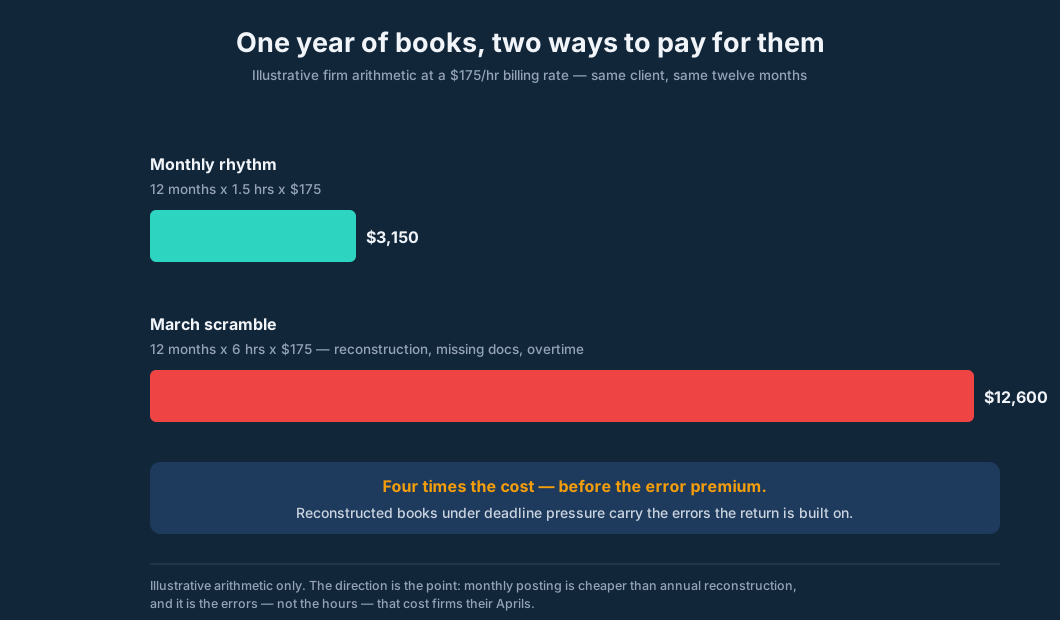
Twelve months at 1.5 hours a month and a $175 billing rate is $3,150 of steady, plannable work. Twelve months at 6 hours each in a March scramble — reconstruction, missing documents, overtime — is $12,600. Same year, same client, four times the cost. And the arithmetic understates the real damage, because reconstructed books under deadline pressure carry the errors the return gets built on. The hours are visible. The error premium is not.
The penalty math that makes late worse than wrong
If the rhythm has a single sharpest argument, it is the IRS penalty structure. Late is not a little worse than on-time-but-imperfect. Late is dramatically worse — and filing late is ten times worse than paying late.
| Penalty | Rate | Cap | What triggers it |
|---|---|---|---|
| Failure to file | 5% of unpaid tax per month | 25% | Return filed after the deadline |
| Failure to pay | 0.5% of unpaid tax per month | 25% | Balance unpaid after April 15 |
| Both at once | 5% combined per month (4.5% + 0.5%) | 25% on the file portion | Late return with a balance due |
| Interest | Federal short-term rate + 3%, compounded daily | None | Runs on tax and penalties from April 15 |
| 60+ days late | Minimum $525 (returns due in 2026) or 100% of tax, whichever is less | — | The floor, not the ceiling |
| S-corp / partnership late | $255 per owner per month, up to 12 months | Per owner | Form 1120S / 1065 late, even with zero tax due |
| Late K-1 | $340 per form | Per K-1 | Information return penalties |
Two facts in that table do most of the work. First, an extension of time to file is not an extension of time to pay — the balance is still due April 15, and interest plus the pay penalty accrue regardless. Second, the file penalty dwarfs the pay penalty. Run the numbers on $10,000 of tax owed, three months late:
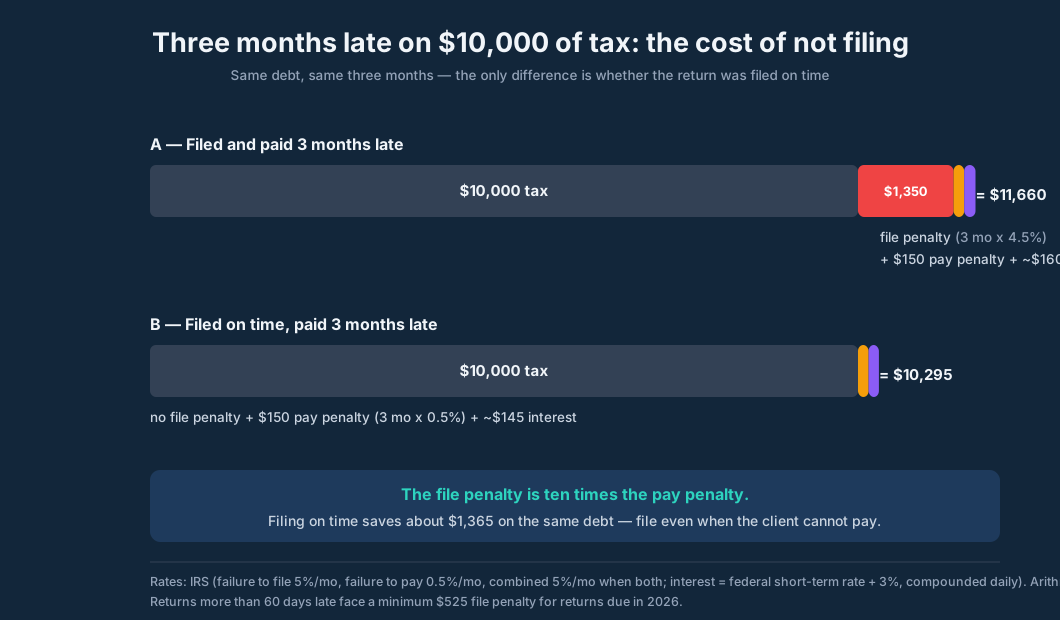
File and pay three months late: $1,350 of file penalty (three months at the combined 4.5%), $150 of pay penalty, about $160 of interest — $11,660 total, a 16.6% surcharge in ninety days. File on time and pay three months late: no file penalty at all, $150 of pay penalty, about $145 of interest — $10,295. Same debt, same delay, $1,365 apart. The single most valuable tax-season advice a firm can give a cash-strapped client is three words long: file anyway.
The entity penalties deserve their own warning because they bite even when no tax is owed. An S corporation or partnership return filed two months late with three owners costs 3 x $255 x 2 = $3,060 — on a return that reports zero tax due. Late K-1s stack another $340 per form on top. March 15 is not a soft deadline.
The 12-month rhythm, month by month
The rhythm is twelve monthly jobs. None of them is heroic. Together they make April boring.
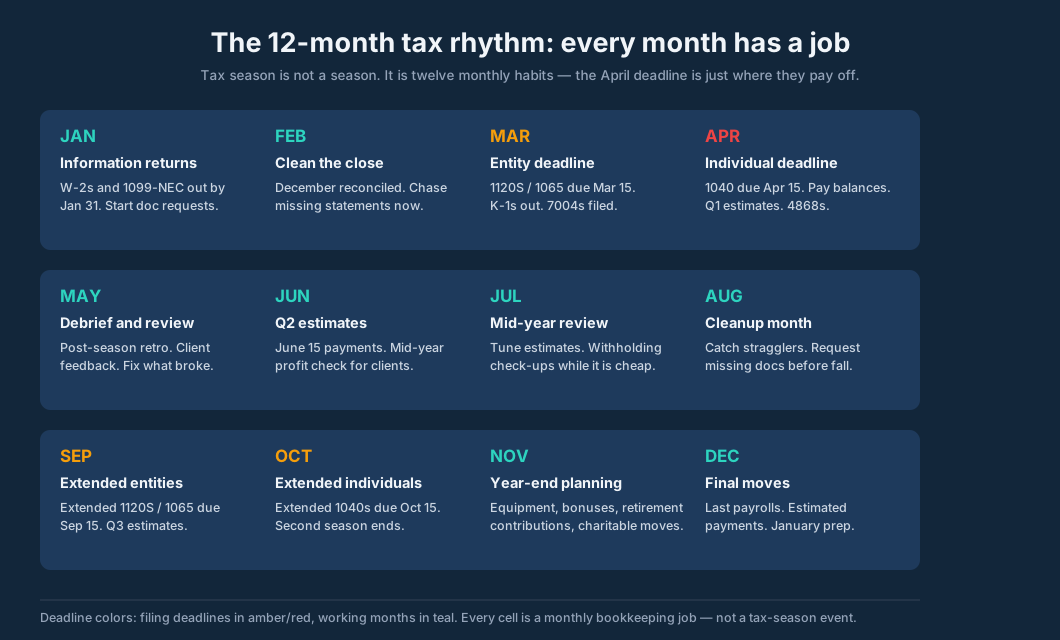
January: the information-return sprint
W-2s go to employees and the Social Security Administration by January 31; 1099-NECs go to contractors and the IRS by the same date. The penalty for late or incorrect information returns runs $60 to $340 per form depending on how quickly it is corrected. The bookkeeping job underneath is reconciliation: payroll has to tie to the ledger, contractor payments have to be complete, and the December close has to be real. Firms that run the rhythm start document requests in early January — engagement letters, organizers, and a checklist of what each client owes — because the client who gets the request January 5 answers by February, and the client who gets it March 1 becomes an extension.
February: clean the close
December gets its final reconciliation: bank accounts, credit cards, loan balances tied to statements, and the revenue number the owner will see on the return agreed before anything is filed. This is also missing-document month — the statements and receipts that did not arrive in January get chased while there is still time to find them. A clean February is what makes March possible.
March: entity deadline month
Calendar-year S corporations and partnerships file Form 1120S and Form 1065 by March 15 (March 16 in 2026, when the 15th fell on a Sunday), and furnish Schedule K-1s to owners. Miss it and the $255-per-owner-per-month penalty starts running, even on a zero-tax return. File Form 7004 where the return genuinely is not ready — the extension moves the filing deadline to September 15, not the K-1 obligation away. The rhythm's March job is triage: which entity returns are genuinely ready, which need extensions filed deliberately rather than discovered late, and whose K-1s will unblock individual returns downstream.
April: individual deadline month
Individual returns are due April 15. Three jobs, in order: file every return or a Form 4868 extension; pay every balance due (extensions do not extend payment); and make Q1 estimated payments, also due April 15. The penalty math from the last section is the month's sermon: a filed return with an unpaid balance costs a fraction of a late return. April is also the month to log what broke — which clients were late with documents, which estimates were wrong — while the pain is fresh.
May: debrief and review
The most skipped month in the profession. May is for the post-season retro: which clients cost more than they paid, which processes failed, what the firm's capacity actually was versus what it sold. Client feedback goes out now, when the experience is vivid. Pricing changes for next year get decided here, not in January when leverage is gone. Firms that skip May repeat April.
June: Q2 estimates and the mid-year profit check
Second-quarter estimated payments are due June 15. But the rhythm's June job is bigger than a payment: a mid-year profit check for every significant client. Six months of clean books means the firm can see who is having an unexpectedly good year — the client who will owe in April and should be adjusting estimates now, not discovering it later. This is the month year-round preparation earns its keep.
July: tune the estimates
With half the year posted, withholding check-ups and estimate tuning are cheap. A W-4 adjustment in July fixes a shortfall; the same discovery in March becomes a penalty conversation. July is also catch-up insurance: any client drifting behind on bookkeeping gets attention now, in the year's quietest stretch.
August: cleanup month
The year's designated slack month. Straggler bookkeeping gets caught up, document requests for the fall go out early, and the firm preps its extension-season workflow before September arrives. August work is September work done at half the stress.
September: extended entities
Extended S corporation and partnership returns are due September 15, along with Q3 estimated payments. This is the second busy season's first peak — and it is where the year's earlier discipline shows. K-1s issued on time in September unblock the individual extensions waiting on them; K-1s still missing in September are why October becomes a fire drill.
October: extended individuals
Extended individual returns are due October 15, and the second season ends. With roughly 20 million extension filers a year — disproportionately the complex ones — October deserves the staffing and the calendar respect April gets. Firms that treat October as an afterthought get an afterthought's results.
November: year-end planning begins
With ten-plus months of actuals, year-end tax planning is arithmetic instead of guessing: equipment purchases timed before year-end, bonuses accrued, retirement contributions sized, charitable moves planned. The November job is running the numbers while there is still time to act on them.
December: final moves
Last payrolls, final estimated payments, and January preparation — the information-return data gets verified while the year is still open. December closes the loop back to January: the firm that finishes December in December starts the new year issuing forms instead of reconstructing books.
The second busy season nobody plans for
April gets the war stories, but the extension deadlines quietly create a second tax season — and firms staff for one. September 15 (extended entities, Q3 estimates) and October 15 (extended individuals) land six months after the main event, staffed by whoever has not quit and scheduled around work nobody budgeted.
The extension filers are not the easy returns deferred. Per the IRS, they are the complex ones — more income sources, more entities, more K-1 dependencies. A September where entity K-1s go out late cascades directly into October individual returns waiting on those K-1s. The rhythm treats September and October as deadline months with the same seriousness as March and April: capacity planned, document requests sent in August, and triage done before the deadlines rather than after.
What the rhythm is worth to a firm
Put the two operating models side by side across the first four months of the year:
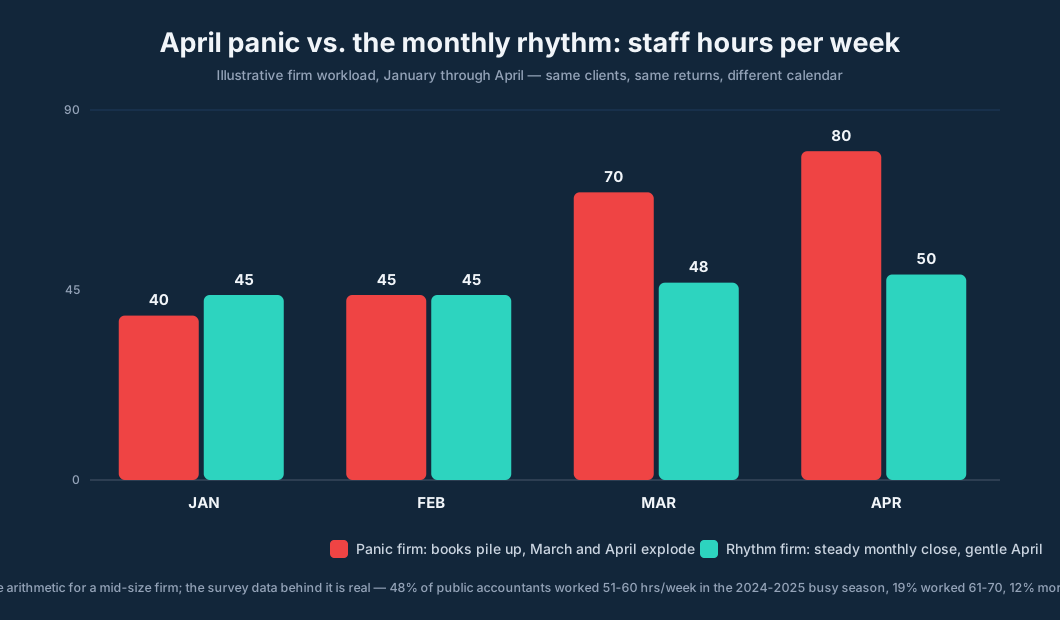
The panic firm runs 40-hour weeks in January and February, then 70 and 80 in March and April — the exact shape the survey data describes, with nearly a third of public accountants past 60 hours a week in busy season. The rhythm firm runs 45 to 50 all the way through. Same clients, same returns. The difference is entirely when the bookkeeping happens.
The economics run deeper than hours. April hours are the most expensive hours a firm buys: overtime pay, turnover from burnout (the survey-to-departure pipeline is well documented), and the error premium on returns built from reconstructed books. The monthly model converts all three into plannable, billable, lower-stress work spread across twelve months — work clients will pay for monthly, which is also the steadier revenue model.
Running the rhythm in LedgerHQ
The rhythm is a bookkeeping discipline, and it needs the books to be current every month — not reconstructed every March. That is the job LedgerHQ is built for. Every claim below was verified against the live LedgerHQ product documentation on October 9, 2026.
The monthly habit has a name in the product: Monthly review — check reports, registers, Bank Feeds, Statements, Bank Recs, and open client questions. That is the rhythm's operating loop, stated as a workflow. One honesty note the docs state plainly: there is no separate month-end close worksheet or report-readiness gate in LedgerHQ. The review is a discipline the firm runs, not a button the software presses.
What the software does supply for each monthly pass:
- Bank feeds that keep posting. Coded and posted feed rows flow into the ledger continuously, so January's books are being built in January. Uncoded or unposted rows stay out of reports until they are handled — the ledger shows what exists, and the review shows what still needs work.
- Reports that answer the return's questions. Income Statement, Balance Sheet, Trial Balance, and General Ledger, on Cash or Accrual basis. Click any account name or amount to expand its activity inline — dates, descriptions, debits, credits, running amounts — and open the source journal entry from there. When a K-1 number looks wrong in September, the drill-down is seconds, not a file-room expedition.
- Class columns for the multi-entity reality. The Income Statement offers total, monthly, quarterly, and Class columns, so firms can compare income and expenses across departments, properties, or locations — the segmentation that entity returns and K-1s are built from.
- Client-ready exports every month. PDF and spreadsheet exports for core reports, a Management Financial Statements PDF packet combining the main statements, and Monthly financial review packets with comparisons, cash explanations, and supporting statements under the firm's own branding. The November year-end planning meeting runs on the October packet.
- Tally watching the unknowns. Tally investigates unknown money, and Ask Client rows post to Management Review income and expense accounts — visible on the P&L as their own section, posted and recodable later rather than guessed at. Tally can also prepare supported report PDFs for an authorized recipient, with the period, basis, and recipient reviewed before anything goes out.
- Year-end protection. Closed fiscal years stay protected; changing books inside one requires the supported fiscal-year reopen with explicit authorization. January's information returns rest on a December that cannot silently shift.
And the boundary, stated plainly: LedgerHQ is the books, not the tax return. The CPA still prepares returns in tax software. What the rhythm buys is that the return starts from a ledger that has been reviewed twelve times instead of reconstructed once.
LedgerHQ runs $20 per month per business, with a Free Preview through January 1, 2027 (verified October 8, 2026).
FAQ
Isn't tax season just inherently brutal? The deadlines are fixed, but the brutality is optional. The hours data shows the pain concentrates in firms where bookkeeping piles up — 48% of public accountants at 51-60 hours a week in busy season is a symptom of annual reconstruction, not of tax law. Firms that close monthly spread the same work across twelve months.
What is the single highest-value monthly habit? The monthly review: reports, registers, bank feeds, statements, and reconciliations, every month, no exceptions. Everything else in the rhythm — clean January forms, calm March entities, boring Aprils — is downstream of that one habit.
Should clients file extensions or rush to meet April 15? A well-prepared extension beats a rushed return. The extension moves the filing deadline to October 15 with no penalty; rushing produces the errors that cost real money. But the balance due is still due April 15 either way — extend the filing, pay the estimate.
What if a client's books are already a year behind? Catch up once, properly, in the year's quiet months — August is built for this — and install the monthly rhythm going forward. The catch-up is expensive (see the $3,150 vs $12,600 arithmetic above); the rhythm is what keeps it from recurring.
How do estimated payments fit the rhythm? They are the rhythm's quarterly heartbeat: April 15, June 15, September 15, and January 15. Each estimate date is a profit check — with current books, the firm can see whether the client's year is running hot and tune the payment. Without current books, estimates are guesses.
Can software replace the monthly review? No — and LedgerHQ's own documentation says as much: there is no separate close worksheet or readiness gate, and reports show the ledger that exists without certifying that every transaction that should exist has been entered. Software makes the review fast; the accountant's judgment is still the review.
Sources
- FloQast / University of Georgia burnout survey; 2024-2025 busy-season hours (48% at 51-60 hrs/wk, 19% at 61-70, 12% above 71) — via The Expert CFO / ABNewswire, September 19, 2026 — https://www.abnewswire.com/pressreleases/accountant-burnout-is-driving-a-wave-of-career-pivots-into-fractional-cfo-work-the-expert-cfo-finds_836764.html
- IRS Collection Procedural Questions — failure-to-file 5%/month, failure-to-pay 0.5%/month, combined 5%, interest at federal short-term rate + 3% compounded daily — IRS.gov — https://www.irs.gov/faqs/irs-procedures/collection-procedural-questions/collection-procedural-questions-3
- IRS late-filing penalty guide — 10x asymmetry, $525 minimum for returns due in 2026 more than 60 days late, installment agreement 0.25% rate — Jupid, March 26, 2026 — https://jupid.com/blog/late-filing-penalty-guide-2026
- IRS penalty calculator worked example — $10,000 owed, three months late — Jupid — https://jupid.com/irs-penalty-and-interest-calculator
- TIGTA Final Results of the 2025 Filing Season — 144.8M returns received, 92.0M refunds, $2,947 average refund — September 29, 2025 — https://www.tigta.gov/sites/default/files/reports/2025-09/2025400048fr.pdf
- IRS filing season statistics — late-May data excludes Form 4868 filers; extension filers skew complex — IRS.gov — http://www.irs.gov/uac/Filing-Season-Statistics
- ~19 million extension requests on 2023 returns (IRS estimates) — Nasdaq — https://www.nasdaq.com/articles/cant-make-tax-deadline-heres-how-file-extension-or-set-irs-payment-plan
- Up to 20 million extension filers per year, 15-20% of filers; October 15, 2026 extended deadline — CPA Practice Advisor, October 6, 2026 — https://www.cpapracticeadvisor.com/2026/10/06/key-irs-deadline-looms-for-as-many-as-20-million-tax-filers/191195/
- IRS on extensions — automatic six-month extension via Form 4868; payment still due April 15 — IRS.gov — https://www.IRS.gov/newsroom/2-out-of-3-taxpayers-have-already-filed-use-free-file-or-direct-pay-to-get-a-6-month-tax-filing-extension-e-pay-and-payment-agreement-options-available-on-irsgov
- Form 1120-S guide — March 16, 2026 deadline; $255/shareholder/month penalty for returns due in 2026; $260 for 2027 — Jupid, September 2026 — https://jupid.com/blog/form-1120-s-instructions-2026
- Form 1065 guide — $255/partner/month; $340 per late K-1 — Jupid, September 2026 — https://jupid.com/blog/form-1065-instructions-2026
- Late K-1 penalty mitigation — $255/owner/month entity penalty; $340 per K-1 information penalties — NATP, September 2026 — https://www.natptax.com/news-insights/blog/how-to-limit-penalties-when-schedule-k-1s-are-issued-late/
- S-corporation compliance deadlines — January 31 W-2/1099-NEC ($340 per form); March 15 entity returns — SDO CPA — https://www.sdocpa.com/s-corporation-tax-guide/
- LedgerHQ Docs — Monthly review: reports, registers, Bank Feeds, Statements, Bank Recs; no separate close worksheet — https://ledgerhq.pro/docs/help/month-end-close
- LedgerHQ Docs — Reports: Cash/Accrual IS/BS/TB/GL, inline drill-down, PDF/XLSX exports, Class columns, management packets — https://ledgerhq.pro/docs/help/reports
- IRS penalties overview — 5% file / 0.5% pay monthly rates, 25% caps — Wikipedia — https://en.wikipedia.org/wiki/IRS_penalties
- Average 2026 refund $3,623 as of March 13 (mid-season snapshot) — Asbury Park Press / app.com, March 23, 2026 — https://www.app.com/story/news/2026/03/23/days-left-before-tax-season-ends-how-to-get-a-tax-filing-extension/89285173007/