
Firm operations
Pricing Psychology for Bookkeeping Retainers: Anchors, Packages, and the Quarterly Advisory Upsell
Clients do not judge a retainer in isolation — they judge it against the options beside it. The research on anchoring, decoys, and charm pricing, translated into a three-package ladder and a quarterly advisory upsell a bookkeeping firm can run honestly.
The short answer
A prospect never sees your price alone. They see it next to the other packages on your page, next to the last bookkeeper they paid, and next to the number they had in their head before the call. That comparison — not the absolute dollar amount — is what makes a retainer feel expensive or obvious.
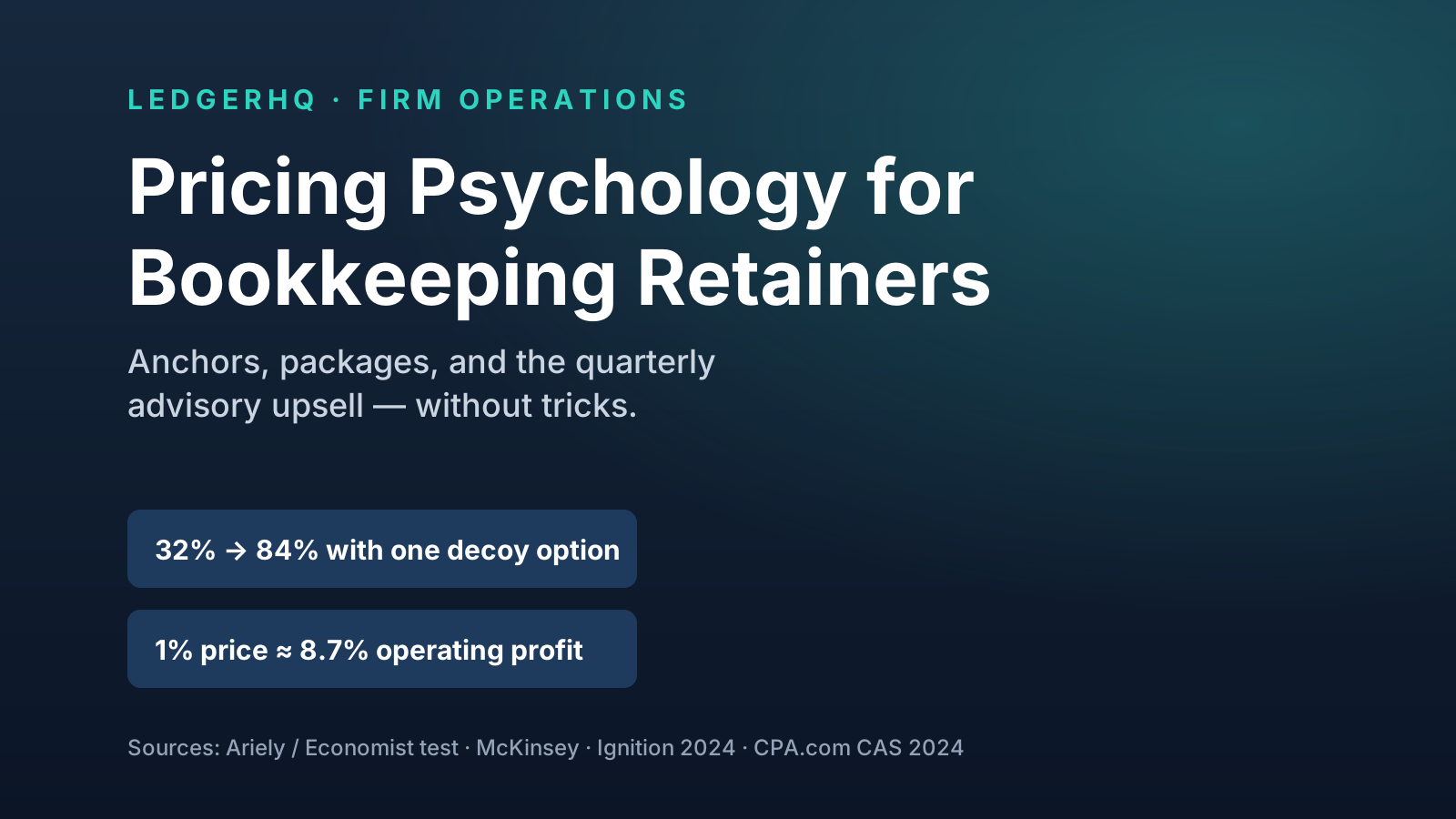
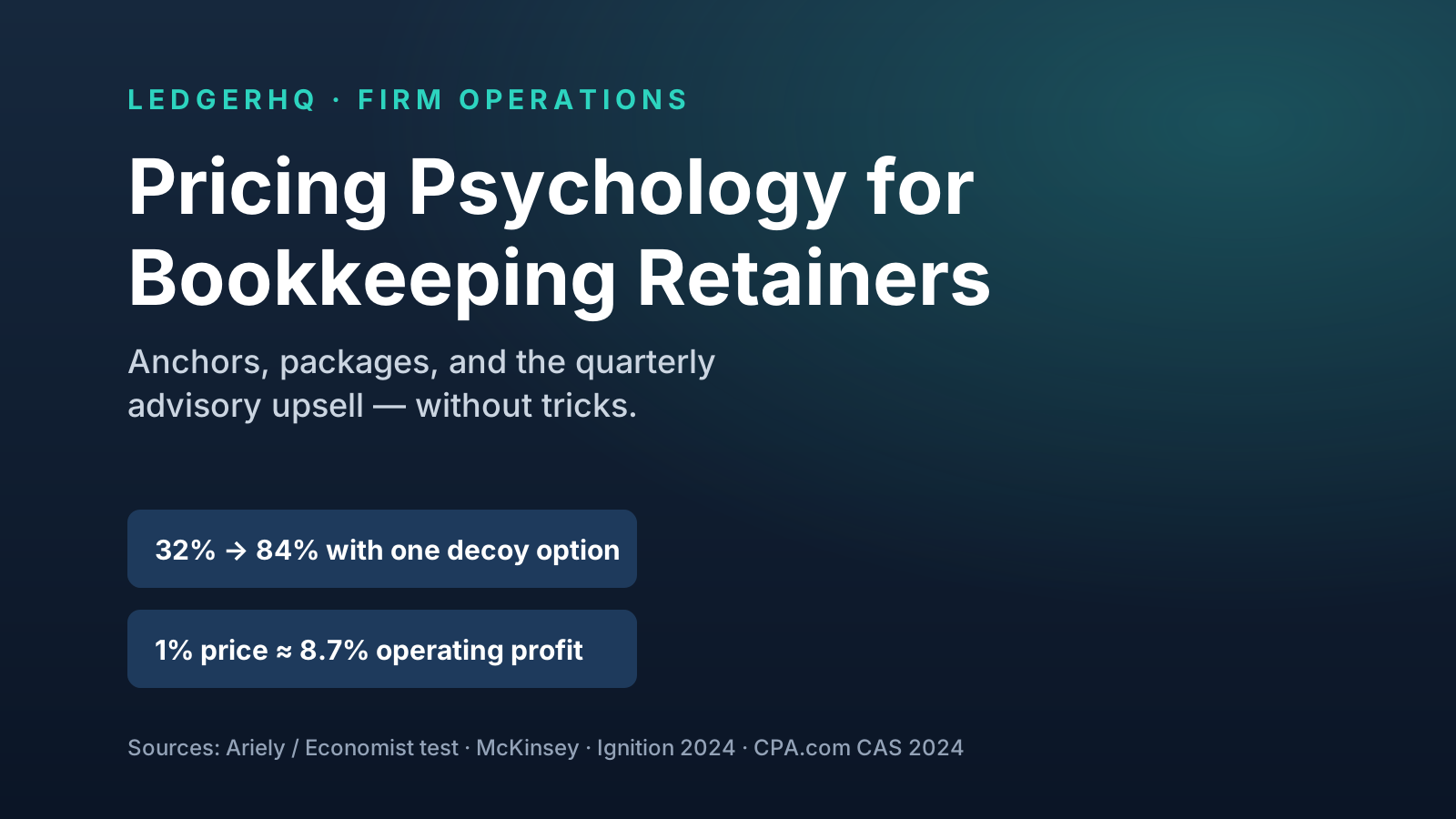
Three findings from the pricing literature do most of the work for a bookkeeping firm. First, the first number in the conversation anchors everything after it: present a credible top package first and the middle package stops looking like a splurge. Second, people disproportionately choose the middle of three options, and a carefully placed comparison option can shift that choice dramatically — in the best-known test, adding one almost-never-chosen option moved the premium choice from 32 percent to 84 percent. Third, the ending of a price is a signal: a 9-ending reads as a deal, a round number reads as premium, and mixing the two signals inside one ladder confuses both.
None of this requires deception. Every package in this article is a real offer, priced to be profitable, that you would be glad to deliver. Psychology here is not a trick layered on top of pricing. It is the presentation layer of pricing you have already done honestly — and the firms in the benchmark data that package well are, not coincidentally, the ones growing advisory revenue fastest.
Why presentation matters more than most firms think
Start with the leverage. McKinsey's analysis of large-company economics found that, volume held constant, a 1 percent improvement in price translated on average into roughly an 8.7 percent increase in operating profit — a larger effect than a comparable improvement in volume or in variable or fixed costs. A bookkeeping firm is not a Global 1200 company, but the arithmetic direction is the same and arguably stronger: a retainer increase falls almost entirely to the bottom line, because the close, the reconciliations, and the review meeting take the same time at $349 a month as they did at $299.
Now look at how firms actually use that lever. Ignition's 2024 U.S. Accounting and Tax Pricing Benchmark, a survey of 345 firm owners and decision-makers, found that 57 percent planned to raise fees across all services in 2025 and 85 percent planned to raise bookkeeping and accounting fees — yet only about 5 percent said they were raising prices in order to grow revenue. The dominant reason, cited by roughly 58 percent, was covering rising costs. In other words, most firms treat price as a cost-recovery dial they turn reluctantly, not as a designed offer a client chooses between.
The same benchmark shows the packaging shift already under way. About 79 percent of respondents used fixed-fee or value-based pricing for bookkeeping and accounting, and only about 8 percent billed bookkeeping hourly. The modal bookkeeping fee sat in a band the survey reports as roughly $250 to $749 a month for a majority of firms. The question for most firms is no longer whether to package. It is whether the packages are structured so a client can actually choose — and choose the tier the firm built its economics around.
That is exactly where the psychology comes in, because a package page is a choice architecture whether you designed it as one or not. The order of the tiers, the gaps between them, which one is labelled, and what each price ends in are all decisions. The only choice you have is whether you make them deliberately.
Anchoring: the first number does the framing
Anchoring is the tendency, first demonstrated systematically by Amos Tversky and Daniel Kahneman in 1974, for an initial number to pull later judgments toward it, even when people know the initial number is arbitrary. In a pricing conversation the anchor is simply the first credible price the prospect encounters. Everything after it is judged as a distance from that number, not on its own terms.
For a bookkeeping firm this has three practical consequences.
Lead with the top package, verbally and on the page. When you walk a prospect through your offers, start with the most complete package and what it includes, then step down. A $599 Complete package presented first makes $349 Plus a relief. Presented in the opposite order, $599 arrives as a shock after $199, and the conversation becomes a negotiation about why the top costs triple the bottom instead of a discussion about which level of help the business needs.
Anchor against the cost of the alternative, not against a competitor's retainer. The honest comparison for most small businesses is not another bookkeeper's $299. It is the owner's own evenings, a part-time hire with payroll taxes and supervision, or the cleanup bill and penalties that arrive when the books are wrong at tax time. Naming that reference point — factually, with the client's own numbers where you have them — frames your retainer against the real status quo.
Never anchor with a price you would not charge. A struck-through list price nobody ever paid, or a top tier stuffed with services no client has ever bought, is not an anchor; it is a credibility risk the prospect can smell. Anchoring works with a real top tier that some clients genuinely choose. In a healthy ladder, the top tier does sell — just to a minority — and that is what makes it a believable reference for everyone else.
The compromise effect: why three packages beat two
Offer a prospect two packages and you have built a yes-or-no decision about money: the cheap one or the expensive one, with the natural pull toward cheap. Offer three and the decision changes shape. Research on the compromise effect, beginning with Itamar Simonson's 1989 work, shows that an option gains share when it becomes the middle of a set — buyers avoid extremes because the middle is the easiest choice to justify to themselves and to a partner or co-owner. Extremeness aversion is not irrationality; for a business owner who cannot fully evaluate bookkeeping quality in advance, the middle package is a reasonable risk hedge. Your job is to make sure the middle is the package your economics are built on.
A workable ladder has a specific geometry:
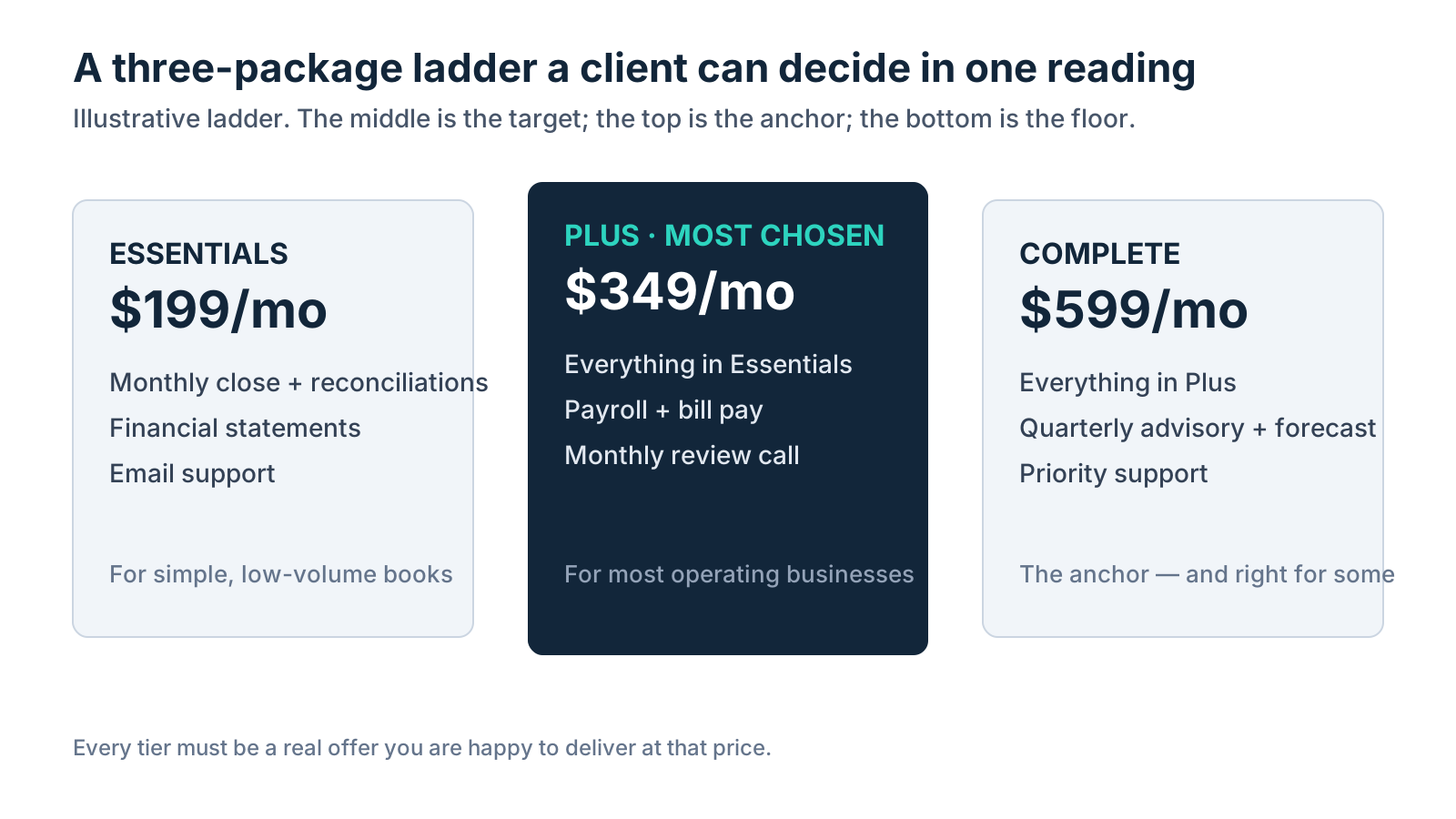
- The floor (Essentials). A genuinely useful, tightly scoped package: monthly close, reconciliations, financial statements, email support. It exists so a price-sensitive prospect has somewhere to land that is not a competitor, and so the middle has something to be compared against. It must be profitable at its price — a floor you lose money on is a leak, not a ladder.
- The target (Plus). Everything in the floor, plus the services most operating businesses actually need next: payroll coordination, bill pay, and a monthly review call, as in the illustrative ladder below. This is the package you design staffing, capacity, and margin around, and the one most clients should land on.
- The anchor (Complete). Everything in Plus, plus the forward-looking work — quarterly advisory and a forecast, priority access. Priced far enough above Plus that Plus looks measured, close enough that a larger client recognizes it as the right buy rather than theatre.
Mind the ratios. If the target is roughly one and a half to two times the floor, and the anchor roughly one and a half to two times the target, each step reads as a considered upgrade. Compress the gaps and the tiers blur into one price with three names. Stretch them too far and the anchor stops being credible, which silently kills the framing effect for the whole page.
One more design rule: differentiate by outcome and contact, not by withholding the basics. Every tier should produce accurate, reconciled books — that is the profession, not an upgrade. What scales across tiers is speed, scope around the books (payroll, payables, sales tax), frequency of conversation, and how far forward the work looks. A floor package that deliberately delivers sloppy books to push upgrades will produce churn and referrals of the wrong kind.
The decoy effect: a comparison option, used honestly
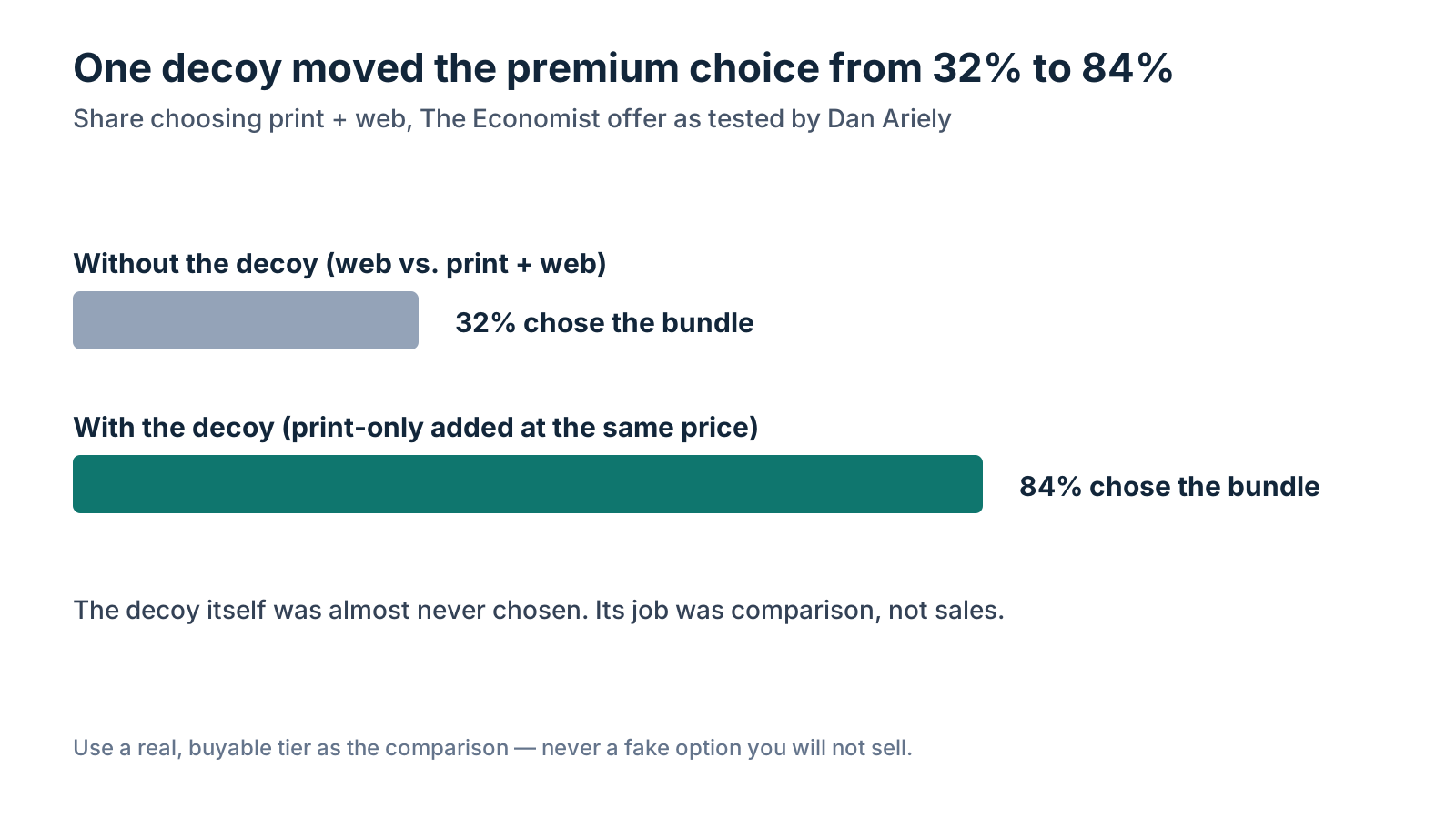
The decoy, or attraction, effect was identified by Joel Huber, John Payne, and Christopher Puto in 1982: adding an option that is clearly worse than one existing option — but not clearly worse than the other — shifts share toward the option it flatters. The famous illustration is the Economist subscription offer popularized by Dan Ariely. Shown a web-only subscription and a combined print-and-web subscription, about 32 percent of test participants chose the combined offer. Add a third option — print-only, at the same price as the combined offer — and the combined share rose to about 84 percent. Almost nobody chose the print-only option itself. It existed to make the combined offer's value legible at a glance: for the same money, strictly more.
Translate that carefully into a retainer ladder. Suppose your target is Plus at $349, which includes the monthly review call. A decoy variant might be a package at $329 that includes everything in Plus except the review call and priority response — a real, buyable package, priced close enough to Plus that the missing pieces cost far more than the $20 saved. Prospects who compare the two do the arithmetic you want them to do: the full package is obviously the better buy. Some firms implement this as a named tier; others implement it inside the sales conversation as the documented cost of removing items from the target package — each removal saving surprisingly little, because the expensive part of bookkeeping is the close itself, not the extras around it.
Two guardrails keep this honest. First, the decoy must be a package you will actually sell and deliver at the stated price, to a client who insists on it, without resentment. Second, never build a decoy out of degraded core work. The legitimate decoy differs in scope around the books — meetings, turnaround, advisory — never in the accuracy of the books themselves.
Expect a smaller effect than 32-to-84 in the wild. That figure comes from a controlled test with a stark, same-price contrast; later replications across many product categories have found the attraction effect to be real but context-dependent. Treat decoys as one nudge among several in a well-built ladder, not as a lever that triples upgrades on its own.
Charm pricing, round pricing, and what the ending signals
Prices ending in 9 are the oldest tool in this article, and the evidence for them is unusually concrete. In field experiments published by Eric Anderson and Duncan Simester in 2003, catalog items with 9-endings sold better than the same items at other prices — in the best-known result, a dress priced at $39 outsold the same dress at $34, a higher price beating a lower one because of the ending alone. Two mechanisms are usually offered. The left-digit effect, documented by Manoj Thomas and Vicki Morwitz in 2005, is that readers process a price left to right and overweight the first digit, so $199 registers first as one-hundred-something rather than nearly two hundred. The second is signalling: shoppers have learned to read a 9-ending as this is priced to sell, and a round ending as full price.
That second mechanism is why the standard advice — always use charm pricing — is wrong for half of a bookkeeping ladder. A 9-ending signals a deal, which is exactly right for a volume Essentials and Plus ladder competing on value. It is the wrong signal for an advisory or fractional-CFO tier, where the buyer is purchasing judgment and confidence and a bargain signal undercuts the positioning. Premium services across industries tend toward round numbers for this reason: $500 a month for a quarterly advisory package reads as a professional fee; $499 reads as a promotion.
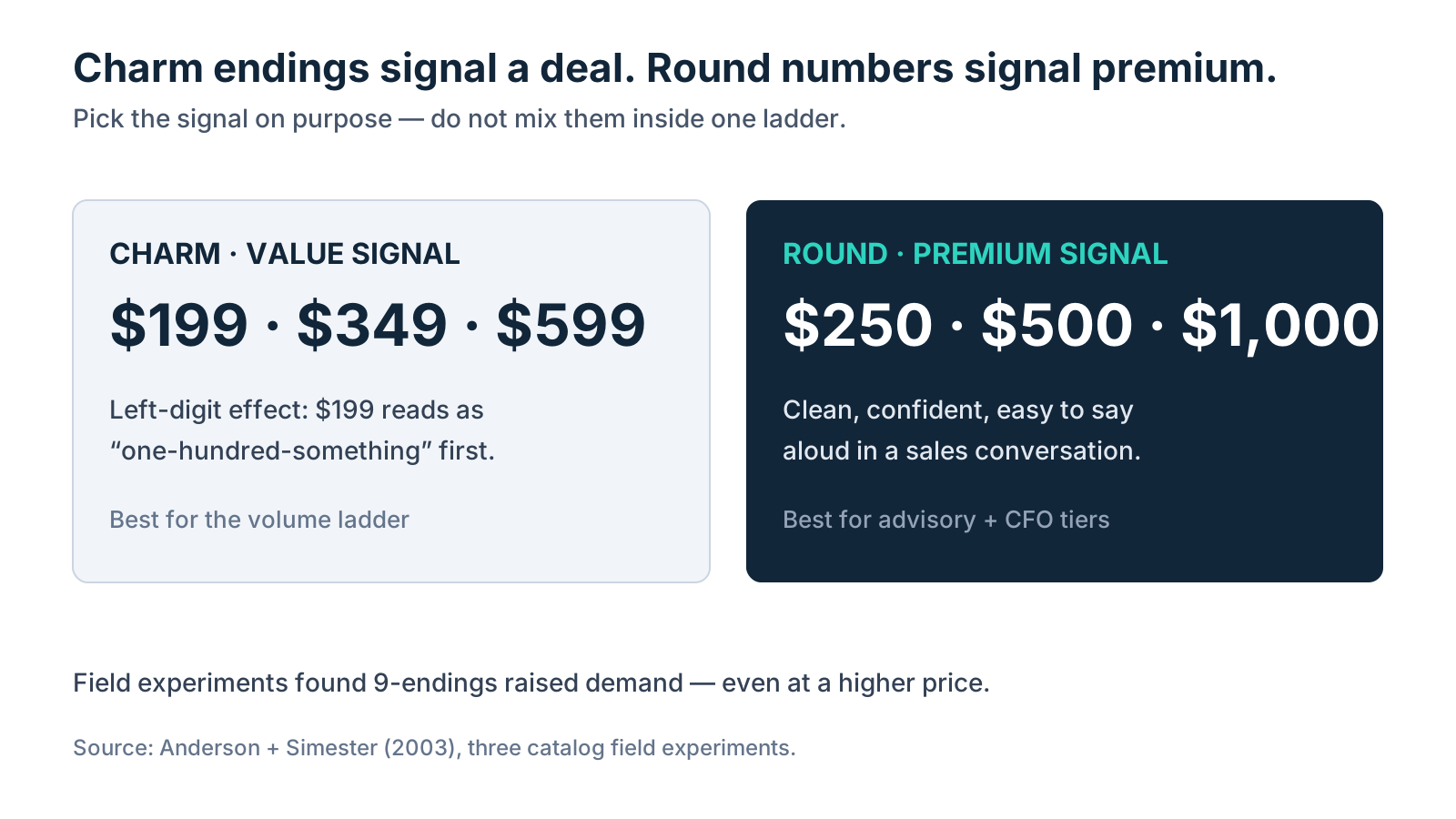
So pick per tier, and be consistent inside a tier family. A practical pattern: charm endings on the bookkeeping ladder ($199, $349, $599), round numbers on advisory and project work ($500 quarterly review package, $1,500 cleanup assessment, $250 an hour-equivalent fixed diagnostic). And do not overlook the spoken form: you will say these prices aloud on sales calls. A price that is awkward to say gets rounded by the prospect anyway — usually up in their memory when they repeat it to a partner, which is the one rounding direction you do not want.
The quarterly advisory upsell: where the ladder leads
Everything above fills the ladder. The quarterly upsell is where the ladder pays a second time, and it works because of timing and trust rather than any pricing device. A client who has received three clean monthly closes and three readable financial statements from you has evidence — their own — that your numbers can be trusted. The quarterly review is the natural moment to ask the forward-looking question the monthly close keeps raising: given these margins, this cash pattern, and this tax picture, what should change next quarter?
The industry context is that advisory is where firm growth is concentrating. CPA.com and the AICPA's 2024 CAS Benchmark Survey, covering more than 200 firms with client advisory services practices, reported a median CAS growth rate of 17 percent, with respondents projecting their CAS revenue to roughly double — a projected median increase of 99 percent — over the following three years. Median net client fees per professional rose to $156,250, up 29 percent over the 2022 survey, and firms earning significant revenue from CFO-level and business-insights work reported more than 30 percent higher monthly recurring revenue than peers. Wolters Kluwer's 2025 Future Ready Accountant survey of 2,768 professionals found more than nine in ten U.S. firms now offering advisory services in some form. The direction of the profession is not in dispute. The open question for a small firm is the mechanism — and a package ladder with a quarterly step is the simplest mechanism there is.
Price the upsell as its own package, not as an hourly add-on. A fixed quarterly advisory package — review meeting, forecast update, tax-planning checkpoint, one agreed action list — at a round, premium-signalling price does three things an hourly offer cannot. It can be added to the existing retainer in one sentence. It renews automatically with the retainer instead of being re-sold every quarter. And it anchors the next conversation: a client on a $500-a-quarter advisory package is comparing your eventual CFO-tier offer against $500, not against zero.
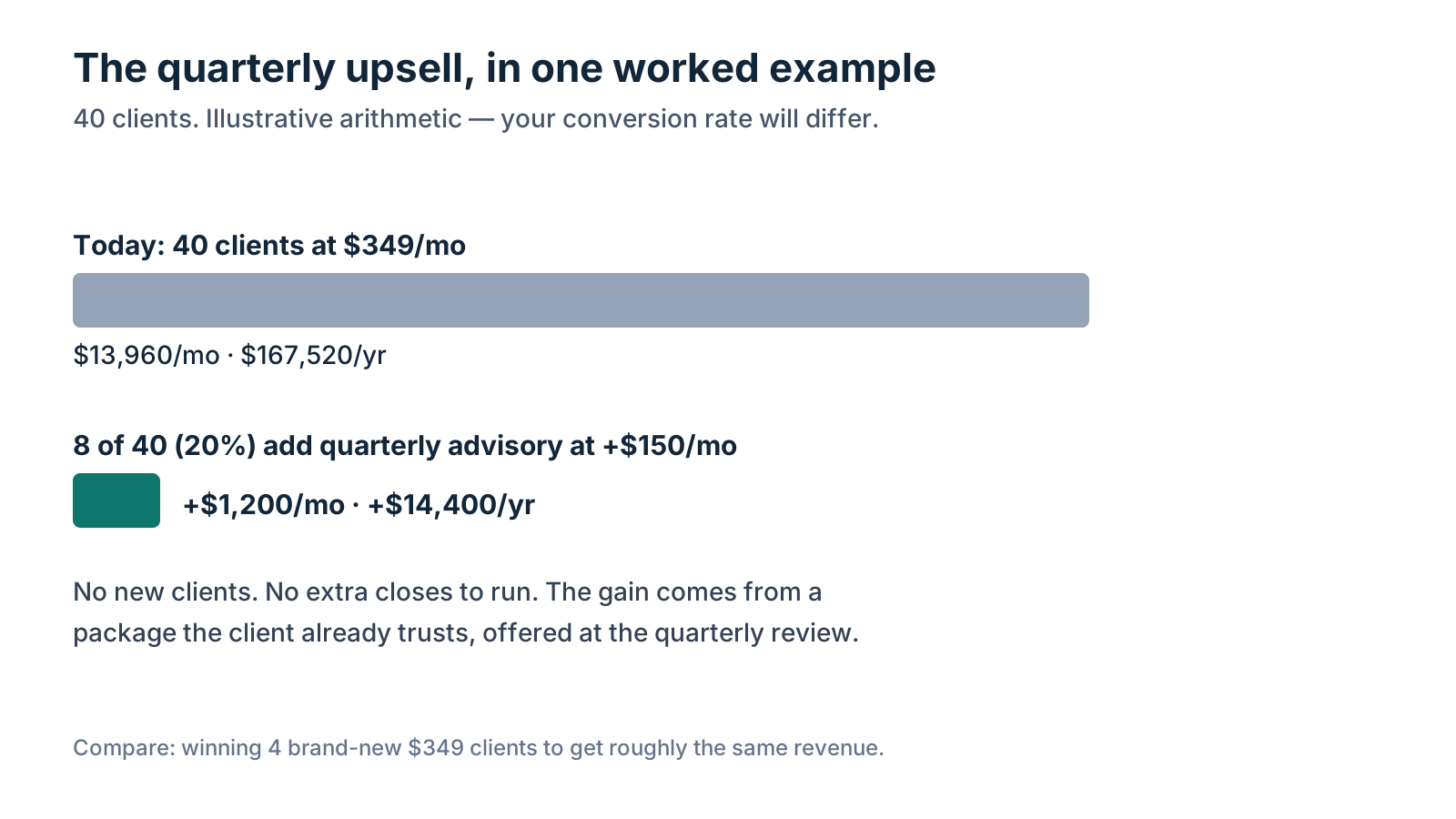
Now the arithmetic, kept deliberately plain. Take a firm with 40 clients on a $349 Plus package: $13,960 a month, $167,520 a year, before any advisory. Offer the quarterly advisory package at the quarterly review — priced here as the equivalent of $150 a month — and suppose a modest one in five clients says yes. That is 8 clients, an extra $1,200 a month, $14,400 a year, from clients already onboarded, already trusting the books, with no new closes to perform and no new-client cleanup to absorb. To get the same revenue from new Plus clients you would need to win, onboard, and clean up roughly four additional businesses. Most firms find the upsell conversation — held at a meeting that already exists, about numbers the client has already seen — considerably easier than four new sales.
Sequence matters. Do not sell advisory at signing, when the client has no evidence yet and the total price is the only thing they can evaluate. Sell the bookkeeping ladder at signing, deliver three months of clean closes, and put the advisory package on the agenda of the first quarterly review, framed by one specific observation from their own books — a margin drift, a cash pinch that repeats, a tax estimate that needs a decision. The observation is the offer. The package is just how they pay for more of it.
Putting it on the page and in the conversation
A few presentation details carry an outsized share of the effect, and all of them are cheap to get right.
Order and emphasis. List packages with the target visually centred and marked for what it is — most chosen, if that is true — and walk through the top package first in conversation. Default matters: the tier you present as the normal choice becomes the normal choice.
Name packages for the buyer, not the work. Essentials, Plus, and Complete describe a level of help. Bronze, Silver, and Gold describe medals. Client-outcome names (Steady, Growth, Full Finance Team) can work for advisory-heavy firms, provided each name still makes the scope jump obvious at a glance.
Show the annual shape once, honestly. A monthly retainer is already the friendliest framing in professional services — use it, and show the annual total plainly beside it. Prospects who discover the annual number later, in a contract, re-open a decision they thought was closed.
One decision at a time. The signing flow should ask for a package choice, then engagement, then payment — not all three as one wall of commitment. Each small yes, made with the ladder still visible, keeps the anchor working while the paperwork proceeds.
This is also where your tooling either supports the ladder or quietly fights it. Verified on LedgerHQ's live site tonight: the product's pricing-and-onboarding flow presents the firm's packages for the client to choose, then takes them through signing and payment and into onboarding in one connected experience, and its engagements flow builds the agreement, collects the signature, saves the payment method, and bills the chosen package on schedule. That matters for pricing psychology in a concrete way — the ladder you designed is the ladder the client actually sees at the moment of choice, unchanged by a PDF proposal and a separate payment link. LedgerHQ is priced at $20 per client, with a Free Preview running until January 1, 2027, and its Academy includes a pricing and packaging course built around offering three packages. Use whatever stack you have, but audit the actual signing path a prospect walks: if the packages disappear after the sales call and the client next sees a lone invoice total, you have thrown away the framing the ladder was built to create.
The ethics line, stated plainly
Every technique in this article has a manipulative twin, and the line between them is not subtle. Anchoring with a real top tier is presentation; anchoring with a price nobody pays is fabrication. A decoy that is a genuine, deliverable package is choice architecture; a decoy designed to be quietly swapped or downgraded after signing is a bait-and-switch. Charm pricing on a real price is formatting; a perpetual fake discount off a list price that never applied is a false claim — and, for the accountants reading this, a professional-standards problem as well as a legal one in many jurisdictions.
There is also a practical reason to stay on the right side of the line, beyond the obvious ones. Bookkeeping retainers are trust products sold into long relationships and small professional communities. A client who feels steered into the wrong tier does not usually complain; they churn at the next renewal and describe the experience to two other business owners. The firms compounding advisory revenue in the benchmark data are doing it on retention and expansion of clients who stay — which is the one outcome manipulation reliably destroys. Use psychology to make a fair offer easy to understand and easy to choose. That is the whole brief.
A two-week rebuild, step by step
You do not need a rebrand to use any of this. Most firms can rebuild their ladder in two weeks of spare hours.
Days 1–2: cost the floor. Take your current average client and cost the monthly close honestly — hours by task, at the rate of the person who does them. Your Essentials price must clear that cost with margin at your target utilization. If it cannot, the floor is scope, not price: remove work from Essentials before you discount it.
Days 3–4: build the three tiers. Write each tier as a scope list a prospect can compare in under a minute. Set the target at roughly one and a half to two times the floor, the anchor at roughly one and a half to two times the target, and check each tier is deliverable and profitable on its own. Add the decoy variant of the target only if you can describe, in one sentence, the real client who would rationally buy it.
Day 5: set the endings. Charm endings on the bookkeeping ladder, round numbers on advisory and projects. Say every price out loud. Fix any that stumble.
Days 6–8: fix the surface. Rebuild the pricing page and proposal in the order clients decide: top tier described first, target centred and marked, annual total shown once beside the monthly price, one decision per step in the signing flow. Then walk your own signing path as a prospect, on a phone, and note every place the ladder disappears.
Days 9–10: script the quarterly upsell. Pick the existing clients with three or more clean closes. For each, write the one observation from their books that opens the advisory conversation. Put the fixed quarterly package — price, contents, and the sentence that adds it to the retainer — on the review agenda template.
Days 11–14: run it and measure. Present the new ladder to every new prospect, and the advisory package at every quarterly review in the window. Track three numbers only: share of new clients landing on the target tier, advisory attach rate at quarterly reviews, and average monthly revenue per client against the month before the rebuild. If the target share is not the plurality within a quarter, the ladder geometry — not the traffic — is the first thing to revisit.
FAQ
How many packages should a bookkeeping firm offer? Three for the core bookkeeping ladder is the reliable default: a floor, a target, and an anchor. It is the smallest set that creates a genuine middle for the compromise effect to work on. Add separate fixed packages for advisory and one-off projects rather than a fourth and fifth retainer tier, which tends to blur the comparison the ladder depends on.
Should the middle package always be the one I want to sell? Yes — that is the design. The compromise effect pulls buyers toward the middle, so the middle should be the package your staffing, capacity, and margin are built around. If your current clients cluster on your cheapest tier, the usual cause is a middle tier priced or scoped so close to the floor that there was no real decision to make.
Is a decoy package dishonest? Not if it is a real offer. A decoy variant must be buyable at the stated price, deliverable at a profit, and different only in scope around the books — meetings, turnaround, advisory — never in the accuracy of the core work. If you would be annoyed to actually sell it, it is not a decoy, it is a prop, and it should come off the page.
Charm pricing or round pricing for a $350 retainer? For a bookkeeping ladder competing on value, the charm form — $349 — carries the deal signal and the left-digit effect. Reserve round numbers for the tiers where you want a premium signal: advisory packages, diagnostics, and CFO-level work. Do not mix signals randomly across one ladder; each family of prices should be internally consistent.
When should I offer the advisory upsell? At the first quarterly review after three clean monthly closes, not at signing. The client needs their own evidence that your numbers are trustworthy before forward-looking advice has any weight, and the quarterly review gives you a specific observation from their books to open with. Price it as a fixed package added to the retainer, not as hourly time.
What if a prospect only ever asks for the cheapest tier? Sell it gladly, provided the floor is profitable — that is what it is for. Then let the delivery do the upselling: a floor client who hits the limits of the floor (a payroll question with no meeting to ask it in, a cash squeeze with no forecast) has discovered the target tier's value from experience, which is the most durable reason to upgrade there is.
Sources
- Tversky, A. and Kahneman, D. — Judgment under Uncertainty: Heuristics and Biases, Science, 1974. The original anchoring demonstration. https://www.science.org/doi/10.1126/science.185.4157.1124
- Huber, J., Payne, J. W. and Puto, C. — Adding Asymmetrically Dominated Alternatives, Journal of Consumer Research, 1982. The first attraction (decoy) effect study.
- Simonson, I. — Choice Based on Reasons: The Case of Attraction and Compromise Effects, Journal of Consumer Research, 1989. The compromise effect.
- Ariely, D. — Predictably Irrational, 2008, reporting The Economist subscription test (32 percent without the decoy, 84 percent with it).
- Anderson, E. T. and Simester, D. I. — Effects of $9 Price Endings on Retail Sales, Quantitative Marketing and Economics, 2003. Three catalog field experiments; the $39 dress outsold the $34 dress.
- Thomas, M. and Morwitz, V. — Penny Wise and Pound Foolish: The Left-Digit Effect in Price Cognition, Journal of Consumer Research, 2005.
- McKinsey and Company — Using Big Data to Make Better Pricing Decisions, 2014. A 1 percent price increase translating to about an 8.7 percent operating-profit increase, volume held constant. https://www.mckinsey.com/capabilities/growth-marketing-and-sales/our-insights/using-big-data-to-make-better-pricing-decisions
- Ignition — 2024 U.S. Accounting and Tax Pricing Benchmark, November 6, 2024 (survey of 345 firms). https://www.ignitionapp.com/news/ignitions-pricing-benchmark-uncovers-shift-among-u-s-accounting-firms-toward-price-increases
- CPA.com and AICPA PCPS — 2024 CAS Benchmark Survey, December 9, 2024 (more than 200 firms; median CAS growth 17 percent, projected 99 percent growth over three years, net client fees per professional $156,250). https://www.cpa.com/news/aicpa-and-cpacom-benchmark-survey-client-advisory-services-cas-practices-report-17-growth
- Wolters Kluwer — 2025 Future Ready Accountant report, October 2025 (2,768 professionals; advisory now offered by more than nine in ten U.S. firms). https://www.businesswire.com/news/home/20251008689553/en/Wolters-Kluwer-releases-its-2025-Future-Ready-Accountant-report-highlighting-key-trends-in-the-global-tax-accounting-industry
- LedgerHQ — ledgerhq.ai, accessed October 13, 2026. Package-based pricing and onboarding flow, engagements and recurring billing, $20 per client, Free Preview until January 1, 2027.