
Firm operations
Revenue Recognition Basics for Service Businesses: When Work Becomes Income
Revenue isn't cash — it's earned when promised services transfer. The ASC 606 five-step model in plain English, the four billing models and when each recognizes revenue, why service firms leak 4.3% of revenue before it reaches the bank, a worked $120,000 project shown three ways, and the deferred-revenue entries every retainer business should run.

The short answer
Revenue is not cash. Revenue is the value you delivered to a customer — and accounting says you book it when you deliver the service, not when the money lands. A $60,000 annual retainer paid in January is not $60,000 of January revenue; it is $5,000 of revenue per month for twelve months, with the rest sitting on the balance sheet as a liability called deferred revenue until you earn it.
The authoritative framework behind that sentence is ASC 606 (IFRS 15 internationally): the revenue standard the Financial Accounting Standards Board and the International Accounting Standards Board jointly issued as ASU 2014-09, creating a single five-step model that replaced hundreds of industry-specific rules (Salesforce). The core principle fits in one line: recognize revenue when you transfer the promised goods or services to the customer, in the amount you expect to receive (JFW Accounting, CPA). Every step that follows is bookkeeping in service of that principle.
This matters for service businesses more than the standard's enterprise origins suggest, for three reasons. First, most small service businesses keep cash-basis books — roughly 10% of small business owners in Bench's survey of ~1,100 were even doing cash bookkeeping with accrual filing — so their P&L reports cash flow dressed up as profit (Bench, 2016). Second, service firms routinely sell four different billing models (hourly, fixed-fee, retainer, milestone) that each recognize revenue on a different schedule; 85% of digital agencies work primarily on retainer (SparkToro, 2025), which is the model most likely to be booked wrong. Third, recognition is only half the battle: professional services firms leak an average of 4.3% of revenue — earned but never realized — through unbilled time, scope creep, and rate drift (GRF CPA). You can get the accounting perfect and still lose the money.
This article walks the whole thing from the owner's seat: the five-step model in plain English, the cash-basis trap, over-time versus point-in-time recognition, the four billing models and their patterns, a worked $120,000 project shown three ways, the leakage data, the late-payment reality that follows recognized revenue, and the deferred-revenue entries every retainer business should run. It ends with an honest accounting of where LedgerHQ fits — and where it doesn't.
The five-step model, in plain English
ASC 606 organizes every revenue decision into five steps (JFW Accounting; Salesforce). Run them against a concrete example: a $60,000 consulting engagement with a $55,000 fixed fee plus a $5,000 bonus the client will "probably" pay if a milestone is hit.
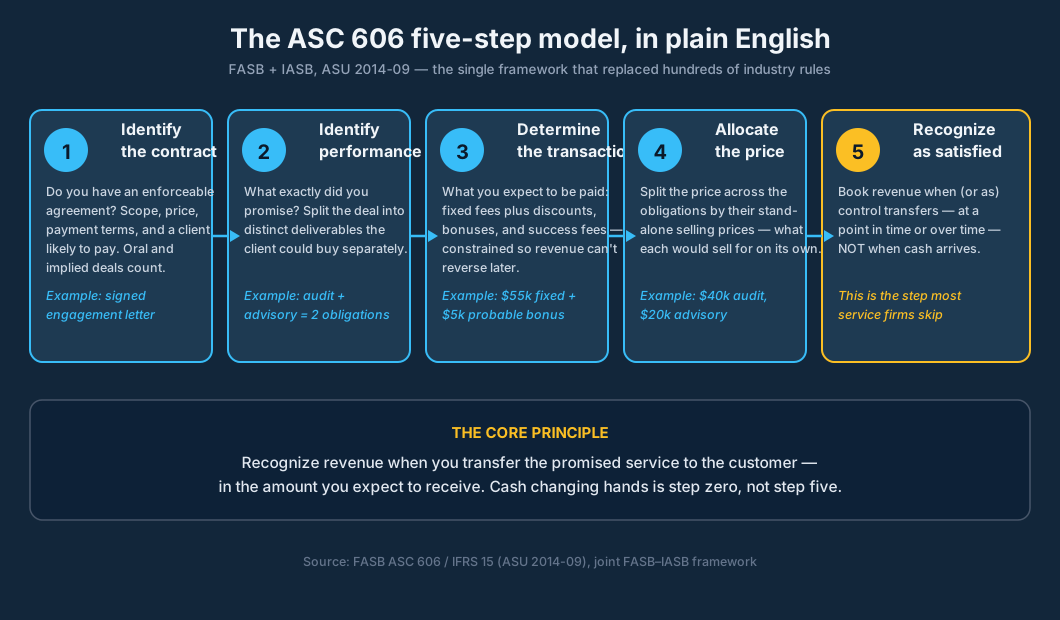
Step 1 — Identify the contract. A contract exists when the parties have approved the agreement, each party's rights are identifiable, payment terms are clear, the contract has commercial substance, and collection is probable (JFW Accounting). Contracts can be written, oral, or implied through customary business practices. For the service business, this is the signed engagement letter — and the discipline here is that a handshake scope agreement is a weaker contract than it feels like. The firms that leak revenue to scope creep (about 25% of all leakage, per the analysis below) usually lost step 1 before they started.
Step 2 — Identify the performance obligations. A performance obligation is a distinct good or service promised to the customer — distinct meaning the customer can benefit from it on its own or with other readily available resources (JFW Accounting). Our $60,000 engagement might actually be two obligations: a diagnostic audit ($40,000 standalone value) and three months of advisory ($20,000 standalone). Why it matters: if the client cancels the advisory after month one, you know exactly how much revenue was attached to the part you delivered versus the part you didn't.
Step 3 — Determine the transaction price. This is the amount you expect to receive: fixed amounts plus variable consideration like discounts, rebates, and bonuses (JFW Accounting). Our engagement's price is $55,000 fixed plus the $5,000 bonus — but variable consideration comes with a constraint: you only include it if a significant reversal of revenue is not probable. The bonus you "probably" get does not belong in the transaction price until it clears that bar. This is the step where optimistic pricing quietly becomes overstated revenue.
Step 4 — Allocate the transaction price. When the contract has multiple obligations, split the price by relative standalone selling price (JFW Accounting). $40,000 of standalone value against $20,000 gives a 2:1 split — so $40,000 of the $60,000 transaction price attaches to the audit and $20,000 to the advisory. If standalone prices aren't directly observable, you estimate them (cost-plus-margin, market assessment, or residual approaches).
Step 5 — Recognize revenue when (or as) obligations are satisfied. This is the step the article is about: revenue lands when control of the service transfers — at a point in time or over time (Salesforce). Everything before it was setup; this is the judgment call most service businesses never make deliberately, and the next two sections exist because of it.
The cash-basis trap
Most small service businesses keep cash-basis books because cash basis is simple: record revenue when cash arrives, expenses when cash leaves (Bench). The IRS lets most of them do it — under Section 448(c), a business qualifies as a "small business taxpayer" with average annual gross receipts of $31 million or less for the three prior tax years (tax years beginning in 2025; IRS Publication 334). Below that line, sole proprietors, S corporations, and partnerships without C corporation partners can generally use the cash method for tax.
But cash-basis books for a service business hide three things that matter:
- Earned but unbilled revenue. You did the work in March and invoiced in April. Your March P&L shows the labor cost and none of the revenue. Multiply by a dozen projects and your monthly P&L is a random number generator.
- Invoiced but unpaid revenue. The invoice went out; the client pays in 60 days (or, per the data below, far longer). Cash basis shows nothing until payment, so a growing AR balance — your actual sales effort — is invisible.
- Collected but unearned revenue. The retainer client paid January's $5,000 along with eleven more months upfront. Cash basis books $60,000 in January, and January looks like your best month ever while February through December look inexplicably weak.
Bench's finding that roughly 10% of surveyed owners were keeping cash books but filing on accrual (2016) tells you how common the mismatch is: the tax return and the management books literally tell different stories, and the owner runs the business on the wrong one.
None of this means cash basis is wrong. It is the right choice for a large share of small service businesses, and the IRS blesses it. The trap is not the method — it is not knowing what the method hides. The moment a business needs to answer "how much did we actually earn in March," it needs accrual thinking, whether or not it formally switches methods. And lenders and investors strongly prefer accrual-basis statements, which show accounts receivable and payable and match revenue with the expenses that produced it.
Over time or at a point in time?
Step 5's central question: does the service transfer all at once, or gradually? ASC 606 answers with three tests (ASC 606-10-25-27; Grant Thornton's navigational guide). Revenue is recognized over time if any one is met; otherwise it is recognized at a point in time.
- The customer simultaneously receives and consumes the benefits as you perform. This is the service-business workhorse. The standard's own example is a routine or recurring service — a cleaning service — where the customer consumes the benefit the moment it is delivered (ASC 606-10-55-5). A monthly bookkeeping engagement, a SaaS subscription, an ongoing advisory retainer: the client gets value every day, so revenue accrues every day.
- Your performance creates or enhances an asset the customer controls. A contractor renovating the client's building: the client controls the work-in-progress as it improves.
- Your work has no alternative use to you, and you have an enforceable right to payment for work completed to date. Custom-built deliverables — a bespoke software build the client can cancel but must pay for through the cancellation date — often land here.
If none of the three is met, recognition waits for the transfer point: the finished website goes live, the completed tax return is delivered, the training is taught. Note the discipline this imposes on fixed-fee projects: a $60,000 website delivered in month six is not $10,000 per month of revenue unless the contract gives you an enforceable right to payment along the way. Absent that, the honest answer is $0, $0, $0, $0, $0, $120,000 — five months of cost with no revenue, then one enormous month. That is not an accounting failure; it is what the economics actually were. The failure is being surprised by it.
The four billing models and their recognition patterns
Service businesses sell their work four ways, and each one draws a different revenue curve — even for identical totals.
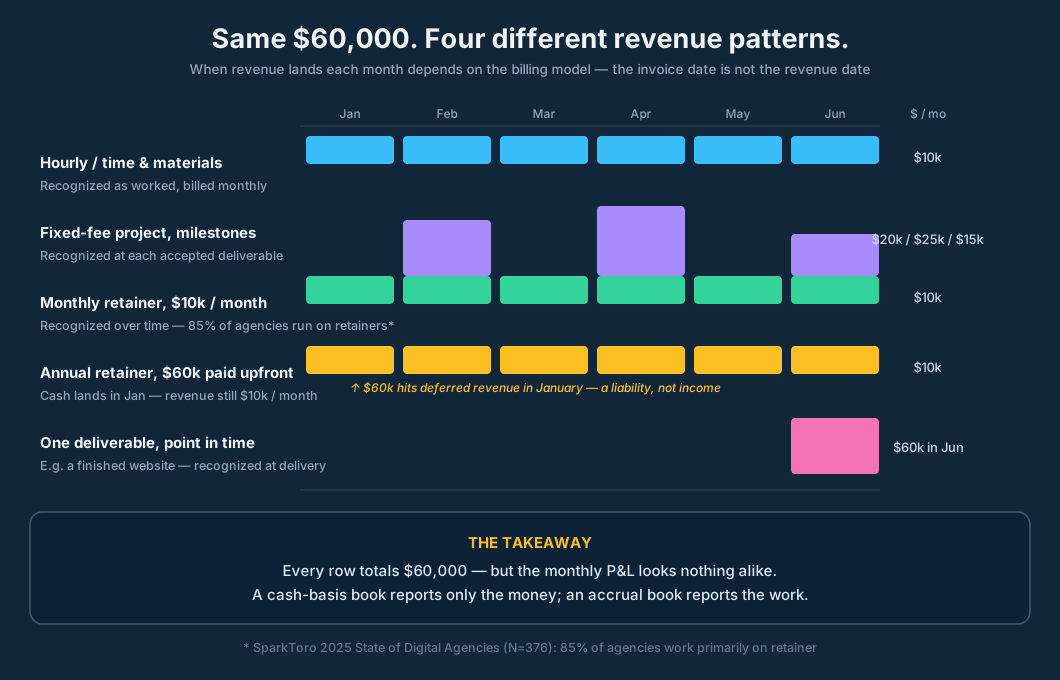
Hourly / time and materials. Revenue is recognized as the work is performed — the first over-time criterion, satisfied continuously. Billing follows monthly or biweekly, and invoicing and recognition stay roughly in sync. The risk here is not timing; it is leakage (below).
Fixed-fee project. Revenue attaches to milestones or measured progress. A $60,000 build with $20,000 / $25,000 / $15,000 milestones recognizes $20,000 when the client accepts milestone one, and so on. The contract-asset account (sometimes called unbilled WIP) captures work performed but not yet invoiced; it keeps the income statement aligned with delivery instead of forcing every period to follow the invoice date (MyOfficeOps).
Retainer / subscription. Recognized over time, typically straight-line: $10,000 a month for a $10,000 monthly retainer. Here is the fact most agencies miss: billing frequency does not change revenue. A subscription business analysis makes the point sharply — monthly, annual, and three-year contracts at the same monthly price all produce the same monthly revenue line; what changes is the size of the deferred revenue balance and the tax position, not the revenue (GATP Solutions, 2026). This is the dominant model in agency-land: 85% of digital agencies in SparkToro's 2025 survey (N=376) work with clients primarily on retainer, with 49% averaging $1,000–$5,000 per month and 31% at $5,000–$10,000 (SparkToro, via digital.marketing). Fee-based compensation keeps climbing industry-wide — 82% of marketers now use fee-based models, up from 68% in 2016 (ANA's 18th Trends in Agency Compensation). The model the industry runs on is the model most likely to be booked as cash.
Milestone with deposit / point-in-time delivery. The deposit is not revenue — it is a liability (deferred revenue) the day it arrives. Revenue waits for delivery or acceptance. The firms that book deposits as income are borrowing profit from their future selves, and the correction always arrives in the slowest month.
Worked example: one $120,000 project, three books
Take a website build: $60,000 deposit in January, $60,000 paid at delivery in June, work spread evenly across the six months. Same project, same $120,000, same cash. Now watch what three recognition policies do to the story.
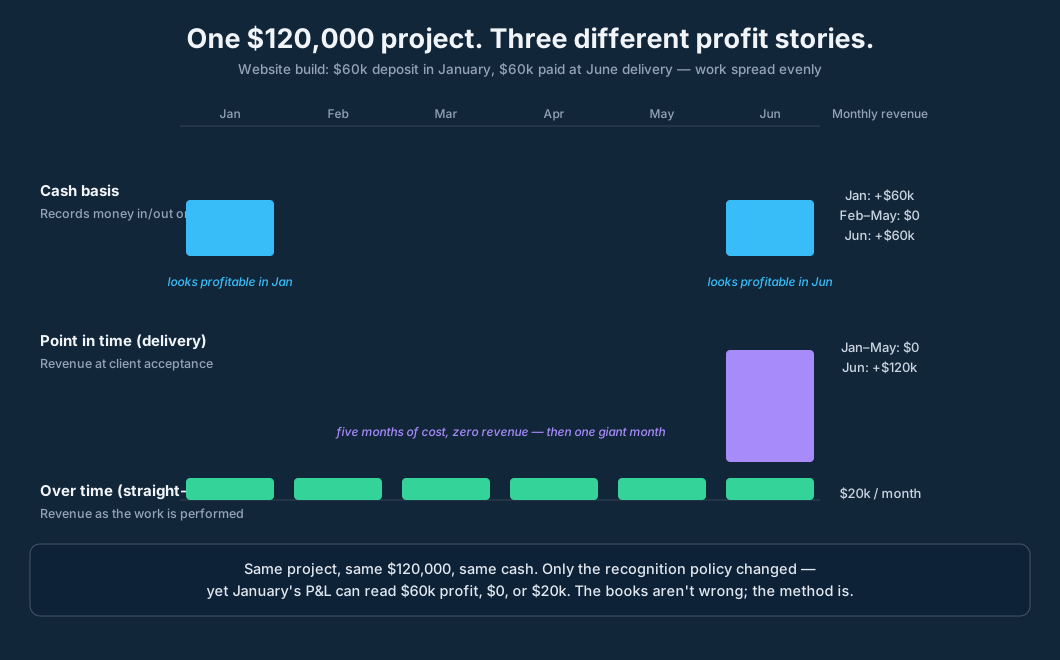
| Month | Cash basis | Point in time (delivery) | Over time (straight-line) |
|---|---|---|---|
| Jan | $60,000 | $0 | $20,000 |
| Feb | $0 | $0 | $20,000 |
| Mar | $0 | $0 | $20,000 |
| Apr | $0 | $0 | $20,000 |
| May | $0 | $0 | $20,000 |
| Jun | $60,000 | $120,000 | $20,000 |
Cash basis says January was a $60,000 month — it was a $20,000 month with a $40,000 unearned liability attached. Point-in-time says the team produced nothing for five months and then had the best month in company history — the team worked steadily; the revenue was just waiting for acceptance. Over-time recognition is the only version where the P&L matches the economics, and it is available precisely because routine services satisfy the first over-time criterion.
Now put costs next to it. Suppose the project costs $15,000 a month in labor. Under cash basis, January shows a $45,000 "profit" and February shows a $15,000 "loss" — the owner celebrates, then panics, then celebrates again, all over an accounting artifact. Under over-time recognition, every month shows a $5,000 profit, which is what actually happened. The recognition policy is not a technicality. It is the difference between a P&L you can steer by and one that lies to you monthly.
The leaks that eat recognized revenue
Here is the uncomfortable second act: getting recognition right does not mean you get the money. Professional services firms leak an average of 4.3% of revenue — revenue earned but never realized — and the range by service type runs from just over 3.3% (management consulting) to more than 6% (software implementation teams), per survey data compiled by GRF CPA. On a $1 million firm, 4.3% is $43,000 a year. Gone, not disputed — evaporated.
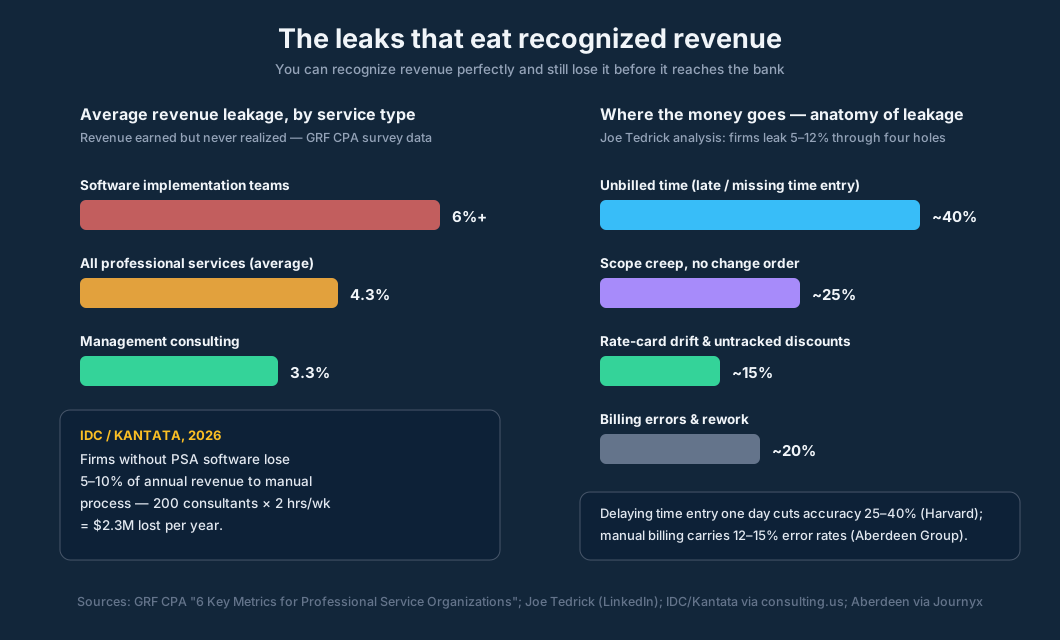
The anatomy is consistent. In one analysis of where the 5–12% total leakage goes, unbilled time is the biggest hole by far — around 40% (Joe Tedrick, via LinkedIn). This is the quiet killer: time worked that never makes it onto an invoice. The number-one cause is delayed time entry — a Harvard study found that delaying time entry by even a single day drops accuracy 25 to 40%, and research found 22% of professionals record less than 70% of the time they spend on client work. Friday-afternoon timesheets reconstructed from memory are not a record; they are fiction, and the fiction always underestimates.
Scope creep without change orders accounts for roughly 25%. "Can you also look at this?" A two-hour addition on a 200-hour project is 1% — absorb one of those a week for six months and the scope grew 12%, all delivered free. Informal scope changes that never make it into the contract are one of the largest and most preventable leaks in the business. (This is step 1 of the five-step model failing in the wild.)
Rate-card drift is about 15%: inconsistent discounting, concessions nobody tracked, legacy rates quietly honored. Standard pricing exists on paper; actual pricing drifts. The remaining ~20% is billing errors and rework — and manual billing carries error rates of 12–15% (Aberdeen Group, via Journyx).
The systems data completes the picture. IDC's study of professional services firms (funded by Kantata, ~March 2026) found that firms operating without professional-services-automation software lose 5–10% of annual revenue to fragmented manual processes: consultants and project managers spend up to 20% of their time on manual data instead of client work, and in IDC's modeled scenario, 200 consultants losing two hours a week to non-billable admin equals $2.3 million in lost annual revenue (consulting.us). The study's punchline: "the money 'saved' by not investing in a PSA system has already been lost through inefficiency, rework, and missed billing."
The cash gap: getting paid for revenue you recognized
Recognized revenue is not collected revenue. The service business sits at the wrong end of the payment-timing problem: you deliver first, invoice after, and get paid whenever the client feels like it.
The numbers are grim. A 2025 Gateway Commercial Finance survey of more than 500 small business owners found late payments cost businesses nearly $40,000 per year on average, with about 10% reporting $100,000 in losses (gopresstimes / Stacker). The Kaplan Group's 2025 survey found 93% of businesses lose revenue due to late payments, with 11% losing more than 5% of revenue to invoice defaults. Hiscox's February 2026 research (1,000 sole traders and SMB owners) found SMEs chase an average of 14 late payments a year — 331 days of cumulative waiting time — and 58% named late payments their primary cashflow issue (Retail Gazette). The macro trend is deteriorating: average B2B invoice payment time reached 47 days (versus 32 in 2019), 61% of invoices are paid late, and SMEs are writing off 3.2% of annual revenue as bad debt (Credit Management News Digest, October 2025).
For the revenue-recognition story, the cash gap creates two specific disciplines. First, invoice fast: a two-week delay in sending the invoice can push receipt of payment out by another 30 days or more, because the client's payment cycle starts at invoice delivery (Aberdeen/Journyx research). Every day between "work done" and "invoice sent" is unbilled revenue sitting in the most fragile state — recognized in your head, documented nowhere. Second, deposits and staged payments are not just cash-flow tools; they are recognition tools. A 50% deposit converts half the engagement from a collection risk into a liability you extinguish by doing the work — which is exactly what deferred revenue is for.
Deferred revenue done right
Deferred (unearned) revenue is the account that makes retainer and subscription businesses honest: cash received for work not yet performed, carried as a liability until earned. The entries are simple and worth running every month.
Take a $60,000 annual retainer billed monthly at $5,000 (the worked example from an agency accounting playbook, MyOfficeOps):
- Day one (invoice/collection): Debit Cash $5,000 — Credit Deferred Revenue $5,000. You have the money; you have not earned it. The balance sheet now carries a $5,000 obligation to do the work.
- Month-end (recognition): Debit Deferred Revenue $5,000 — Credit Retainer Revenue $5,000. One month of service delivered; one month of revenue earned.
For a retainer paid fully upfront, the day-one entry is $60,000 to deferred revenue, and the monthly entry stays $5,000 — the deferred balance just starts larger (MyOfficeOps). Ramp's subscription illustration runs the same mechanics at $1,200 a year, $100 a month (Ramp, 2026). The pattern never changes: cash in is a liability; work out is revenue.
Three rules keep this clean. One: never net the deposit against the invoice — the deposit is deferred revenue on day one and the invoice is a receivable; they are different accounts with different meanings, and netting them hides both. Two: reconcile the deferred balance monthly to the actual remaining obligation (unperformed months × monthly value); if the two drift, either the recognition entries or the contract records are wrong. Three: treat deferred revenue as the early-warning system it is — a growing deferred balance with flat recognized revenue means the team is selling faster than it can deliver, which is a capacity problem wearing an accounting costume.
Where LedgerHQ fits — and where it doesn't
The honest boundary first: LedgerHQ does not advertise revenue-recognition automation. Its public docs and pricing describe no deferred-revenue scheduler, no ASC 606 tooling, no percentage-of-completion engine — and this article will not invent one. The recognition policy — which of the four patterns, over time versus point in time, how the transaction price is constrained — belongs to the firm and its accountant. Software cannot make that judgment; it is a professional call about the substance of each contract.
What LedgerHQ does provide is the layer underneath the judgment, and that layer is where recognition goes wrong in practice:
- The books the entries land on. Chart of accounts, journal entries, and registers are included in the price — so the deferred-revenue liability, the AR, and the contract-asset accounts the accountant needs actually exist and stay clean (ledgerhq.ai/pricing).
- Invoices recorded, activity coded. Tally codes the bank activity, works the reconciliations, asks for whatever is missing, and hands you finished financial statements (ledgerhq.ai/pricing). The deposits, the retainer collections, the milestone payments — all coded to the right accounts, so the deferred-revenue balance the accountant reconciles each month reconciles to something real.
- Reconciliation that confirms the cash. Reconciliation confirms that a bank or credit card register agrees with a statement ending balance, finishing at zero difference (LedgerHQ docs). Recognized revenue means nothing if the cash side is a mess; the reconciliation is the control that says the collections actually happened.
- Finished statements, monthly. Financial statements and the monthly review come from the books Tally worked (ledgerhq.ai/pricing) — the P&L the owner reads, the balance sheet carrying the deferred revenue, the AR aging showing the cash gap.
The division of labor is clean: the accountant sets the recognition policy per contract; LedgerHQ keeps the underlying books — invoices, registers, coding, reconciliations, statements — accurate enough that the policy produces true numbers. A $5,000 monthly deferred-revenue release posted against unreconciled books is a guess. Posted against reconciled books, it is a fact.
LedgerHQ is $20 per month per business — and $0 until January 1, 2027, Tally's AI use included (ledgerhq.ai/pricing).
FAQ
Does my small service business really need to think about ASC 606? The full standard was written for larger enterprises, but its principles describe what your accountant should already be doing with your books (leadgen-economy). You do not need a five-step memo for every invoice — but if you sell retainers, fixed-fee projects, or anything with deposits, you need the concepts: what you promised, what it is worth, and when you earned it.
I'm on cash basis for tax. Does any of this apply? For management purposes, yes. The IRS lets qualifying small businesses (≤$31M average gross receipts over three years) use cash for tax (IRS Pub 334), but your monthly decisions — pricing, capacity, hiring — need the accrual view of what you earned. Many firms keep cash books and convert at tax time; the trap is running the business on the cash view all year.
We invoice when the work is done. Isn't that revenue? Invoicing creates a receivable, not revenue. Revenue is created by delivering the service. If you invoice in March for February's work, February earned the revenue and March just documented it. If you invoice a deposit before starting, you created a liability, not income.
How do I handle a client who pays a year upfront? Deferred revenue. The full amount is a liability on day one; you release it to revenue as you perform the work — monthly for a monthly service. The billing frequency changes the deferred balance and the cash position, never the monthly revenue (GATP Solutions, 2026).
What's the difference between deferred revenue and accounts receivable? They are mirror images. Deferred revenue: cash received, work not done (a liability — you owe service). Accounts receivable: work done, cash not received (an asset — the client owes you). A retainer business lives in the first; a project business that invoices in arrears lives in the second.
Does LedgerHQ handle revenue recognition automatically? No — and be wary of any bookkeeping software that claims to. LedgerHQ keeps the books the recognition entries depend on: invoices recorded, bank activity coded, reconciliations finished, financial statements delivered. The recognition policy itself is your accountant's professional judgment, applied contract by contract.
Where does revenue leakage show up in the books? Mostly it doesn't — that is the point. Unbilled time never becomes a receivable; unbilled scope never becomes an invoice. The books look clean because the revenue was never recorded. The defense is operational (time entry daily, change orders in writing, rate cards enforced), not accounting.
Sources
- Salesforce — "What Is Revenue Recognition? Principles and 5 Steps" (FASB/IASB joint ASU 2014-09; five-step model). https://www.salesforce.com/sales/revenue-lifecycle-management/revenue-recognition-principle/?bc=WA
- JFW Accounting (CPA) — "ASC 606 Revenue Recognition Guide for Business Leaders and Finance Teams" (five steps in detail). https://jfwaccountingservices.cpa/asc-606-revenue-recognition-guide/
- Grant Thornton — "Revenue from Contracts with Customers: Navigating the guidance in ASC 606 and ASC 340-40" (over-time criteria, ASC 606-10-25-27, cleaning-service example). https://aem-dev.grantthornton.com/content/dam/grantthornton/website/assets/content-page-files/audit/pdfs/revenue-from-contracts-with-customers-navigating-guidance/revenue-from-contracts-with-customers-navigating-guidance.pdf
- Ramp — "Revenue Recognition Journal Entries Under ASC 606" (deferred revenue mechanics, $1,200 subscription example). https://ramp.com/blog/revenue-recognition-journal-entries
- IRS — Publication 334, Tax Guide for Small Business (2025) ($31M gross-receipts test, small business taxpayer). http://www.irs.gov/publications/p334/ch10.html
- Bench — "Convert Your Cash-Basis Books to Accrual at Tax Time" (2016 survey ~1,100 owners; cash vs accrual mechanics). https://www.bench.co/blog/accounting/converting-cash-basis-to-accrual
- GRF CPAs & Advisors — "6 Key Metrics for Professional Service Organizations" (4.3% average revenue leakage; 6%+ implementation, 3.3% consulting). https://www.grfcpa.com/wp-content/uploads/2021/11/Whitepaper_6-Key-Metrics-for-Professional-Service-Organizations.pdf
- Joe Tedrick (LinkedIn) — "Why Professional Services Firms Bleed Money Between the Sale and the Invoice" (~July 2026; leakage anatomy: unbilled time ~40%, scope creep ~25%, rate drift ~15%; Harvard time-entry study; 22% record less than 70% of time). https://www.linkedin.com/pulse/why-professional-services-firms-bleed-money-between-sale-joe-tedrick-ila9c
- Consulting.us — "Firms without PSA platform can lose up to 10% of potential revenue: IDC study" (~March 2026; 5–10% loss, 20% time on manual data, $2.3M scenario). https://www.consulting.us/news/13210/firms-without-psa-platform-can-lose-up-to-10-of-potential-revenue-idc-study
- Aberdeen Group via Journyx — "Stop Revenue Leakage" whitepaper (manual billing error rates 12–15%; invoice-delay cash impact). https://b2saas.com/uploads/topics/files/journyx/2.pdf
- Stacker / GoPresstimes — "The real cost of late payments" (Gateway Commercial Finance 2025: ~$40k/yr average; 10% report $100k; Kaplan Group: 93% lose revenue, 11% lose >5%). https://gopresstimes.com/premium/stacker/stories/the-real-cost-of-late-payments-how-collection-issues-can-drain-cash-flow,349225
- Retail Gazette — "Late payments leave retail SMEs waiting almost a full year for income" (Hiscox, Feb 2026: 14 late payments/yr, 331 days waiting, 58% primary cashflow issue). https://www.retailgazette.co.uk/blog/2026/02/late-payments-full-year-income/
- Credit Management News Digest (Medium) — "Credit Management Crisis" (Oct 2025: 47-day average payment, 61% late, 3.2% bad-debt write-offs). https://medium.com/@phaniacapital/credit-management-crisis-how-late-invoice-payments-are-crushing-smes-in-october-2025-9f14338cedfe
- Digital.marketing — "Performance Fees vs Retainer: Which Agency Model to Buy" (SparkToro 2025: 85% on retainer, $1–5k/49%, $5–10k/31%; ANA: 82% fee-based). https://digital.marketing/blog/performance-fee-vs-retainer-agency-pricing
- MyOfficeOps — "Accounting for Marketing Agencies: A Practical Playbook" (worked $60k retainer entries; unbilled WIP/contract assets). https://myofficeops.com/resources/accounting-for-marketing-agencies/
- GATP Solutions — "SaaS Revenue Recognition 2026: ASC 606 Rules and Examples" (billing frequency vs revenue; five-step for subscriptions). https://gatpsolutions.com/blog/saas-revenue-recognition-in-2026/
- Hubifi — "The 3 Criteria for Revenue Recognition Over Time" (SaaS/consulting over-time application). https://www.hubifi.com/blog/revenue-recognition-over-time
- LedgerHQ — Pricing (Tally capabilities; $20/mo per business; $0 until Jan 1, 2027). https://ledgerhq.ai/pricing
- LedgerHQ Docs — Banking & Reconciliation (reconciliation confirms register agrees with statement ending balance; zero difference). https://ledgerhq.ai/docs/modules/banking