
Firm operations
Sales Tax Compliance for Multi-State Sellers: A Bookkeeper's Overview
Since the 2018 Wayfair decision, an online seller can owe sales tax in states it has never visited. How economic nexus works, the marketplace trap, a worked $2.4M seller example with real exposure math, filing calendars, exemption certificates, penalties, and the monthly bookkeeper rhythm that keeps clients compliant.

The short answer
Sales tax is a pass-through. The customer pays it, the seller collects it, and the state trusts the seller to hand it over. When a seller fails to collect in a state where it has nexus — a legal connection strong enough to trigger the collection duty — the state does not shrug and bill the customer. It bills the seller, for the tax it should have collected, plus penalties and interest, out of the seller's own pocket.
The 2018 Supreme Court decision in South Dakota v. Wayfair is what put almost every online seller in this position. Before June 21, 2018, a state could generally only require sales-tax collection from sellers with a physical presence there — an office, a warehouse, employees, inventory. Wayfair upheld South Dakota's law imposing the duty on remote sellers exceeding $100,000 in sales or 200 transactions into the state, with no physical footprint required at all (Marketplaces Partner). Within a few years, every state with a sales tax had enacted its own economic nexus law, and every one of them plus the District of Columbia had enacted marketplace facilitator laws putting the collection duty on platforms like Amazon and Etsy (beancount.io; TaxJar).
So the bookkeeper's job now includes a multi-state compliance watch: knowing where each selling client has nexus, making sure registration happens before the state notices, keeping the filing calendar, and making sure the books can prove every number on every return. This article is the overview — the law in plain English, the math that shows what non-compliance costs, and the monthly rhythm that keeps it handled.
What Wayfair actually did
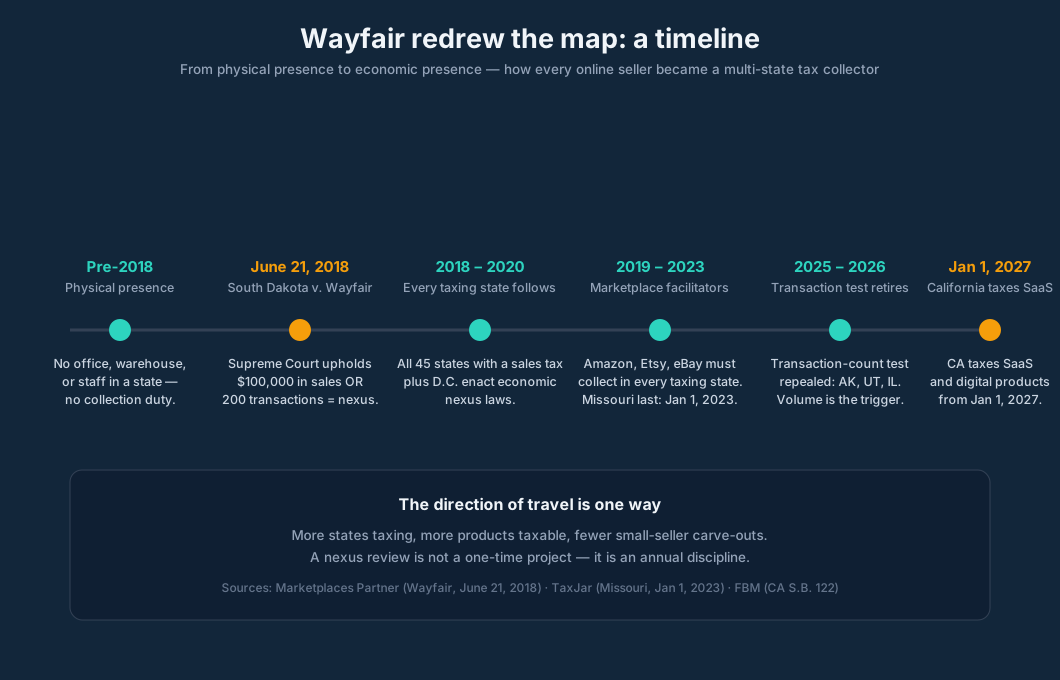
For most of the 20th century, the rule was simple: no physical presence, no collection duty. A mail-order seller in Ohio shipping into Texas collected Texas sales tax only if it had some footprint in Texas. The Supreme Court's Wayfair decision replaced that physical-presence test with an economic one: sell enough into a state, and the state can make you its collector.
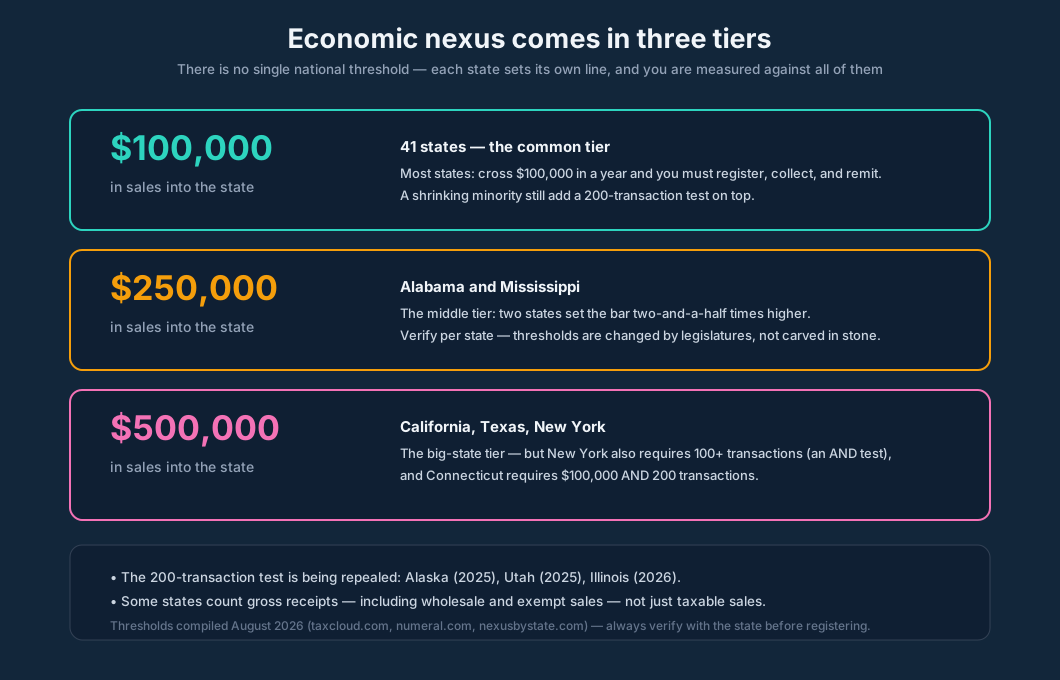
The numbers that became the national template came straight from the South Dakota statute the Court upheld: more than $100,000 in sales into the state in a year, or more than 200 separate transactions (Marketplaces Partner). A compilation of state thresholds updated August 2026 shows 46 states publish an economic-nexus threshold for remote sellers; 41 use the common $100,000 figure, two use $250,000 (Alabama, Mississippi), and three use $500,000 (California, Texas, New York) — via taxcloud.com, numeral.com, and nexusbystate.com (scult-tools compilation).
Three details matter more than the headline numbers:
The 200-transaction test is dying. It was always the harsher of the two tests for small sellers — two hundred $10 orders is a trivial business — and states have been repealing it. Only 18 jurisdictions still maintain it; Alaska repealed its version effective January 1, 2025, Utah removed its in July 2025, and Illinois removed its on January 1, 2026 (same compilation). The direction of travel is clear: sales volume is the trigger.
Two states use AND tests, not OR tests. New York requires more than $500,000 in gross receipts AND more than 100 transactions, measured over the preceding four sales-tax quarters (New York runs its own calendar: March–May, June–August, September–November, December–February). Connecticut requires $100,000 AND 200 transactions (salestaxsolutions.us; scult-tools compilation).
States don't all count the same sales. Some count only taxable sales toward the threshold; others count gross receipts — including exempt and wholesale sales. California, Washington, New York, and Pennsylvania include wholesale and exempt sales in the calculation, so a seller doing $90,000 of taxable retail plus $20,000 of exempt B2B sales into California has crossed the line even though a tenth of the counted sales would never be taxable (beancount.io, 2026 guide). If the bookkeeper only tracks taxable receipts, the nexus map is wrong.
The three ways a state can claim you
Economic nexus gets the headlines, but it is one of three doors into a state's sales-tax system. A complete nexus review — the thing a bookkeeper should run for every selling client at least once a year — checks all three.
1. Physical nexus. Still exists, still the easiest to establish. A store, office, or warehouse; employees or contractors soliciting in the state; inventory in a third-party fulfillment center (Amazon FBA inventory explicitly creates nexus activity in the standard treatments); even regular delivery runs in the seller's own vehicles can do it (TaxJar nexus guidance; salestaxsolutions.us on New York). Physical nexus has no dollar threshold — a single craft-fair weekend can trigger registration in some states.
2. Economic nexus. The post-Wayfair volume test described above. Measured per state, usually over the prior calendar year or the trailing twelve months, and once crossed, registration is typically required within about 30 days to the next month (finance-sales-tax reference data).
3. Marketplace-amplified nexus. This is the one sellers miss. Marketplace sales — the ones Amazon or Etsy collects tax on — still count toward economic-nexus thresholds in many states, including California, New York, and Texas. A brand doing $300,000 on Amazon and $60,000 on its own Shopify store has crossed $100,000 in plenty of states, and the direct sales are the ones it must register and collect on itself. The marketplace covers its channel; it covers nothing else (TaxJar dropshipping guide, 2026; beancount.io).
The five states with no statewide sales tax — New Hampshire, Oregon, Montana, Alaska, Delaware, the "NOMAD" states — sit outside this system at the state level, though Alaska's municipalities levy their own local taxes (finance-sales-tax reference data).
Threshold math is state-by-state
A seller does not have "economic nexus" in the abstract. It has nexus in Illinois and not in Indiana, or nexus in seven states and clean in forty-three. The bookkeeper's working document is a state-by-state table: trailing-twelve-month sales per state, the state's threshold, and a yes/no/maybe flag. Three things make that table harder than it looks:
- Threshold tiers differ. The $500,000 states (California, Texas, New York) give a mid-size seller breathing room; the $100,000 states do not. A $150,000 year into Illinois is nexus; the same year into Texas is not.
- The measurement period differs. Most states look at the prior calendar year or current year-to-date; some use a rolling twelve months. A seller that spikes in Q4 can cross a line in January on a rolling basis while looking clean on a calendar-year basis.
- What counts differs. Gross receipts versus taxable sales; whether marketplace and wholesale sales count. The conservative bookkeeping practice is to track gross sales by ship-to state across all channels, then let the state's rule narrow it — never the reverse.
And remember the transaction-count sunset: where the test still exists, a high-volume, low-ticket seller can trip it on transactions alone. Check whether each nexus state still has one before dismissing a client's 1,800-order year as "too small to matter."
The marketplace trap
By 2025, every taxing state plus the District of Columbia had marketplace facilitator laws on the books — Missouri was the last, its law effective January 1, 2023 (TaxJar). On the surface this looks like the problem solved for marketplace-only sellers: Amazon, Etsy, eBay, and Walmart collect and remit on the seller's behalf, and the seller doesn't file for those transactions.
The trap has two jaws:
Jaw one: mixed channels. The moment a seller also sells direct — its own website, Shopify standalone, Faire, WooCommerce, in-person — those direct sales are entirely the seller's responsibility. Marketplace facilitator coverage stops at the marketplace's edge. The seller must track nexus, register, collect, and file on the direct channel, and must keep records cleanly separating marketplace sales from direct sales for audit (finance-sales-tax reference data).
Jaw two: threshold counting. In many states, the marketplace sales that the facilitator handles still count toward the seller's economic-nexus threshold. The single biggest sales-tax mistake mid-stage e-commerce brands make: they look at their Shopify revenue, decide they're under the threshold in a state, and miss that their Amazon revenue pushed them over months ago (beancount.io, 2026). The bookkeeper's nexus tracker must include all channels — then subtract the facilitator-covered sales only when computing what to collect and remit, not when deciding whether nexus exists.
One more channel-specific wrinkle for drop shippers: in some states, the supplier's warehouse location can create obligations for the seller, and resale certificates are needed per state where the supplier has nexus (TaxJar dropshipping guide, 2026). Drop-shipping is a three-party transaction wearing a two-party costume, and the tax treatment follows the costume's seams.
Worked example: the $2.4M seller and the $167,000 exposure
Hypothetical numbers, labeled as such — but built from real thresholds and the Tax Foundation's national average rate. Meet a direct-to-consumer home-goods brand:
- $2.4 million in annual revenue.
- 60% through Amazon (marketplace facilitator collects and remits — handled).
- 40% direct through its own website: $960,000 a year of sales it must handle itself.
- Trailing-twelve-month sales by ship-to state (all channels): California $320,000; Texas $280,000; Florida $210,000; Illinois $150,000; Washington $130,000; Georgia $115,000; North Carolina $105,000. Seven states over $100,000. The seller has never registered anywhere.
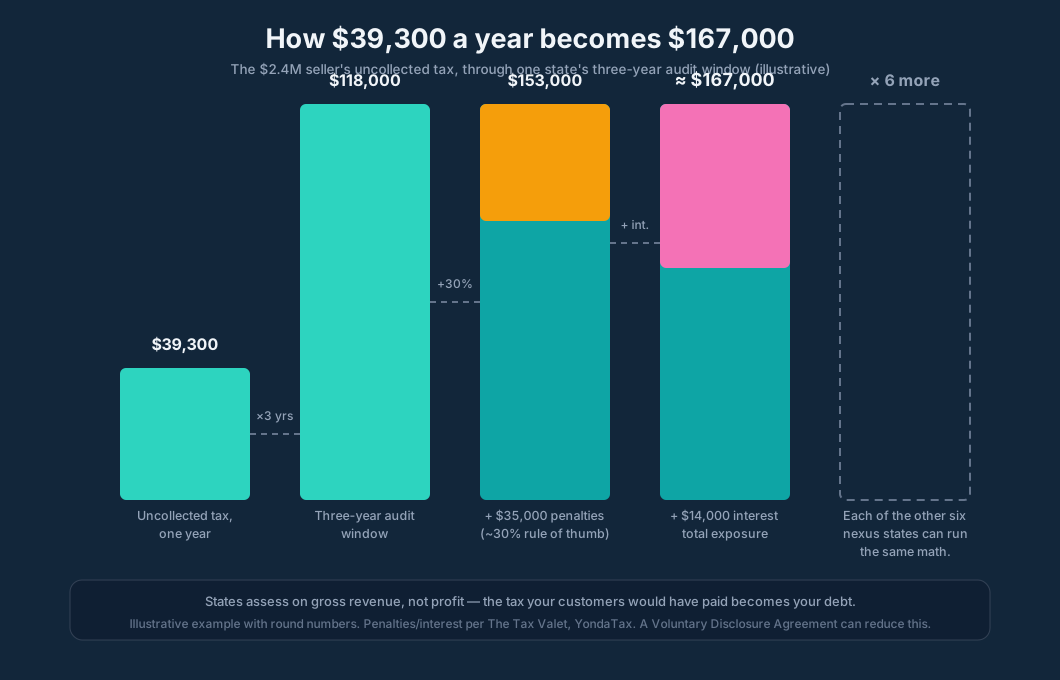
The direct (uncollected) taxable sales in those seven states come to about $524,000 a year — 40% of the $1.31 million total into those states. At roughly 7.5% (near the Tax Foundation's 7.53% population-weighted national average combined rate, midyear 2026), that's $39,300 a year in tax the seller should have collected and didn't.
Now the audit math. A state auditor typically reaches back about three years:
| Line | Amount |
|---|---|
| Uncollected tax, 3 years ($39,300 × 3) | $118,000 |
| Penalties (~30% — the standard planning rule of thumb) | $35,000 |
| Interest on the unpaid balance | $14,000 |
| Total exposure from one state's audit | ≈ $167,000 |
The penalty figure follows the industry rule of thumb: plan on the original tax due plus about 30% for penalties and interest combined, with many states charging around 4% of the tax due for failure to file or pay up to roughly a 30% maximum (The Tax Valet). New York charges 10% of the tax due for the first month plus 1% for each additional month; California charges 10% plus a discretionary Collection Cost Recovery Fee (YondaTax).
And the kicker: that is one state. The seller has nexus in seven. Each of the other six can run the same math on its own window. The $39,300-a-year leak compounds into a multi-state liability that can exceed a year's profit — on tax the customers would have paid without blinking had it been on the invoice.
Same product, 11,000 different answers
Knowing where you must collect is half the job. The other half is knowing what to collect on — and the answer changes at state lines, county lines, and sometimes city lines. The Tax Foundation counted over 11,000 standard sales-tax jurisdictions in the United States as of 2020, and 38 states allow local sales taxes on top of the state rate (Tax Foundation 2020; Tax Foundation midyear 2026). A state rate is the beginning of the calculation, not the end.
Digital goods and SaaS are the moving frontier. Twenty-seven states tax software and SaaS in some form, according to tax-intelligence firm Anrok — and the holdouts are falling. California's S.B. 122, enacted in 2026, brings digital products including remotely accessed software into California's sales and use tax framework starting January 1, 2027 (Channel Dive; FBM). Connecticut taxes SaaS for business use at a special 1% rate; Texas taxes data-processing services at 80% of the price. A SaaS company selling nationally in 2027 will need a taxability matrix, not a single answer.
Shipping is taxed differently everywhere. California generally does not tax separately stated shipping at actual cost; New York and Texas tax shipping when the underlying goods are taxable; Illinois generally exempts separately stated direct shipment charges. The same $12 shipping line is taxable, exempt, or conditional depending on the destination (finance-sales-tax reference data).
Sourcing rules decide which jurisdiction's rate applies. Most states are destination-based — the tax follows the customer. A few, including Missouri and Illinois, are origin-based, where the seller's location sets the rate. Get the sourcing rule wrong and every rate in the return is wrong even if the nexus analysis was perfect (claytondb prestashop guide).
The everyday edge cases are audit bait. Promotions, coupons, loyalty programs, returns, and gift cards are not treated uniformly: in some states sales tax applies to the full pre-discount price when a manufacturer reimburses the coupon; in others the taxable price is what the customer actually paid. Auditors know most retailers handle these inconsistently, and a systematic under-collection across thousands of transactions turns into multi-year back taxes, interest, and penalties (Retail CPA Report, September 2026). The Streamlined Sales Tax Project — a 24-state pact to harmonize these rules — has smoothed some of this, but not all states participate and member states keep their exceptions (TaxCloud; Retail CPA Report).
For the bookkeeper, the practical takeaway: the client's product catalog needs a taxability column per nexus state, reviewed whenever the catalog or a state's law changes. That column is a living document, not a one-time setup.
Registration and the filing calendar
Once nexus exists, the clock starts. Registration is typically required within about 30 days to the next month after crossing a threshold — New York gives 30 days to register and 20 more days before collection must begin (salestaxsolutions.us). Some states, like Rhode Island, require registration before the business even starts operating (RI Division of Taxation).
Filing frequency is assigned by volume, not chosen by preference:
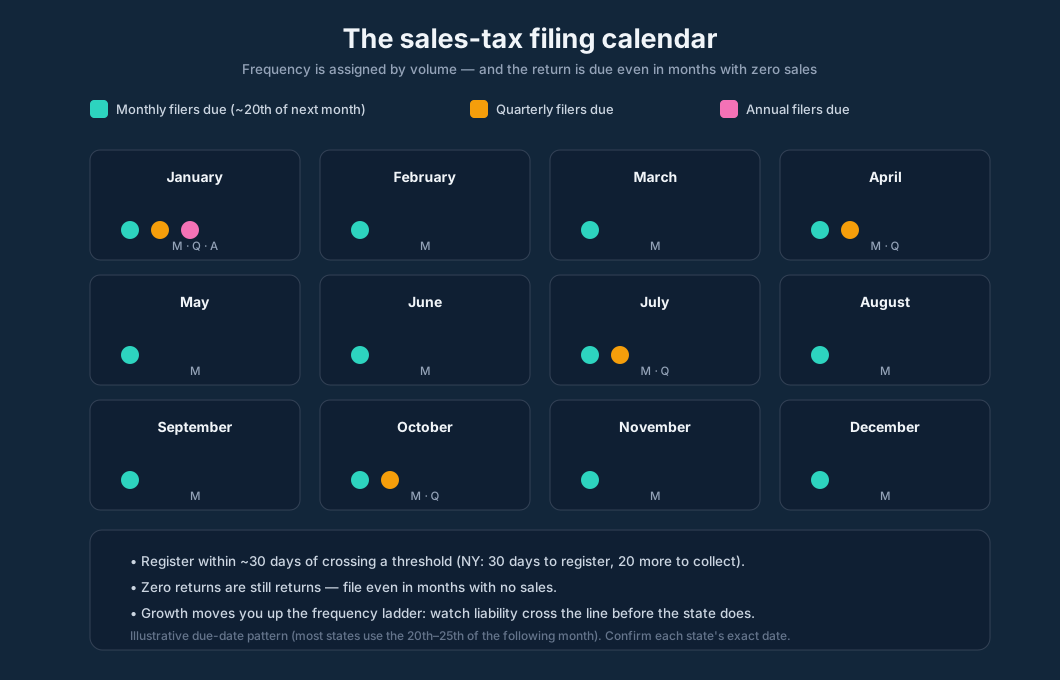
- Colorado: $600 or more per month in tax means monthly filing; under $600 quarterly; $15 or less per month can file annually (Colorado Dept. of Revenue).
- Kansas: over $5,000 a year in liability means monthly returns; $1,000 or under means annual (Kansas Dept. of Revenue notices).
- Rhode Island: monthly by default, quarterly only with written authorization — and a return showing zero sales and zero tax is still required when nothing was sold (RI Division of Taxation).
Three calendar disciplines follow:
- File even at zero. Most states require a return every period, sales or no sales. A missing zero return reads as non-compliance, not as a quiet month.
- Report on the accrual basis. Sales are generally reported in the period the sale was made, not when the customer paid (RI Division of Taxation) — which means the books' revenue cutoff has to be right, every period.
- Watch the frequency escalator. As the client's volume grows, states move them from annual to quarterly to monthly. The bookkeeper who notices the liability crossing the line first gets the frequency change filed before the state does it by notice.
Certificates: the paper that proves you didn't owe
Every exempt sale needs its proof, collected at the time of sale, kept where an auditor can find it years later:
- Resale certificates — for wholesale and drop-ship transactions: the buyer will resell the goods, so no tax is due on that leg. Needed per state, and each state has its own form and validity rules.
- Exemption certificates — for buyers exempt by status (nonprofits, government, manufacturers buying inputs): the classic example is New York's ST-120 for resale purchases (salestaxsolutions.us).
- Direct-pay permits — in some states, large buyers self-remit; the seller keeps the permit on file instead of collecting.
The certificate binder is the first thing an auditor asks for and the thing most likely to be incomplete. A missing certificate turns an exempt sale into a taxable one — assessed against the seller. Real enforcement lands here: a New York art auction house allegedly accepted false paperwork that let a customer avoid sales tax for years (Source Advisors). Certificates must be valid, current, and actually describe the transaction; "we had one on file somewhere" is not a defense.
What it costs to be wrong
States treat uncollected sales tax as the seller's debt because the seller was the state's agent at the register. The consequences stack:
- Back taxes on gross revenue, not profit. The assessment is the tax that should have been collected — a percentage of sales, with no deduction for the cost of goods, rent, or payroll.
- Penalties and interest. The planning rule of thumb: take the original tax due and add about 30% for penalties and interest (The Tax Valet). The real cases are worse: a New York window-store owner paid back over $125,000 in unremitted sales tax plus over $110,000 in interest (Source Advisors).
- Personal liability. Under provisions like California Revenue and Taxation Code section 6829, the state can pursue individuals who controlled a company's tax compliance and willfully failed to pay — and that personal exposure can follow the responsible person even after the company ceases operations (FBM, September 2026). New California rules expanding the tax to digital products in 2027 make this worth flagging to every SaaS client now, before the liability accrues.
- Business consequences beyond money. States can shut down a non-compliant seller's website, revoke licenses, and a sales-tax lien will surface in any due-diligence process if the owner ever sells the business (YondaTax).
The escape hatch has a name: the Voluntary Disclosure Agreement (VDA). Come forward before the state finds you, and most states will limit the lookback period and reduce or waive penalties. The best case is recognizing the error and voluntarily correcting it; the worst case — discovered by audit, with evidence of intent — can mean criminal exposure for responsible parties (Source Advisors). The bookkeeper who spots the nexus problem is the one who gets the client into a VDA while "voluntary" is still an option.
The bookkeeper's monthly sales-tax rhythm
Sales-tax compliance is not a project; it is a rhythm. For every selling client, monthly:
- Update the nexus tracker. Trailing-twelve-month gross sales by ship-to state, all channels, against each state's threshold. Flag any state within 80% of its threshold as "approaching."
- Reconcile the liability account. Sales tax collected per the books versus per the POS/marketplace reports. The sales-tax payable balance should tie to the returns filed; a growing unreconciled balance is either unfiled liability or a data problem — both urgent.
- Check the filing calendar. Returns due this month, by state, with the correct frequency. File zero returns where required. Confirm payments cleared.
- Mind the certificates. New wholesale or exempt customers need certificates before the first exempt invoice, not after the audit notice.
- Review catalog changes. New products, new bundles, new states shipped to — each one is a taxability question.
- Annual deep review. Re-run the full three-door nexus analysis (physical, economic, marketplace), confirm registrations are current, and verify filing frequencies still match volume.
None of this requires a tax department. It requires a tracker, a calendar, and the discipline to run them every month — which is exactly what a bookkeeping firm is built to provide.
Where LedgerHQ fits — and where it doesn't
The honest version, because this article is read by the people who would catch the dishonest one: LedgerHQ does not track nexus, calculate rates, register sellers, file returns, or manage exemption certificates, and this article does not claim otherwise. Those decisions belong to the bookkeeper and the firm's tax advisor — and the filing layer belongs to tools built for it, like the Streamlined Sales Tax Certified Service Providers that file at no cost in the 24 SST member states for eligible remote sellers (TaxCloud).
What LedgerHQ does is the layer underneath that makes the whole rhythm possible: Tally codes the bank activity, works the reconciliations, asks for whatever is missing, and hands you finished financial statements (ledgerhq.ai/pricing). Tally clears the matching activity and shows the remaining difference — so the sales-tax payable account ties out instead of drifting. The chart of accounts, journal entries, and registers are all included, and the revenue data the nexus tracker feeds on comes from books that are actually reconciled. The sales-tax decisions are yours; the clean books they rest on are Tally's. Twenty dollars a month per business, free until January 1, 2027 (ledgerhq.ai/pricing).
FAQ
Do I need to worry about sales tax if I only sell on Amazon and Etsy? For collection on those channels, mostly no — marketplace facilitator laws make the platform the collector in every state with a sales tax. But your marketplace sales still count toward economic-nexus thresholds in many states, so if you also sell direct anywhere, you may owe registration and collection on the direct channel (TaxJar; beancount.io).
What is the actual threshold — $100,000 or 200 transactions? It depends on the state. Most states use $100,000 in sales; a shrinking minority also have a 200-transaction test; Alabama and Mississippi use $250,000; California, Texas, and New York use $500,000, with New York also requiring 100 transactions. Always verify the current threshold with the state before you register — they change (scult-tools compilation, August 2026).
Do wholesale or exempt sales count toward the threshold? In some states, yes — California, Washington, New York, and Pennsylvania include them. Track gross sales by state, not just taxable sales (beancount.io).
How soon after crossing a threshold must I register? Typically within about 30 days to the next month; New York gives 30 days to register and 20 more days to begin collecting. Don't wait for the state to write first (salestaxsolutions.us).
Do I have to file if I had no sales? In most states, yes — a zero return is still a required return (RI Division of Taxation).
What is a Voluntary Disclosure Agreement? A program in most states that lets a non-compliant seller come forward voluntarily in exchange for a limited lookback period and reduced or waived penalties. It is the best path once a bookkeeper discovers unregistered nexus — while "voluntary" is still true (Source Advisors).
Can the owner be personally liable for the company's sales tax? In some circumstances, yes. California's section 6829 lets the state pursue individuals who controlled tax compliance and willfully failed to pay, even after the business closes (FBM).
Does LedgerHQ file sales tax returns? No. LedgerHQ keeps the books — coded activity, reconciled registers, finished financial statements — that the returns are built from. Nexus analysis, registration, rate decisions, and filing belong to the bookkeeper and tax advisor, often with a dedicated sales-tax filing tool.
Sources
- Tax Foundation, "State and Local Sales Tax Rates, Midyear 2026" — https://taxfoundation.org/data/all/state/2026-sales-tax-rates-midyear/
- Marketplaces Partner, "US Sales Tax and Non-Resident LLC Owners" (Wayfair, June 21, 2018) — https://marketplacespartner.com/blog/us-sales-tax-economic-nexus-non-resident-sellers
- Economic nexus thresholds compilation, August 2026 (via taxcloud.com, numeral.com, nexusbystate.com) — https://github.com/scult-india/scult-tools/blob/HEAD/content-engine/05-drafts/article-070.md
- TaxJar, "Economic Nexus Thresholds by State: 2026 Complete Guide" (reviewed Sept 25, 2026) — https://github.com/claytondb/salestaxjar/blob/HEAD/src/content/blog/economic-nexus-thresholds-by-state.md
- TaxJar, "Economic Nexus Guide: What Online Sellers Need to Know in 2026" — https://github.com/claytondb/salestaxjar/blob/HEAD/marketing/blog-posts/economic-nexus-guide.md
- TaxJar, "Missouri's marketplace facilitator law, explained" (July 7, 2025) — https://www.taxjar.com/blog/07-21-missouri-final-state-to-enact-wayfair-sales-tax-laws
- beancount.io, "Drop Shipping Sales Tax in 2026" (May 11, 2026) — https://beancount.io/blog/2026/05/11/drop-shipping-sales-tax-2026-three-party-transaction-resale-certificate-rules-marketplace-facilitator-ecommerce-operators-guide
- TaxJar, "Dropshipping Sales Tax Guide" (2026) — https://github.com/claytondb/salestaxjar/blob/HEAD/src/content/blog/dropshipping-sales-tax-guide.md
- Tax Foundation, "How Many Sales Tax Jurisdictions Does Your State Have?" (2020; 11,000+ jurisdictions) — https://taxfoundation.org/data/state-tax/?sf_paged=29
- Channel Dive, "California's software tax sows confusion among IT firms" (Oct 2026; 27 states tax SaaS per Anrok) — https://www.channeldive.com/news/californias-software-tax-sows-confusion-among-it-firms-saas/831708/
- FBM / The Tax Scribe, "New California Sales Tax Rules Raise Responsible Person Liability Risks" (Sept 17, 2026; S.B. 122, section 6829) — https://www.fbm.com/publications/new-california-sales-tax-rules-raise-responsible-person-liability-risks/
- FastSpring, "California SB 122 Just Made Digital Products Taxable" (2026) — https://fastspring.com/blog/california-sb-122-just-made-digital-products-taxable-what-that-means-for-you/
- TaxCloud, "11 Best Sales Tax Software for Ecommerce" (Sept 2026; 24 SST member states) — https://taxcloud.com/blog/best-sales-tax-software-ecommerce/
- Colorado Dept. of Revenue, "Sales Tax Filing Information" (filing frequency) — https://tax.colorado.gov/sales-tax-filing-information
- Rhode Island Division of Taxation, FAQ (registration, zero returns, accrual reporting) — https://tax.ri.gov/help/faq.php
- salestaxsolutions.us, "New York Sales Tax Guide" (Sept 2026; $500K AND 100 transactions, registration timing) — https://www.salestaxsolutions.us/resources/sales-tax-by-state/new-york-sales-tax-guide/
- The Tax Valet, "Sales Tax Basics Guide for U.S. Businesses" (penalties, 30% rule of thumb) — https://thetaxvalet.com/blog/sales-tax-basics-for-us-businesses
- YondaTax, "Can You Be Penalized for Sales Tax Compliance Slips?" (NY/CA penalty specifics) — https://www.yondatax.com/blog/sales-tax-compliance-can-i-be-penalised-for-not-complying
- Source Advisors, "Sales Tax Omission: Don't Face Penalties, Get Compliant Now" (VDA, NY $125K case) — https://sourceadvisors.com/blogs/sales-and-use-tax/what-happens-if-you-dont-collect-or-remit-sales-tax/
- Retail CPA Report, "Sales Tax Gets Complicated When Things Come Back" (Sept 2026; promos/coupons/returns audit risk) — https://www.retailcpareport.com/p/sales-tax-gets-complicated-when-things
- TaxJar, "Configuring PrestaShop for US Sales Tax" (destination vs. origin sourcing) — https://github.com/claytondb/salestaxjar/blob/HEAD/src/content/blog/prestashop-sales-tax-guide.md
- LedgerHQ pricing (verified Oct 5, 2026) — https://ledgerhq.ai/pricing