
Firm growth
The 200-Client Firm Thesis: How AI Lets Bookkeepers Lower Prices and Grow
The founder's thesis, worked out in numbers: a traditional bookkeeping firm tops out at 20–40 clients per bookkeeper at $400/month. With AI doing the volume work, a firm can serve ~200 clients at $100–$200/month, work fewer hours, and keep wider margins. The full P&L math, the industry data, the objections, and the operating stack.

The short answer
Most bookkeeping firms are built on the same blueprint: win 20 or 30 clients, charge each one $300 to $500 a month, and guard the capacity of the one person (often the owner) whose hours are the product. That model has a hard ceiling — industry data puts it at about 20 to 40 clients per solo bookkeeper — and growth past the ceiling means hiring, which is the single most expensive line in the business.
The 200-client thesis says the ceiling is an artifact of manual process, not a law of nature. When the AI does the volume work — pulling feeds, coding routine transactions, reconciling, flagging exceptions — the per-client labor falls far enough that the firm can charge $100 to $200 a month, serve ten times the clients, and still come out ahead on margin. Lower prices, more clients, fewer hours, better economics. It sounds backwards until you work the math, so this article works the math: the capacity data, the pricing data, a full 20-client vs. 200-client P&L, where the hours actually go, the honest objections, and the operating stack that makes it real.
This is LedgerHQ founder Christopher Ragain's core teaching to bookkeepers, and this article is written in his voice: plain numbers, no jargon, and every LedgerHQ capability claim verified against the real product before it was printed.
The ceiling nobody talks about
Start with the constraint every firm owner knows in their bones. A solo bookkeeper hits a capacity ceiling somewhere between 20 and 40 clients — not because of skill, but because "manual proposal, invoicing, and reminder work consumes most of the week," and disconnected tools eat the hours that could have gone to billable work (Ignition, How to Grow a Bookkeeping Business, checked September 2026). The ceiling is administrative as much as it is technical: once the paperwork, the statement downloads, the follow-ups, and the billing eat the week, there is no week left for clients 41 through 200.
The per-client numbers underneath the ceiling are just as old. Intuit's 2018 rate survey of practitioners found that serving a $400-a-month client takes about four to five hours a month; Bookkeeper Launch's own survey of practitioners put the modal answer at two to four hours, with four to six hours second (via Bookkeeper Launch, 2020 transcript of 2018 data — dated, but the shape has not changed). Take the midpoint: at 4.5 hours per client per month, 30 clients is 135 hours a month. That is a full-time job before you count selling, onboarding, billing, or answering a single client question. This is why the six-figure-practice playbooks describe the same target again and again: 15 to 35 recurring clients, well-scoped, well-priced — a "manageable number of well scoped, well priced relationships that a small practice can serve excellently" (The 6 Figure Bookkeeper, 2025).
And the labor to serve them costs more than most firms admit. The Bureau of Labor Statistics puts the May 2025 median wage for bookkeeping, accounting, and auditing clerks at $50,670 a year — $24.36 an hour — with the lowest 10% under $36,000 and the top decile over $74,550 (BLS Occupational Outlook Handbook, checked September 2026). That is the wage, not the cost: payroll taxes, benefits, and overhead load it toward roughly $62,500 to $70,000 all-in for a full-time hire (Reconciled Solutions, 2025 — a vendor estimate, but directionally consistent with how firms budget). A 30-client practice at $400 a month is $12,000 in monthly revenue against a fully loaded bookkeeper at $5,200 to $5,800 a month plus the owner's time, software, insurance, and acquisition cost. It works. It is also a machine that converts labor into revenue at a fixed ratio — which is exactly why it can't scale: the only way to grow revenue is to grow headcount at the same ratio.
One more data point makes the ceiling concrete. Hubdoc's workflow guide works a simple example: with four accounts per client and three minutes to log in and download each statement, a 20-client practice burns four hours a month just downloading bank statements — "four hours spent on work that (thanks to cloud accounting)" should not need a human at all (Hubdoc, Hours to Minutes guide). That is the texture of the ceiling. It is not one big problem. It is a hundred small frictions, each priced in minutes, each multiplied by the client count.
The price tier nobody serves
While firms compete for the 20–30-client prize at $300 to $500 a month, a whole market sits underneath them, unserved. The industry's own pricing benchmark says monthly bookkeeping "most commonly" runs $250 to $499 a month, cited by 29% of the 219 U.S. firms in Ignition's 2025 survey (via EIN Presswire, January 2026). Independent 2026 price guides put the bands at roughly $300–$1,500 a month for outsourced bookkeeping, $200–$500 for basic service, $500–$1,000 standard, and $1,000–$2,500+ for full service (Possibly.com, September 2026). Freelancers and solopreneurs are quoted $100–$300 a month for basic monthly reconciliation (Mitesh Patel, Medium, September 2026). There is essentially no productized monthly bookkeeping tier between $100 and $200 — which is exactly where the largest business population in the country lives.
That population is enormous. The Census Bureau's Nonemployer Statistics count 29.8 million U.S. businesses with no paid employees — 82.3% of all 36.2 million small businesses, nearly doubled since 1997 (Census Bureau, May 2025; SBA figures via Press Times, August 2026). Most of these businesses are simple: a consultant, a freelancer, a solo trades business, a tiny e-commerce shop. They need real books — for taxes, for cash awareness, for the loan application — but their budgets do not stretch to $300 or $400 a month, and their transaction counts do not justify it. Guidant Financial's 2026 survey found only 45.6% of small business owners outsource bookkeeping at all (via useCarly, checked September 2026) — which reads less as a demand problem than as a price-and-product problem: more than half the market is doing it themselves or not doing it, because nobody sells them the version they can afford.
This is the thesis's first insight: the industry's capacity ceiling has created a price floor, and the price floor has locked out the majority of businesses. The 200-client firm doesn't steal clients from the $400-a-month firms. It sells to the businesses those firms never quoted.
The 200-client P&L, worked
Put the two models on one spreadsheet and the thesis stops sounding like a slogan.
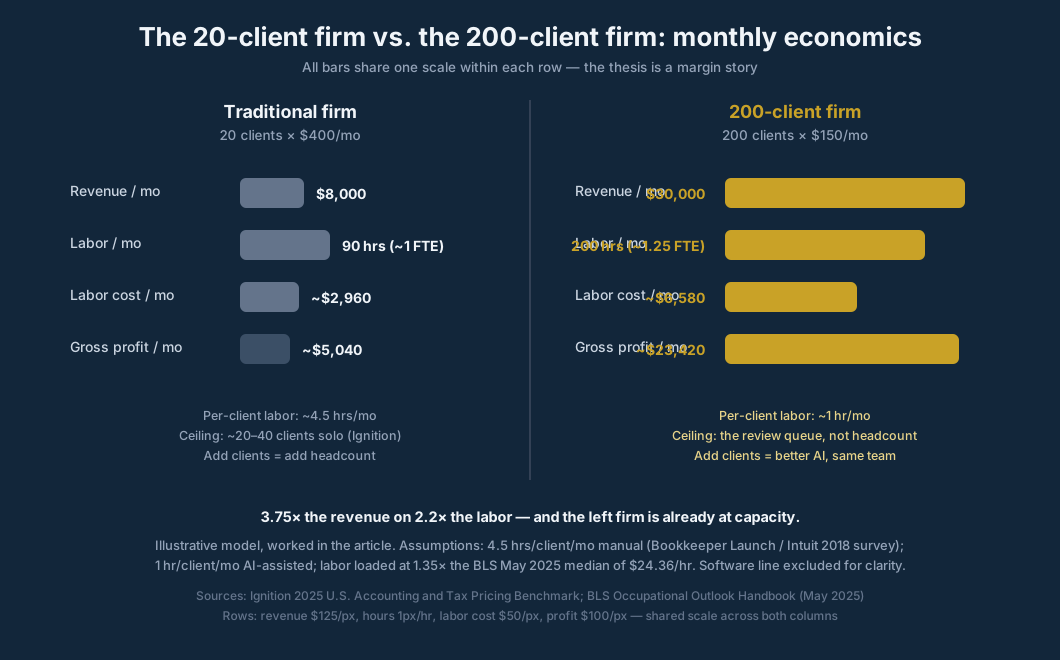
The traditional firm. 20 clients at $400 a month = $8,000 a month in revenue ($96,000 a year). Labor: 4.5 hours per client per month = 90 hours a month. At the BLS median of $24.36 an hour, loaded at a conservative 1.35x for taxes, benefits, and overhead, that's $32.89 an hour — ~$2,960 a month in labor cost. Gross profit before software, marketing, insurance, and the owner's time: roughly $5,040 a month. Real, respectable, and utterly capacity-bound: client 41 needs another bookkeeper.
The 200-client firm. 200 clients at $150 a month = $30,000 a month ($360,000 a year). Labor: the model's whole bet is that per-client monthly time falls from ~4.5 hours to ~1 hour — a bet the next section grounds in data. That's 200 hours a month, about 1.25 full-time reviewers. At the same loaded $32.89 an hour: ~$6,580 a month in labor. Gross profit before software and marketing: roughly $23,400 a month.
Read that again. 3.75x the revenue on 2.2x the labor — and the traditional firm is already at its ceiling. The 200-client firm at $150 a month out-earns the traditional firm by nearly 5x in gross profit while charging 63% less per client. This is the point of the thesis: it is not a charity pricing story. It is a margin story. The per-client labor falls 78%; the price falls 63%; the spread widens.
The chart at the top of this section lays both firms out side by side. The important detail is what the chart doesn't show: the traditional firm's next dollar of growth costs a full hire. The 200-client firm's next dollar of growth costs server time and a better exception queue.
Why the price cut isn't a margin cut
This is the objection that deserves its own section, because it is the one that keeps good firms from trying. "If I cut my price from $400 to $150, I'm doing the same work for less money." No — the work changes first, and the price follows the work. Per-client labor falls ~78% (4.5 hours to 1 hour) while the fee falls ~63% ($400 to $150). The gap between cost and price widens by more than a point of margin for every client.
There is a second, subtler version of the objection: "cheap prices attract cheap clients who churn." The thesis's answer is the law of large numbers. A 20-client firm that loses two clients a month loses 10% of its revenue and has a crisis; a 200-client firm that loses two clients a month loses 1% and has a Monday. At 200 clients, normal churn becomes a statistic instead of a catastrophe. This is also where the onboarding machinery matters — engagement letters, package selection, and CRM-driven follow-up turn acquisition from a heroic founder activity into a system (more on that below).
Where the hours go
The whole thesis rests on one claim: a client's monthly bookkeeping can drop from ~4.5 hours to ~1 hour. Here is where those 3.5 hours come from, task by task, with sources.
The manual month (4.5 hours). Intake and document chasing: ~0.8 hours. This is the Hubdoc math — statement downloads, receipt collection, the client who emails a photo of a crumpled receipt in week three. Coding and keying: ~1.6 hours. Reconciliation by hand: ~1.4 hours. Review and client questions: ~0.7 hours. These are practitioner-anchored estimates consistent with the Intuit 2018 survey data (4–5 hours per client per month) and Bookkeeper Launch's practitioner poll (2–4 hours modal).
The AI-assisted month (~1 hour). Intake review: 0.15 hours — the feeds pulled everything; the human checks what came in and chases only the true gaps. Coding review: 0.2 hours — the machine coded the repeat vendors; the human spot-checks the suggestions. Exception review: 0.35 hours — the reconciliation flagged the handful of transactions it couldn't resolve; the human works the exceptions. Client communication: 0.3 hours — the relationship, the questions, the "here's what your numbers mean."
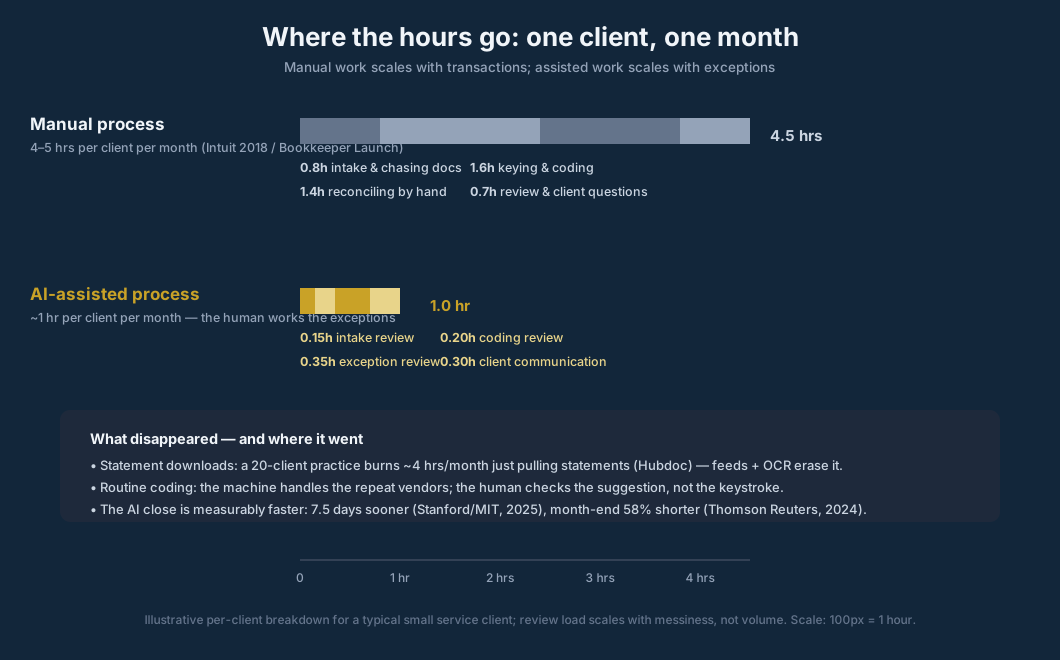
Two measured results say this shape is real, not aspirational. A 2025 Stanford/MIT study of 277 accountants at 79 firms — analyzing hundreds of thousands of real transactions — found that accountants using generative AI managed 55% more clients per week, reallocated 8.5% of their time (~3.5 hours a week) from data entry to high-value work, posted 21% higher billable hours, and closed the month-end books 7.5 days sooner (Journal of Accountancy, August 2025). Separately, Intuit's 2025 Accountant Technology Survey of 700 professionals found 46% use AI daily, 81% say it boosts productivity, and 95% say technology cuts compliance time (Insightful Accountant, September 2025). Thomson Reuters measured a 58% reduction in month-end close time from AI-driven reconciliation tools (2024, via SoftwareOasis).
Apply an honest discount — this site's standing practice is to assume roughly 40% of promised AI productivity is lost to verification and rework — and the story survives. The levers aren't mysterious: bank feeds and statement extraction do the intake; the engine auto-codes the routine transactions; reconciliation collapses to a review of exceptions. The composition of the work changes: manual cleanup scales with transaction count and degrades with fatigue; assisted review scales with the mess, not the volume. The mess is the part that always needed a professional.
The price/capacity ladder
The ladder below shows monthly revenue at every combination of price point and client count. Two readings matter. First, the thesis zone is real money: at $150 a month, 200 clients is $30,000 a month — $360,000 a year of subscription revenue from clients who each pay less than a typical phone bill for their books. Second, the same revenue at the industry-average $400 fee takes only 75 clients — but a manual bookkeeper taps out at 20–40, so the "cheaper" revenue target is actually harder to hit by hand.
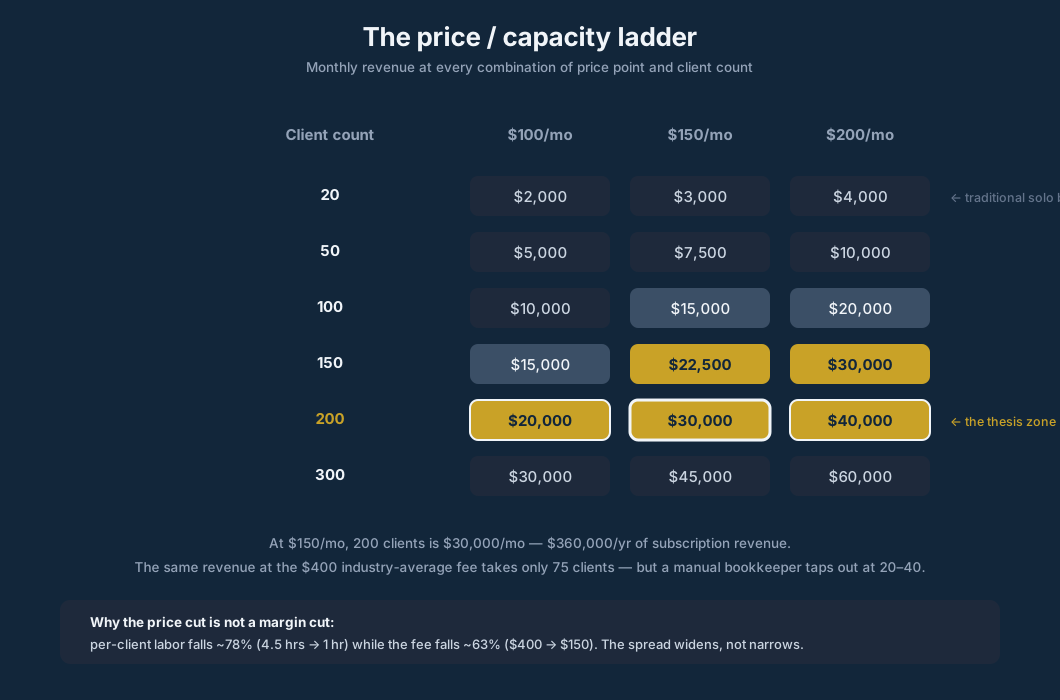
The ladder also answers the "race to the bottom" worry. A race to the bottom is when everyone cuts prices and nobody cuts costs, so margins compress until only the desperate survive. The 200-client thesis cuts price because it cut cost first. Price is a trailing indicator of the cost structure, not a leading strategy. A firm that drops to $150 a month without the AI stack is racing to the bottom. A firm that drops to $150 after cutting per-client labor 78% is just passing productivity gains to the market — the same move every other industry has made since the steam engine.
Lower prices, better service
The paradox at the center of the thesis — cheaper and better — deserves a straight explanation, because it is the part skeptics get stuck on.
A $400-a-month manual client gets, on average, their books touched once a month, after the month closes, by a bookkeeper who is racing the calendar. Practitioners put the danger zone at about 60 days: "If more than 60 days pass without reconciling, transactions pile up, receipts go missing, and what should take 15 minutes turns into hours of cleanup" (Sabrina's Admin Services, September 2026). Manual firms routinely live near that edge for their smaller clients, because the economics say the small clients get the leftover hours.
The 200-client firm flips this. Because the machine does the volume work continuously, clients can get books updated daily or weekly, not in a monthly batch — the cadence that makes the 60-day rot impossible. Because the human's freed hours go to review and communication, the client gets more professional attention, not less — the attention just moves from keystrokes to judgment. And because the freed hours are real hours, the firm can finally sell what it always wanted to sell: advisory. Intuit's 2025 survey found 79% of accountants expect growth in strategic advisory services, with volume projected to grow 38% on average (Insightful Accountant, September 2025). The $150 bookkeeping client who gets a quarterly cash-flow conversation is a more loyal, more valuable client than the $400 client who gets a monthly reconciliation email.
The product at $150 a month is not "the $400 service, cheaper." It's a different product: always-current books, a human who actually reads the exceptions, and a quarterly advisory touch — priced for the 29.8 million businesses that were never buying the $400 version anyway.
The objections, honestly
No thesis survives contact with reality without answering its objections. Here are the five that matter.
1. "Nobody can review 200 clients' books well." Correct — one person cannot. The thesis is not a solo thesis; it's a firm thesis. One owner plus one or two reviewers run the exception queue for 200 clients, because the queue is the whole job: the machine proposes, the professional disposes. The Stanford/MIT finding that AI users managed 55% more clients per week is the directional proof; the rest is staffing arithmetic. The failure mode to watch is review quality — a reviewer rubber-stamping the machine is worse than a manual bookkeeper, because the errors scale. The discipline is the same one from this site's earlier guides: the review is the step, not the bottleneck.
2. "Low prices mean high churn." Somewhat — low-price clients churn more than $2,000-a-month advisory clients. But the math of large numbers changes the consequence of churn, and the onboarding system changes its rate. Churn concentrates in the first 90 days, and front-loaded onboarding with a fast first win is the known counter. With engagement letters, package selection, and CRM-driven follow-up running as a system, acquisition becomes repeatable instead of heroic — and at 200 clients, replacing 3% monthly churn means winning 6 clients a month, a pace a good content and referral engine can sustain.
3. "Where do 200 clients come from?" This is the real objection, and the honest answer is: slower than you'd like, then all at once. The addressable market is the 29.8 million nonemployer businesses and the millions of micro-employers — but reaching them requires marketing, which traditional bookkeepers have never needed at the 20-client scale. The thesis assumes the firm learns demand generation: content, community presence, referrals engineered as a system, and a price point ($100–$200) that makes the buying decision low-friction. Note that 80% of firms plan 5–10% price increases for 2026 (Ignition 2025 benchmark), which widens the gap the 200-client firm sells into. Every price hike by incumbents is an acquisition tailwind for the thesis.
4. "This devalues the profession." The opposite is true on the evidence. The profession's highest-value work is advisory — 79% of accountants expect advisory growth, and advisory commands the premiums. The thesis moves professionals toward that work: freed from keystrokes, the bookkeeper becomes the person who explains the numbers, plans the tax, forecasts the cash. What gets devalued is keystroke-labor, and that labor was already being repriced by the BLS: bookkeeping-clerk employment is projected to decline 6% from 2025 to 2035, even as the economy adds millions of new small businesses (BLS, May 2025). The jobs aren't disappearing because the work disappears — they're disappearing because the machine does the keystrokes and the humans do what's left. The thesis is just the firm-level version of a trend the labor market already priced in.
5. "The software costs will eat the margin." This one is legitimate and firm-specific — price it before you build. A 200-client firm is buying seats, feeds, OCR, and AI compute for 200 companies. The thesis only holds if the software stack costs a fraction of a hire, which is the normal case for modern cloud tooling but not automatic. Check current per-company pricing on everything in the stack, model it in the P&L, and re-check it annually. (For what it's worth, LedgerHQ Pro is free for firms through December 31, 2026 — billing starts January 1, 2027 unless cancelled — so a stack built on it starts the software line near zero for now; verify current pricing before you plan on it.)
The operating stack
Here is the division of labor, task by task, that makes 200 clients feasible — the machine owns the volume, the professional owns the judgment:
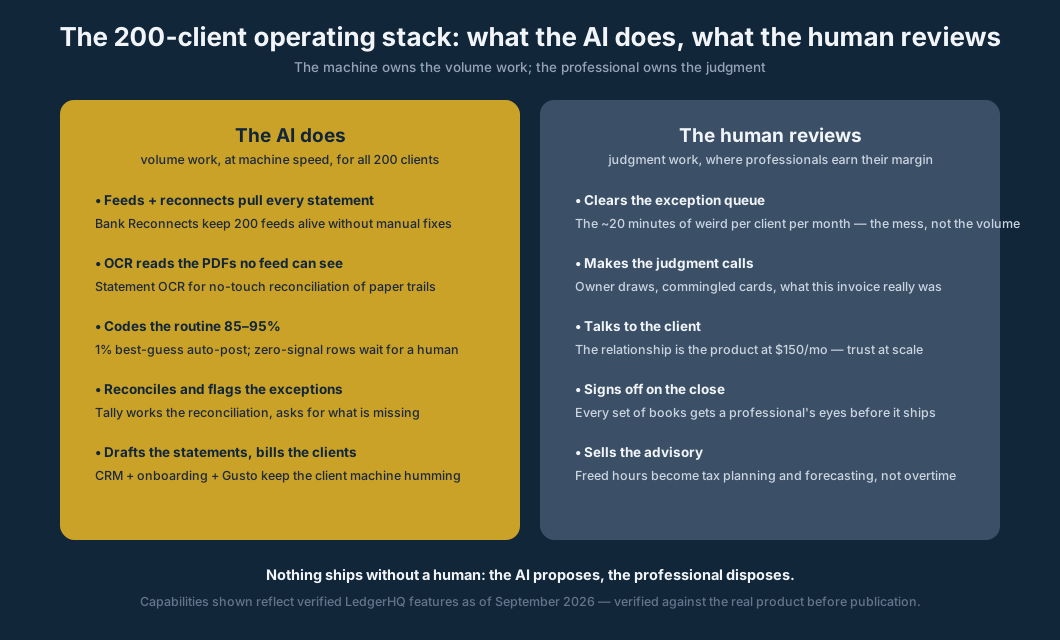
The left column is where the platform earns its place. Every item on it is a capability that has to actually work at 200-client scale, not in a demo: feeds that stay connected without a human babysitting them, OCR that reads the statements no feed can see, coding that gets the routine transactions right the overwhelming majority of the time, reconciliation that surfaces exceptions instead of silently posting, and client machinery — onboarding, billing, CRM — that runs without the owner in the loop. Nothing ships without a human. The AI proposes; the professional disposes. That line is the whole quality model, and any platform that inverts it — machine ships, human apologizes — will fail this thesis at 20 clients, let alone 200.
How LedgerHQ fits — the verified stack
The standing rule for this site's comparisons: lead only with what LedgerHQ has that competitors don't. So here is the 200-client stack, item by item, with only capabilities verified against the real product:
- The full Tally AI agent. Tally codes the bank activity, works the reconciliations, asks for whatever is missing, and hands over finished financial statements — verified against the product in September 2026. It's the left column of the diagram: the machine that does the volume work for all 200 clients. Tally's model picker ships with Luna (gpt-5.6-luna) as the default, and it's funded by LedgerHQ's house key — the firm doesn't burn its own AI budget per client.
- Bank Statement OCR for no-touch reconciliation. The feeds can't see paper or PDF-only trails; OCR reads the statements the bank won't send electronically and feeds them into the same no-touch reconciliation flow. This is the intake gap the 200-client model can't afford to staff manually.
- Bank Reconnects. Feeds die — credentials expire, banks change their logins, MFA interrupts the sync. At 20 clients, reconnecting feeds is an annoyance; at 200, it's a full-time job if the platform doesn't handle it. LedgerHQ's reconnect flow keeps the feeds alive without the firm babysitting credentials.
- The 1% best-guess auto-post policy. Verified in the LedgerHQ codebase in September 2026: confidence is a proposal mechanism, not a quality gate — the engine posts its best guess on the routine 85–95%, and only zero-signal rows stay for human review. That policy is exactly the operating-stack diagram: the machine proposes, the professional disposes.
- The full Client Onboarding module. Engagement letters, package selection, the intake flow — the system that turns client 201 into a process instead of a founder's weekend. At 200 clients, onboarding is an acquisition-rate limiter if it's manual.
- The full Client CRM. Two hundred relationships are a database problem, not a memory problem. The CRM is what keeps the quarterly advisory touch — the product that actually justifies the relationship — from falling through the cracks.
- Connect Gusto inside LedgerHQ. Payroll is the most common upsell from bookkeeping to full-service, and the $100–$200 price tier is where micro-employers live. Native payroll connection keeps the thesis's cheapest tier tax-complete.
The firm product is LedgerHQ Pro at ledgerhq.pro — free through December 31, 2026, with billing starting January 1, 2027 unless cancelled (verified in the product's own billing code); the firm is the single payer, one Stripe customer per firm. Check current pricing before you build your P&L on it. The point of listing it here isn't that any one feature is magic. It's that the thesis needs all six of the left-column capabilities in one stack, or the firm assembles them from five vendors and the 200-client ceiling reappears as integration work. The ceiling always reappears somewhere; the thesis is about pushing it past 200.
The math, one more time
A traditional firm: 20 clients, $400 a month, 4.5 hours of labor each, $8,000 in revenue, ~$5,040 in gross profit, and a hard ceiling at 40 clients because the next client needs the next hire.
A 200-client firm: 200 clients, $150 a month, 1 hour of labor each, $30,000 in revenue, ~$23,400 in gross profit, and a ceiling set by the quality of the review queue — which improves with the tooling, not the headcount.
The thesis is not "AI makes bookkeepers cheaper." It's this: the manual capacity ceiling created a price floor, the price floor locked out 30 million businesses, and AI removes the ceiling — so the firm that serves the locked-out market at $150 a month with machine leverage ends up bigger, more profitable, and working fewer keystroke-hours than the firm that defends $400 a month with headcount. Lower prices, more clients, better service, wider margins. The math only sounds backwards until you do it.
FAQ
Is $100–$200 a month actually enough revenue per client to run a firm on? Yes, if the per-client labor matches the price. 200 clients at $150 is $30,000 a month — more than most 20-client practices will ever see. The unit that matters is margin per hour of review time, not revenue per client. The model fails only if you cut the price without cutting the labor, which is the "race to the bottom" version, not the thesis version.
Doesn't this compete with offshore bookkeeping at $50 a month? Different product. Offshore competes on keystroke cost; the 200-client firm competes on always-current books plus a U.S. professional who reads the exceptions and does the advisory. The client buying $150-a-month bookkeeping from a real firm is buying trust and advice, not keystrokes.
How long does it take to get to 200 clients? Longer than the pitch deck says. The model assumes you learn demand generation — content, community, referrals — because traditional bookkeepers never needed it at 20 clients. Plan on the client count compounding over 2–4 years, and make sure the unit economics work at 50 and 100 clients too, not just at 200.
What breaks first when a 200-client firm is run badly? The review queue. If reviewers rubber-stamp the machine's proposals, errors scale to 200 clients at machine speed — the exact failure mode the thesis's critics predict. The discipline that prevents it: every set of books gets a professional's eyes before it ships, exceptions get worked instead of waived, and judgment calls get documented.
Do clients actually want bookkeeping at $150 a month, or do they just not value the service? The 29.8 million nonemployer businesses suggest the demand exists — most of them don't buy bookkeeping at any price today because the available price points start at $250–$500. And 79% of accountants expect advisory demand to grow: clients value the advice; they just can't justify $400 a month for reconciliation. Separate the two, price the reconciliation for the market, and sell the advice at a premium.
Is this thesis specific to LedgerHQ, or does it work with any AI tooling? The thesis is tooling-agnostic in principle — any stack that genuinely cuts per-client labor to ~1 hour with a disciplined review step can run it. The practical catch is integration: the thesis needs feeds, OCR, coding, reconciliation, onboarding, and CRM all working as one system. Every handoff between vendors is a new ceiling. Verify the full stack, not just the demo'd feature.
What about the existing $300–$500 clients — do I fire them? No. Run both tiers. The 200-client thesis is additive: keep the higher-touch, higher-price clients (many become advisory clients), and fill the $100–$200 tier with the market the old model couldn't reach. The two tiers cross-subsidize the firm's learning curve — the premium tier funds the marketing that fills the volume tier.
Sources
- Ignition, "The end of hourly billing: Ignition's 2025 benchmark signals pricing shift for firms" — 2025 U.S. Accounting and Tax Pricing Benchmark (219 U.S. firms): monthly bookkeeping most commonly $250–$499/mo (29%); 80% raising prices 5–10% in 2026. EIN Presswire, January 2026
- Ignition, "What solo bookkeepers need to grow beyond solo capacity" — solo capacity ceiling 20–40 clients. ignitionapp.com (checked September 2026)
- U.S. Bureau of Labor Statistics, Occupational Outlook Handbook — bookkeeping, accounting, and auditing clerks: median pay $50,670/yr ($24.36/hr), May 2025; employment projected −6% 2025–35. bls.gov (checked September 2026)
- Bookkeeper Launch, "How Much Could I Earn?" — citing Intuit's 2018 rate survey: ~4–5 hrs/month per $400 client; practitioner poll modal answer 2–4 hrs. Transcript PDF, 2020
- Possibly.com, "Bookkeeping Service Costs in 2026" — 2026 bands: $300–$1,500/mo typical; basic $200–$500; standard $500–$1,000; full-service $1,000–$2,500+. possibly.com (September 2026)
- Mitesh Patel, "Monthly Bookkeeping Services Budget Guide for Businesses" — freelancers/solopreneurs $100–$300/mo; in-house $45–$60k/yr. Medium, September 2026
- Journal of Accountancy, "Calculating AI's impact on CPAs: New study quantifies time savings" — Stanford/MIT study: 55% more clients/week, 8.5% time reallocated, 21% higher billable hours, 7.5 days faster close. journalofaccountancy.com, August 2025
- Insightful Accountant, "2025 Accounting Trends" — Intuit QuickBooks 2025 Accountant Technology Survey (700 pros): 46% daily AI use, 81% productivity boost, 95% tech cuts compliance time, 79% expect advisory growth. insightfulaccountant.com, September 2025
- SoftwareOasis, "Technology Adoption Among Entry-level Accountants" — citing Thomson Reuters 2024: AI reconciliation cut month-end close 58%. softwareoasis.com
- U.S. Census Bureau, Nonemployer Statistics — 29.8M nonemployer businesses (May 2025 story). census.gov
- SBA via Press Times, "Small business statistics and trends every owner should know in 2026" — 82.3% of 36.2M small businesses are nonemployers; segment nearly doubled since 1997. gopresstimes.com, August 2026
- Guidant Financial 2026 survey — 80.8% of SMB owners outsource tax prep, 63.3% payroll, but only 45.6% bookkeeping (survey of Guidant's own financing clients, not a national sample). useCarly, September 2026
- Hubdoc, "Hours to Minutes" guide — 20 clients × 4 accounts × 3 min = 4 hrs/month just downloading statements. go.hubdoc.com (PDF)
- The 6 Figure Bookkeeper — 15–35 recurring clients as the six-figure practice model. 6figurebookkeeper.com (2025)
- Reconciled Solutions — all-in bookkeeper cost $62.5–$70k/yr. reconciledsolutions.net
- Sabrina's Admin Services — the 60-day reconciliation danger zone ("what should take 15 minutes turns into hours of cleanup"). sabrinasadminservices.com, September 2026
- Indinero, "How Much Does a CPA Cost for a Small Business?" — Intuit 2021 rate survey $66/hr bookkeepers vs $126/hr CPAs; Ignition 2025 bands. indinero.com