
Bookkeeping operations
The Month-End Close, Start to Finish: A Timetable and Checklist for Bookkeeping Firms
A deep, evidence-backed guide to the month-end close — APQC benchmarks, the five-day timetable that works, a worked close with real numbers, the biggest delay traps, what automation actually changes, and a firm implementation checklist.

The short answer
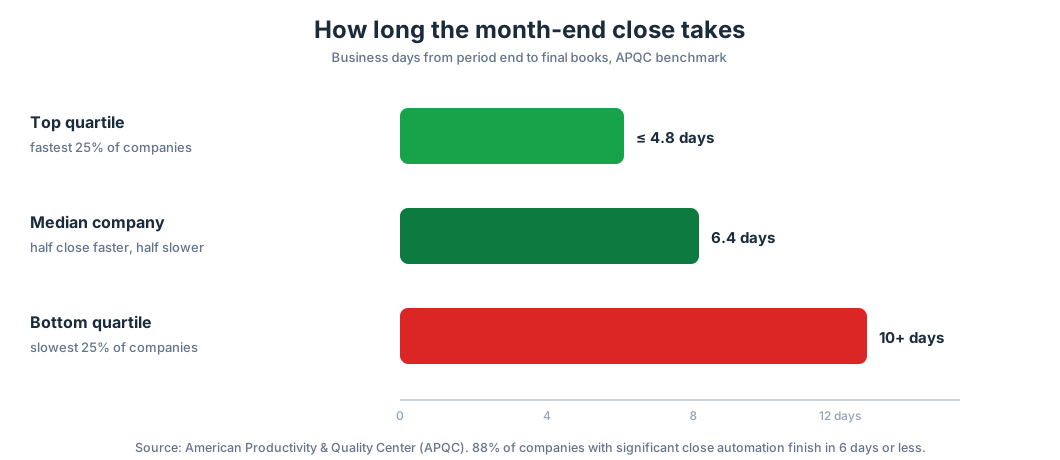
The month-end close is the monthly ritual of proving the books are right: reconcile every account, record what the month owes and is owed, review the financial statements, then lock the period. The median company needs 6.4 days to do it; the fastest quarter finishes in 4.8 days or less and the slowest quarter takes 10 days or more (APQC). The difference is rarely talent. It is a documented order of operations, current bank feeds, and a reviewer who signs off before anything locks — run the same five-day sequence every month, and the close stops being a crisis.
This guide gives you the timetable, the worked numbers, the data on where closes go wrong, and a checklist your firm can run tomorrow.
Why the close eats your calendar
Start with the honest numbers, because they explain the stress.
The American Productivity & Quality Center (APQC) tracks close performance across companies, and the spread is brutal: the median company takes 6.4 days to close the books, the top quartile finishes in 4.8 days or less, and the bottom quartile needs 10 days or more. The fastest companies are not working harder — APQC's data shows that 88% of companies with significant close automation finish in 6 days or less. Automation is doing the compressing.
The human cost sits on top of the calendar cost. A FloQast survey of close professionals, conducted by Dimensional Research, found that 82% describe the month-end close as a negative personal experience — 60% report rising stress levels, and a quarter said close pressure had pushed employees to leave. Only 1 in 4 were "very confident" their last close was error-free, and 3 in 4 had to reopen the books after close to fix errors. The Journal of Accountancy, interviewing FloQast's CEO, reported that over a third of accountants say the close impacts their personal relationships — missed birthdays, rescheduled medical appointments, vacations moved.
The causes are unglamorous. An Adra financial-close survey found 73% of finance teams still run a manually intensive, spreadsheet-driven process, 54% cite coordinating information from other departments as a top obstacle, and 44% struggle with reconciling across multiple systems. And 71% of FloQast respondents said their close process was "tribal knowledge" — undocumented, passed person to person. When the process lives in someone's head, it dies on their sick days.
It does not have to look like this. Podimo, the podcast subscription company, cut its close from 14 working days to 4 by replacing outsourced, spreadsheet-heavy work with a formalized checklist and reconciliation tooling. Fourteen to four is not a marginal gain; it is a different business.
For small businesses, the bar is lower and more attainable: most small firms with current bookkeeping close in three to five business days. The enemy of the small-business close is not complexity — it is catch-up. A firm that keeps feeds current and reconciles weekly closes in days. A firm that opens the month's books for the first time on the 3rd closes in weeks.
Soft close vs. hard close: know which one you are running
Not every month needs the full ceremony. There are two kinds of close:
The soft close is the monthly rhythm: bank accounts reconciled, accruals posted, statements reviewed, numbers that management can use. Most small businesses should run a soft close every month.
The hard close is the audited-grade version: every balance-sheet account reconciled with support, intercompany eliminated, periods locked, nothing editable without a formal reopen. Hard closes typically happen quarterly and annually, and any business that reports to a bank or investors does them more often.
The trap is running a hard close every month with soft-close discipline — the full effort, none of the controls — or running a soft close at year-end and discovering in January what should have been caught in March. Decide per client which months are which, write it down, and schedule the hard closes before the year starts.
The five-day close: stage by stage
Order is the whole game. Every delay trap in the next section is a symptom of starting a stage before its inputs are ready. Here is the sequence, one business day per stage, for a typical small-business client: bank feeds, one payroll, no inventory, no intercompany.
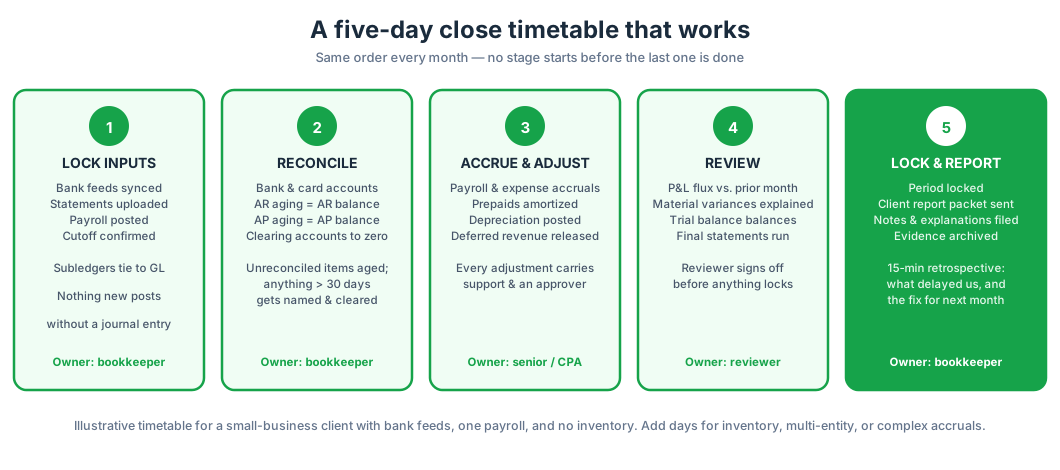
Day 1 — Lock the inputs
Before anyone reconciles anything, confirm the month is complete. Bank feeds synced to the last day of the month. Statements downloaded or uploaded. The final payroll of the month posted. Credit card feeds current. Subledger totals — AR, AP — tie to the general ledger.
Then set the cutoff: what belongs to this month and what belongs to next month. Bills dated the 1st, deposits that cleared on the 31st, payroll earned in August but paid in September. The cutoff decision is a two-minute conversation that prevents a two-hour argument on Day 4.
Nothing new posts to the period after this point except through a journal entry with a reviewer. If the client keeps entering August transactions on September 6th, your close never actually starts.
Day 2 — Reconcile the balance sheet
Start with cash — every bank and card account reconciled to its statement, to the penny. Then work outward: AR aging equals the AR control balance. AP aging equals the AP control balance. Payroll clearing accounts net to zero. Credit card clearing, loan balances, deferred items.
Age every unreconciled item. Outstanding checks and deposits in transit are legitimate timing differences; anything outstanding more than 30 days is probably not timing anymore and gets named, explained, or cleared. The aged exception list is the single most useful page in the close packet.
Day 3 — Accrue and adjust
Record what the month owes and is owed, regardless of when cash moves:
- Payroll accrual — days worked in the month but paid after month-end.
- Prepaid amortization — insurance, software, rent paid ahead; release the month's slice.
- Deferred revenue — cash collected for work not yet delivered; recognize what was earned.
- Depreciation — the month's fixed-asset charge, posted from the register.
- Expense accruals — utilities, professional services, and contractors billed in arrears.
Run recurring entries from templates — depreciation, amortization, the standing accruals — rather than rebuilding them by hand each month. Templates are a control, not a convenience: the same entry, the same support, every month. Every adjusting entry carries documentation and an approver. An adjustment nobody approved is a guess wearing a journal entry's clothes.
Day 4 — Review and sign off
Now — and only now — look at the income statement. Run a flux analysis: this month versus last month, versus budget, line by line, with a materiality threshold your firm actually set. Every line that moved more than the threshold gets a one-line explanation. Unexplained flags stay open; they do not disappear because the meeting is in an hour.
Run the final statements: income statement, balance sheet, cash flow. Check that the trial balance balances (it should — but check). Then the reviewer — a human with authority — reviews the packet, the exception list, and the adjustments, and signs off. No signature, no lock.
Day 5 — Lock, distribute, learn
Lock the period in the accounting system. Generate the client packet: the three statements plus a short cover note explaining what moved and why — clients do not read raw statements, they read your one page. File the reconciliations, approvals, and explanations together as the month's evidence.
Then the fifteen-minute retrospective, which is where next month gets faster: what delayed us, what was the root cause, what is the fix. Fix the system, not the month. A close that takes six days because of the same missing receipt every month is not a close problem; it is a client-communication problem wearing a close problem's costume.
A worked example: Harborline Landscaping, August 2026
Theory is cheap. Here is a full close for a fictional client — Harborline Landscaping, a 12-person landscaping company with one operating account, one payroll, and no inventory — with real numbers that tie out.
Day 1 — inputs. The August bank statement arrives: ending balance $48,312.44. Payroll for the last August pay period posted. The bookkeeper confirms cutoff: the $2,900 equipment invoice dated September 1st belongs to September, and the August 31st card deposit of $1,150 that cleared September 2nd belongs to August.
Day 2 — reconciliation. The operating account reconciles as follows:
| Amount | |
|---|---|
| Bank statement balance, Aug 31 | $48,312.44 |
| Less: outstanding check #2041 (Aug 28, mulch supplier) | ($410.00) |
| Adjusted bank balance | $47,902.44 |
| Book balance, Aug 31 | $47,902.44 |
| Difference | $0.00 |
One timing item, one check, zero difference. AR aging ($23,480) ties to the AR control account. AP aging ($9,115) ties to AP. The payroll clearing account nets to zero. Nothing is older than 30 days.
Day 3 — adjustments. Three journal entries:
| Entry | Debit | Credit |
|---|---|---|
| Payroll accrual — 2 days worked Aug 30–31, paid Sep 5 | Wages expense $1,840 | Accrued payroll $1,840 |
| Insurance amortization — August slice of annual policy | Insurance expense $312 | Prepaid insurance $312 |
| Depreciation — August, mowers and trucks | Depreciation expense $1,175 | Accum. depreciation $1,175 |
All three are recurring templates; total hands-on time is about ten minutes.
Day 4 — review. Flux analysis flags two lines: subcontractor expense up 38% versus July (explained: the August commercial contract that started mid-month — one line, documented), and fuel expense down 22% (explained: two trucks down for maintenance the last week — one line, documented). The reviewer signs off.
Day 5 — lock and report. The period locks. The client packet goes out with a one-page cover note. Retrospective: the mulch supplier's check took 24 days to clear — the bookkeeper notes it, and next month's aged list will flag it earlier.
The time math. Before the firm standardized this sequence, Harborline's close took 9 hours of hands-on work spread over 8 calendar days — mostly waiting: a missing statement, a payroll figure chased by text message, a flux question answered the following week. After: 2.5 hours over 4 business days. At a $65/hour blended bookkeeping rate, that is $422.50 saved per month, $5,070 per year, for one client. Multiply that across a book of forty clients and the close stops being overhead and starts being capacity.
Where the time actually goes
If the close feels like it takes forever but nobody can say why, the surveys can say why. The obstacles accountants name most are not exotic:
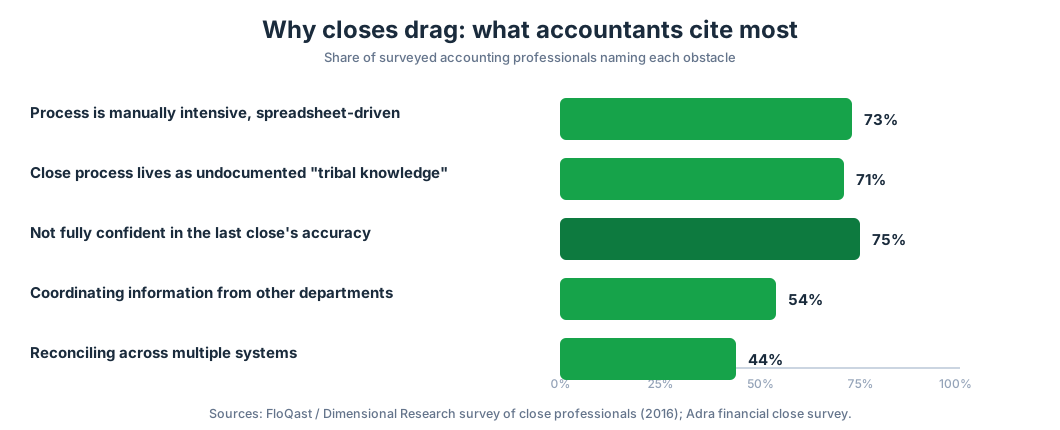
Read that chart as a priority list. The top three bars — spreadsheet chains, undocumented process, and low confidence in the numbers — are all the same problem wearing different clothes: the close is not a system, it is a habit. Document the steps, move the ticking out of spreadsheets, and the confidence number moves with them, because confidence comes from evidence — reconciliations with support, adjustments with approvers — not from optimism.
The bottom two bars are an integration problem: information scattered across departments and systems. Every handoff is a place where the month waits. The fix is boring and effective: one checklist, one owner per line, one place where the evidence lives.
What automation changes — and what it does not
Automation compresses the mechanical stages. Bank feeds that sync daily remove the Day 1 scramble. Statement uploads with OCR remove the data-entry line of the reconciliation. Recurring journal entries remove the rebuilt-from-scratch depreciation post. AI-assisted matching clears the obvious bank matches so the human works the exception list instead of the full transaction population.
What automation does not change is the control structure. Someone still sets the cutoff. Someone still approves the adjustments. Someone still explains the flux. Someone still signs off before the lock. The firms that get the APQC top-quartile results did not automate the judgment — they automated the waiting and the typing, which is where the calendar days were hiding.
A word of caution about the numbers vendors quote: "close in half the time" claims are real in documented cases (Podimo's 14-to-4 is a published case study), but they describe firms that also fixed their process. Software layered over tribal knowledge and stale feeds produces a faster mess. Run the timetable first, then let the tools compress it.
How the close runs inside LedgerHQ
A close is only as fast as the system it runs in. Here is what each stage looks like inside LedgerHQ, verified against the live product:
- Day 1 — inputs. Bank accounts connect through Plaid from the Bank Feeds page ("Connect Bank"), and each account card shows its feed status, so a broken feed is visible instead of silently stale.
- Day 2 — reconcile. The Recs & Statements screen walks each account through matching to its bank statement, with per-account cards showing pending matches and feed status. Uploaded statement PDFs land on the Statements tab with an OCR status column, so paper statements enter the same workflow as feeds.
- Day 3 — adjust. Journal entries support scheduled, recurring entries — depreciation, amortization, and standing accruals run from templates instead of being rebuilt monthly.
- Day 4 — review. The Reports section carries the reviewer's packet: Income Statement, Balance Sheet, Trial Balance, Cashflow, Aged Receivables, plus Profit & Loss and Balance Sheet by period for the flux comparison, and Monthly Packets for the client-ready bundle.
- Day 5 — lock and report. The period locks; the packet goes out.
- Throughout — the assistant. Tally, the AI bookkeeper, sits in the sidebar through the whole close: ask it which accounts are unreconciled, what changed since last month, or what is blocking the lock, and it answers from the live books instead of making you hunt.
Nothing here is a demo promise — every screen above exists in the product today. See the close workflow in a 1:1 demo, or start a LedgerHQ account and run next month's close in it.
The six ways closes break
Every firm hits these. The difference is whether you recognize them as patterns or treat each one as a surprise.
The reopen. Three in four accountants have reopened the books after close to fix errors. Sometimes the reopen is legitimate — a late invoice arrives. Often it is a control failure: the period was "closed" before the review happened. The defense: the review signature precedes the lock, always, and reopens require a reason recorded in the system. A period that gets reopened monthly is not closed; it is paused.
Stale inputs. The bank feed stopped syncing six days ago and nobody noticed, so Day 2 reconciles against old data and produces a clean-looking close against wrong numbers. The defense: every feed displays its last successful sync, and anything older than 48 hours blocks matching until refreshed. Freshness is a control, not a convenience.
The mystery plug. A $37.12 difference that will not resolve becomes a manual adjusting entry to "miscellaneous expense" with no memo. Next month there is another one. Within a year the plug account holds thousands of dollars of unexplained money. The defense: plugs hit a visible account, carry a memo, and appear in the reviewer's queue. A plug nobody reviews is where errors go to hide.
Tribal knowledge walks out the door. The senior who "just knows" which clients need the extra accrual leaves, and the close falls apart for two months. The defense is the checklist itself: if the process is documented step by step, with owners and thresholds, a new person can run it. Seventy-one percent of firms admit their close is tribal knowledge. Be in the other 29%.
The waiting game. The close stalls on Day 2 because the client has not sent the loan statement, or the payroll provider's report is late, or the partner needs to "look at something" and disappears. The defense: assign every input an owner and a due date on Day 1, and chase on schedule, not on hope. Missing-information follow-up is part of the close, not an interruption of it.
Review theater. The reviewer glances at the statements, asks "does this look right," and signs. That is not a review; it is a ritual. The defense: the reviewer works from the exception list and the flux explanations, not from vibes. If there is nothing to review — no exceptions, no unexplained variances — that is the best possible sign, and the sign-off takes two minutes.
The firm checklist: run this tomorrow
Do not overhaul everything at once. Start here, in order:
- Write down the five-day sequence. Day 1 inputs, Day 2 reconcile, Day 3 adjust, Day 4 review, Day 5 lock. Post it where the team works. The sequence is the system.
- Decide soft vs. hard per client. Which clients get the full hard close each quarter, and which run soft closes monthly. Write it in the client file.
- Set a real calendar. Close dates on the firm calendar, inputs due Day 1, review due Day 4. A close without dates is a wish.
- Template the recurring entries. Depreciation, amortization, standing accruals, payroll accruals. Same entry, same support, every month — no rebuilding.
- Set flux thresholds and mean them. Pick the materiality number per client. Every line past the threshold gets a one-line explanation, every month.
- Name the reviewer. Every close has a named human who signs off before the lock. In a solo firm that is you, in a different hat — still write it down.
- Age the exceptions. Every unreconciled item gets an age. Anything over 30 days gets named, explained, or cleared. No exceptions to the exception rule.
- Document the tribal knowledge. Have the senior walk through the close once, out loud, while someone writes. That document is now the process.
- Lock prior periods. Once a period closes clean, it stays closed. Adjustments go through a formal reopen with a reason, not a quiet edit.
- Run the retrospective. Fifteen minutes, every month: what delayed us, what is the root cause, what changes next month. This is how a six-day close becomes a four-day close.
Measure one thing for the first quarter: hands-on hours per client per month, before and after. That number — not a vendor's brochure, not a feeling — is what you use to plan capacity, set prices, and decide what to automate next.
Frequently asked questions
How long should a month-end close take?
The APQC median is 6.4 days; top-quartile companies finish in 4.8 days or less. For a small business with current bookkeeping, three to five business days is a realistic target. Complexity — inventory, multiple entities, intercompany — adds days, not hours.
What is the difference between a soft close and a hard close?
A soft close is the monthly rhythm: reconciled accounts, posted accruals, reviewed statements, usable numbers. A hard close is the audited-grade version with every balance-sheet account supported, periods locked, and formal reopens. Most firms run soft closes monthly and hard closes quarterly and annually.
What is the first thing to fix in a slow close?
The order of operations. Most slow closes are not slow because any single step is hard — they are slow because review starts before inputs are ready, or adjustments get posted before reconciliations are done. Run the five-day sequence in order before buying any software.
Do I need to reconcile every account every month?
Every account with activity, yes — at minimum the bank and card accounts, AR and AP control accounts, and payroll clearing. Dormant balance-sheet accounts can run on a quarterly rotation, but the rotation should be written down, not improvised.
How do I handle a client who sends information late?
Make lateness visible and structural: every input has an owner and a due date on the close calendar, and the retrospective names the delay each month. Chronic lateness is a client-management problem — scope it, price it, or fix the intake process. It is not a bookkeeping problem.
Should the same person prepare and review the close?
No, where staffing allows it. The preparer and the reviewer should be different people — that is the point of the control. In a solo firm, separate the roles in time: prepare one day, review the next, with the checklist as the second set of eyes.
What is flux analysis?
Comparing this month's income statement to prior months and budget, line by line, and explaining every movement past a set materiality threshold. It is the reviewer's main tool: most close errors show up as an unexplained line moving oddly.
Can AI do the month-end close?
AI compresses the mechanical stages — matching, extraction, recurring entries — but it does not replace the control structure. Cutoff decisions, adjustment approvals, flux explanations, and the final sign-off stay human. The firms with the fastest closes automated the waiting and the typing, not the judgment.
Sources
- APQC close benchmarks (median 6.4 days; top quartile ≤ 4.8 days; bottom quartile 10+ days): Phocas Software, "Are you keen to speed up the month-end close process?" — https://www.phocassoftware.com/resources/blog/are-you-keen-to-speed-up-the-month-end-close-process
- APQC figures (6.4-day average; 88% of highly automated companies close in ≤ 6 days): Roark Financial Services — https://www.roarkfs.com/insights/how-to-shorten-your-monthly-or-quarterly-financial-close-process?hs_amp=true
- FloQast / Dimensional Research 2016 close survey (82% negative experience; 60% stress; 1 in 4 very confident; 3 in 4 reopen books; 71% tribal knowledge): FloQast press release — https://www.floqast.com/au/press-releases/survey-reveals-chaotic-month-end-close-process-robs-employees-work-life-balance-error-prone ; FM Magazine — https://www.fm-magazine.com/news/2017/may/overtime-stress-common-during-month-end-close-201716585/
- Adra financial close survey (73% spreadsheet-driven; 54% coordinating info; 44% reconciling across systems; 84% want less time): via FM Magazine — https://www.fm-magazine.com/news/2017/may/overtime-stress-common-during-month-end-close-201716585/
- "82% describe the close as a negative experience; over a third say it impacts personal relationships": Journal of Accountancy, "Ask the expert: Technology — Mike Whitmire, FloQast" — https://www.journalofaccountancy.com/issues/2019/sep/mike-whitmire-floqast-month-end-close-technology/
- Podimo: 14 working days to 4 with formalized close management: FloQast case study — http://www.floqast.com/stories/how-podimo-cut-its-month-end-close-to-four-days
- Small-business close timeline (3–5 business days with current bookkeeping): EbizCharge — https://ebizcharge.com/resources/templates/accounting-month-end-close-checklist/
- Close-process ordering (9-step framework adapted for the five-day timetable): Xenett — https://www.xenett.com/blog/robust-financial-close-process
- Size-dependent timelines (large companies ~3 days, smaller companies up to 14 days): Numeric — https://www.numeric.io/blog/how-long-does-month-end-close-take
- The worked example (Harborline Landscaping) is fictional and illustrative; all figures tie out arithmetically as shown.
- LedgerHQ product claims (Plaid bank feeds, Recs & Statements, statement OCR, reports list, Tally close Q&A, period lock) verified against the live LedgerHQ app (2026-09-22) and the app's in-app help knowledge and Tally tool catalog (2026-09-23).
- All third-party web sources accessed September 2026; publication dates as given by each publisher.