
Firm operations
The Solo Bookkeeper's Hiring Playbook: Your First Contractor, Reviewer, or VA
Every solo bookkeeper hits the capacity wall. The 80% rule that tells you when to hire, the loaded-cost math behind the BLS $50,670 median, contractor vs. W-2 vs. VA economics, the IRS classification test, the delegation ladder, and a 90-day playbook — with sources.
The short answer
Every solo bookkeeper hits the same wall, usually somewhere between the twenty-fifth and fortieth client. The work that fit comfortably in a month stops fitting. Weekends disappear first, then review quality, then — if you wait too long — clients. The question is never really whether to hire. It is what kind of hire, when, and what you hand them on day one.
Here is the whole playbook in one paragraph: hire when your utilization crosses 80% of your real monthly capacity, not when you are drowning at 100%. Price the hire on loaded cost, not the wage — a bookkeeper at the national median costs about $72,500 a year once benefits and payroll taxes are in, while a US contractor at typical freelance rates costs around $55 an hour with zero overhead, and an offshore VA around $13. Pick the door that matches the work: contractors for lumpy overflow, a part-time W-2 for the keeper role, a VA for process work that runs on checklists. Run the IRS classification test honestly before anyone starts — the contract label does not decide it. Hand work off from the bottom of the delegation ladder up, and give the whole thing 90 days. Every number in this article is sourced, and the arithmetic is shown.
The math that decides: capacity first, feelings second
Solo owners hire on feeling: the Sunday-night dread, the inbox at midnight, the client you almost lost because a close ran two weeks late. Feeling is a lagging indicator. Capacity is a leading one, and it is simple arithmetic.
Start with your real month. A solo owner has about 160 working hours in a month. Roughly 40 of those are non-billable and non-negotiable: marketing, admin, email, the software that needs updating, the proposal that needs writing. That leaves about 120 productive hours.
Now the production load. A typical small-business monthly client takes about 3 hours of production work: coding, reconciling, following up, assembling the close. Your number may be 2 or 5 — plug in your own — but 3 is a fair planning figure.
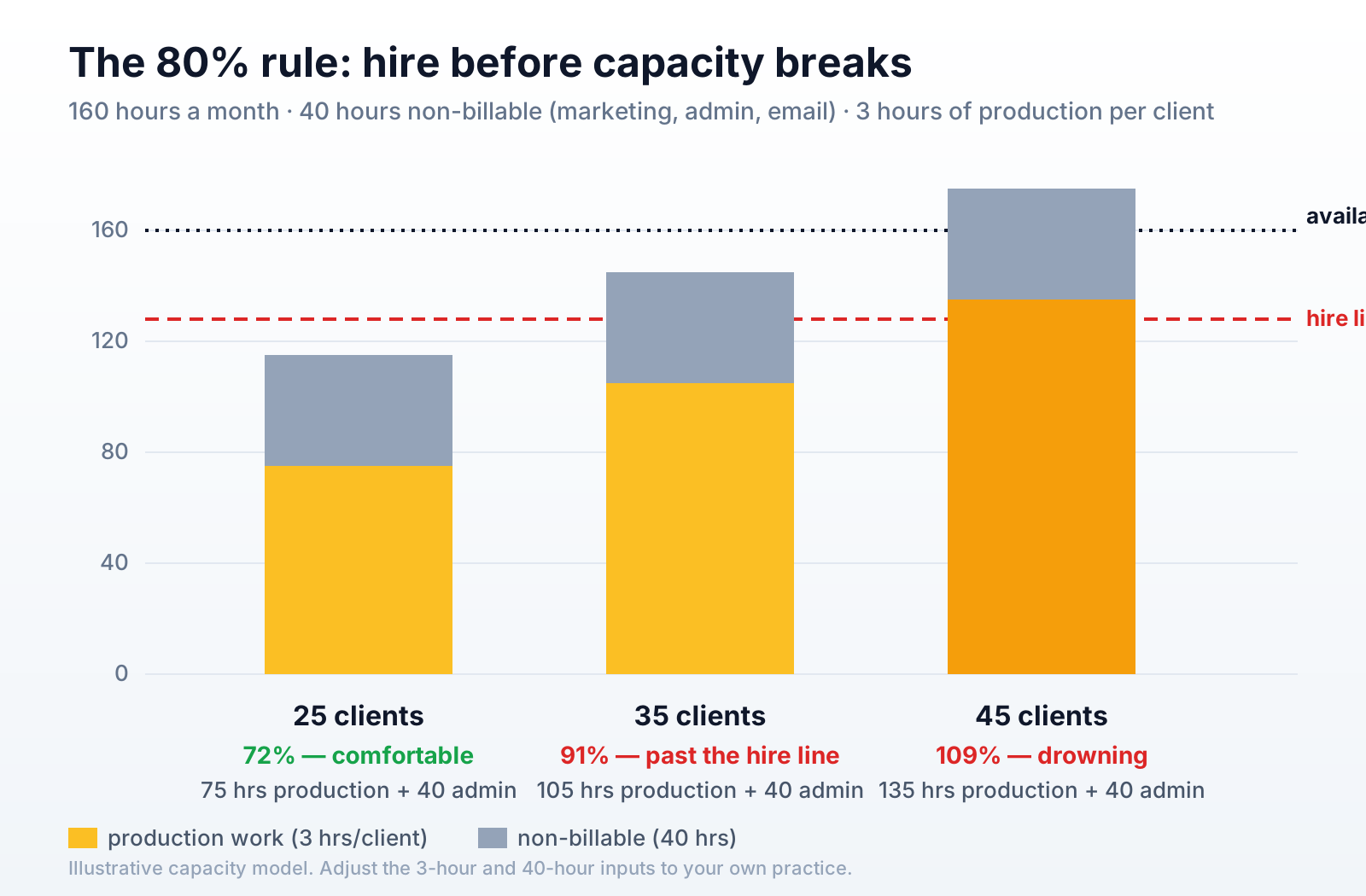
At 25 clients, you are at 72% — comfortable, with room to sell. At 35 clients, you are at 91% — past the hire line, and every new client now degrades the service of the existing ones. At 45, the math says 109%, which is not a number anyone actually works; it is the number at which things start breaking silently.
The rule: hire at 80%, not at 100%. Eighty percent of 160 hours is 128 hours. The reason is that hiring takes 60 to 90 days from decision to a productive teammate (see the playbook below), and during those 90 days you will keep selling — or you should, because a hire without a full pipeline behind them is the other expensive mistake. If you start hiring at 100%, you spend the entire onboarding quarter underwater, and the new hire's first impression of your firm is chaos. Nobody does their best work while being trained by someone who is drowning.
Three warning signs that the model is confirming, in case you distrust arithmetic:
- You are turning away or slow-walking new business. Every declined $200-a-month client is $2,400 a year of revenue you paid to acquire and then refused. That is the most expensive line item in this whole article.
- Review quality is slipping. You used to catch the miscoded freight charge before the close went out. Now you catch it in April, or the client's CPA does. Rework is production work you pay for twice.
- The work is leaking into life. Weekends, evenings, the vacation you checked email through. This one matters because burnout is how solo owners lose not just capacity but the business itself.
What your first hire really costs: the loaded-cost math
The wage is the smallest number on the page. Here is the full stack, bottom to top, using the Bureau of Labor Statistics' current data.
The wage. The BLS puts the median pay for bookkeeping, accounting, and auditing clerks at $50,670 a year — $24.36 an hour — as of May 2025. The lowest-paid 10% earn less than $36,000; the highest-paid 10% earn more than $74,550. There are about 1.53 million of these jobs, and the occupation is projected to shrink 6% through 2035 — though the BLS still expects roughly 144,100 openings a year, all of them from people retiring or leaving the field. (Source: BLS Occupational Outlook Handbook, updated August 2026.)
The load. Wages are only part of what an employee costs. The BLS Employer Costs for Employee Compensation survey for March 2026 found that for private-industry workers, wages are 69.9% of total compensation and benefits are the other 30.1% — paid leave, insurance, retirement, and legally required benefits like Social Security, Medicare, unemployment insurance, and workers' compensation. Apply that ratio to the median clerk wage: $24.36 divided by 0.699 is $34.85 an hour, or about $72,494 a year for a full-time hire. That is illustrative — your actual load depends on your state and your benefits — but it is the right order of magnitude, and it is the number most first-time hirers never compute.
Just the employer's share of FICA on the median wage is 7.65%, or $3,876 a year — before unemployment insurance, workers' comp, or a single day of paid leave.
The market alternatives. Current Robert Half contract postings for bookkeepers run roughly $22 to $40 an hour depending on the market — Little Rock at the low end, New York at the high end, full-charge roles in Indianapolis around $28 to $34. (Source: Robert Half job listings, October 2026.) US freelance bookkeepers on platforms like Upwork span $25 to $90 an hour, with $55 a reasonable planning midpoint; offshore bookkeepers and VAs through the same channels run $8 to $18 an hour, midpoint $13. (Source: Zedtreeo 2026 freelance rates guide, compiled from Upwork, Glassdoor, PayScale, and BLS data.)
The hidden line items. Budget 5 to 10 hours a month of your own time managing the hire in the first quarter — that is real cost, priced at whatever your hour is worth. Budget the cost of getting it wrong, too: SHRM's benchmarking puts the average cost-per-hire at $5,475 for nonexecutive roles, and the Society for Human Resource Management estimates that replacing an employee who leaves costs six to nine months of their salary — $25,300 to $38,000 at the median clerk wage. A rushed hire is the most expensive hire.
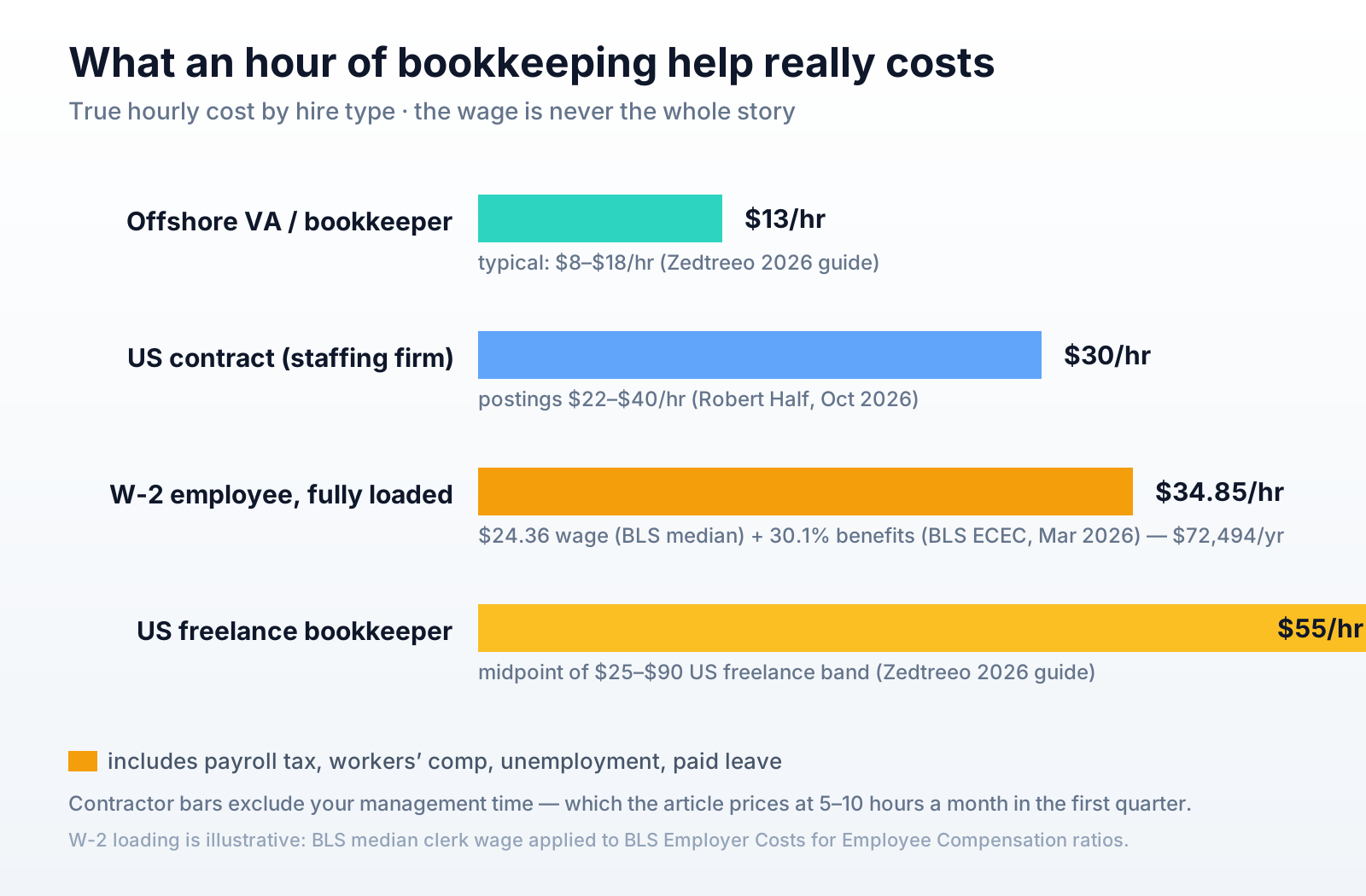
Read the chart carefully: the W-2 bar includes everything — payroll tax, unemployment, workers' comp, leave. The contractor bars include none of your management time. Neither number is the "real" one until you add the missing piece. That is the honest comparison, and it is why the next section matters more than the chart.
Contractor, part-time employee, or VA: the three doors
There are three ways to buy your first pair of hands. They are not interchangeable — each one wins in a different situation.
| Contractor | Part-time W-2 employee | VA / offshore | |
|---|---|---|---|
| Best for | Lumpy overflow, cleanup projects, busy seasons | The keeper role: someone who learns your firm | Process work that runs on checklists |
| Typical true cost | ~$55/hr, zero overhead | ~$13/hr, zero overhead | |
| Control | Low by design — you buy outcomes | Full — schedule, methods, priorities | Medium — tight SOPs required |
| Commitment | None; scale up and down | Payroll, compliance, a real relationship | None; but training investment |
| Biggest risk | Misclassification if you manage them like staff | Turnover cost if you hire badly | Quality drift without review systems |
| Wins when | Demand spikes and dips | You have steady 15–25 hrs/week of work | Follow-ups, inbox, document chase eat your week |
Door one: the contractor. A contractor is how you buy capacity without buying commitment. Twenty hours a week at $35 an hour is $2,800 a month — $33,600 a year — with no benefits, no payroll tax, no unemployment exposure, and no severance conversation if the work dries up. The trade is control: a real contractor sets their own hours, uses their own tools, and works for other clients. If you need someone at your desk, on your schedule, doing it your way — that is not a contractor, and calling them one does not make it so (more on this below).
Door two: the part-time W-2. This is the door most solo owners actually want but talk themselves out of because it feels "serious." A part-time employee at 20 hours a week, loaded at $34.85 an hour, costs about $36,200 a year — barely more than the contractor — and you get schedule control, training investment that stays in the firm, and someone who can grow into the keeper role. The compliance load is real but small at this size: an EIN, a payroll provider, state unemployment registration, workers' comp. A payroll service handles nearly all of it for the price of one client retainer a month.
Door three: the VA. The VA door is for a specific pain: the follow-up work. Chasing missing statements, organizing the inbox, sending the monthly checklist, nudging the client who has not answered in six days. This work is high-volume, low-judgment, and it is what actually eats a solo owner's week — owners consistently underestimate it because it arrives in five-minute fragments. A VA at $13 an hour for 15 hours a week is about $850 a month. The requirement is non-negotiable: everything the VA touches must run on a written checklist, because you cannot manage judgment at a distance and across a time zone. Process work, not judgment work.
Most firms that grow well walk through the doors in order: contractor for the spike, VA for the process load, part-time W-2 for the keeper. The order matters because each hire teaches you what the next one's job description should say.
The classification question you cannot skip
This is the section first-time hirers skip, and it is the one that can cost the most. Whether your helper is a contractor or an employee is not decided by what the contract says. It is decided by the IRS's common-law test, and the IRS looks past the label to the actual working relationship.
The test has three categories of evidence:
- Behavioral control — do you control how the work gets done, not just the result? Who sets the hours and the location? Do you train them in your methods? Must they follow your procedures in your sequence? Can they send someone else to do the work?
- Financial control — who controls the economics? Do they invest in their own tools? Can they profit or lose on the job? Do they offer their services to the general market? Are they paid by the project or by the hour?
- Type of relationship — is there a written contract, and what does it actually describe? Benefits? An indefinite relationship versus a project with an end? Is the work a key activity of your business — and for a bookkeeping firm, bookkeeping is definitionally a key activity.
No single factor decides it. But read those lists honestly against the "contractor" who works only for you, on your schedule, in your systems, doing the core work of your firm: the substance controls, and the substance says employee.
The stakes: a business that treats an employee as a contractor without a reasonable basis can be held liable for the employment taxes it never withheld, plus interest, under Internal Revenue Code section 3509. There is a relief provision — Section 530 — but it requires a reasonable basis for the classification, consistent information returns, and never having treated a substantially similar worker as an employee. When the answer is genuinely unclear, Form SS-8 puts the question to the IRS directly — and a determination takes at least six months to arrive. (Sources: Top Pro Accounting's 2026 classification guide, citing IRS Publication 15-A; EveryCentCounts' 2026 explainer.)
The practical rule for a solo firm: if the person works like staff, hire them like staff. The part-time W-2 is often cheaper than the audit. And none of this is legal advice — run your specific situation past your CPA or employment attorney before anyone starts. (Sources for this section are linked below; the IRS's own Publication 15-A is the primary reference your advisor will use.)
What to hand off first: the delegation ladder
The most common first-hire failure is not hiring the wrong person. It is handing them the wrong work — usually everything, all at once, with no system. Work climbs the ladder from the bottom. Nothing moves up a rung until the rung below it runs clean for two full closes.
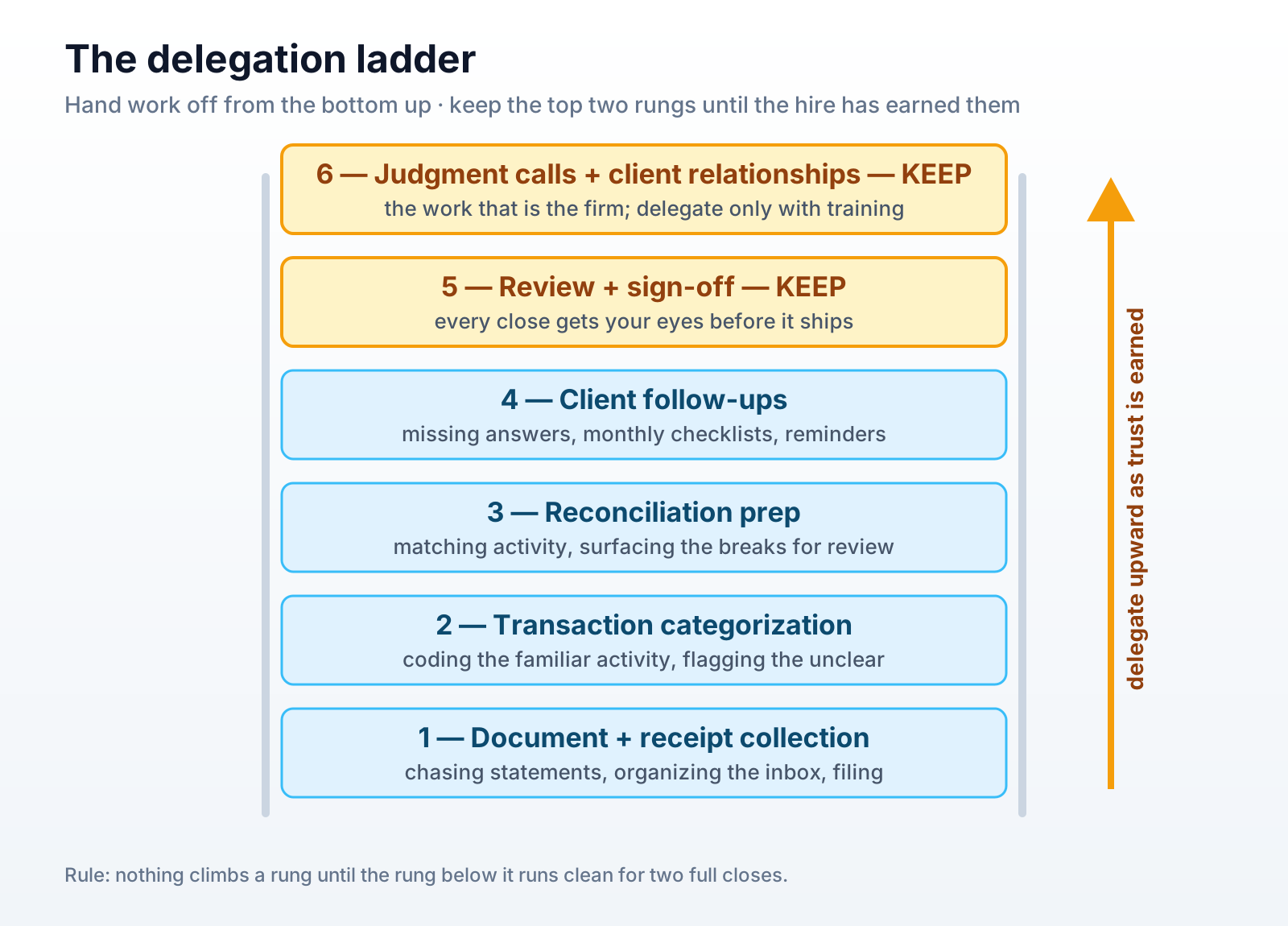
Rung 1 — document and receipt collection. Chasing statements, organizing the inbox, filing. Nobody's judgment is required; everybody's time is consumed. This is VA work on day one.
Rung 2 — transaction categorization. Coding the familiar activity, flagging the unclear items instead of guessing. This is where most contractors and junior hires start, and it is the rung where a written chart-of-accounts guide pays for itself ten times over.
Rung 3 — reconciliation prep. Matching activity, tying the accounts, surfacing the breaks in plain language for review. Note the word prep: the hire assembles, you review.
Rung 4 — client follow-ups. The monthly checklist, the missing-answer nudge, the "we still need March's Amex statement" email. Follow-up is a system, not a personality trait — give it a template and a cadence.
Rung 5 — review and sign-off. Keep this. Every close gets your eyes before it ships, until the hire has earned spot-check status with months of clean work. Your name is on the financials.
Rung 6 — judgment calls and client relationships. Keep this longest. The "was that transfer an owner contribution" calls, the pricing conversations, the relationship itself. This is the firm. A hire earns their way here through training, not tenure.
The ladder is also a hiring filter: if a candidate cannot explain what they would do when a transaction is genuinely unclear — flag it, document what they know, move on — they are not ready for rung 2, no matter how impressive the resume.
The 90-day playbook
Hiring is a project with a schedule. Here is the one that works, compressed from what good small firms actually do:
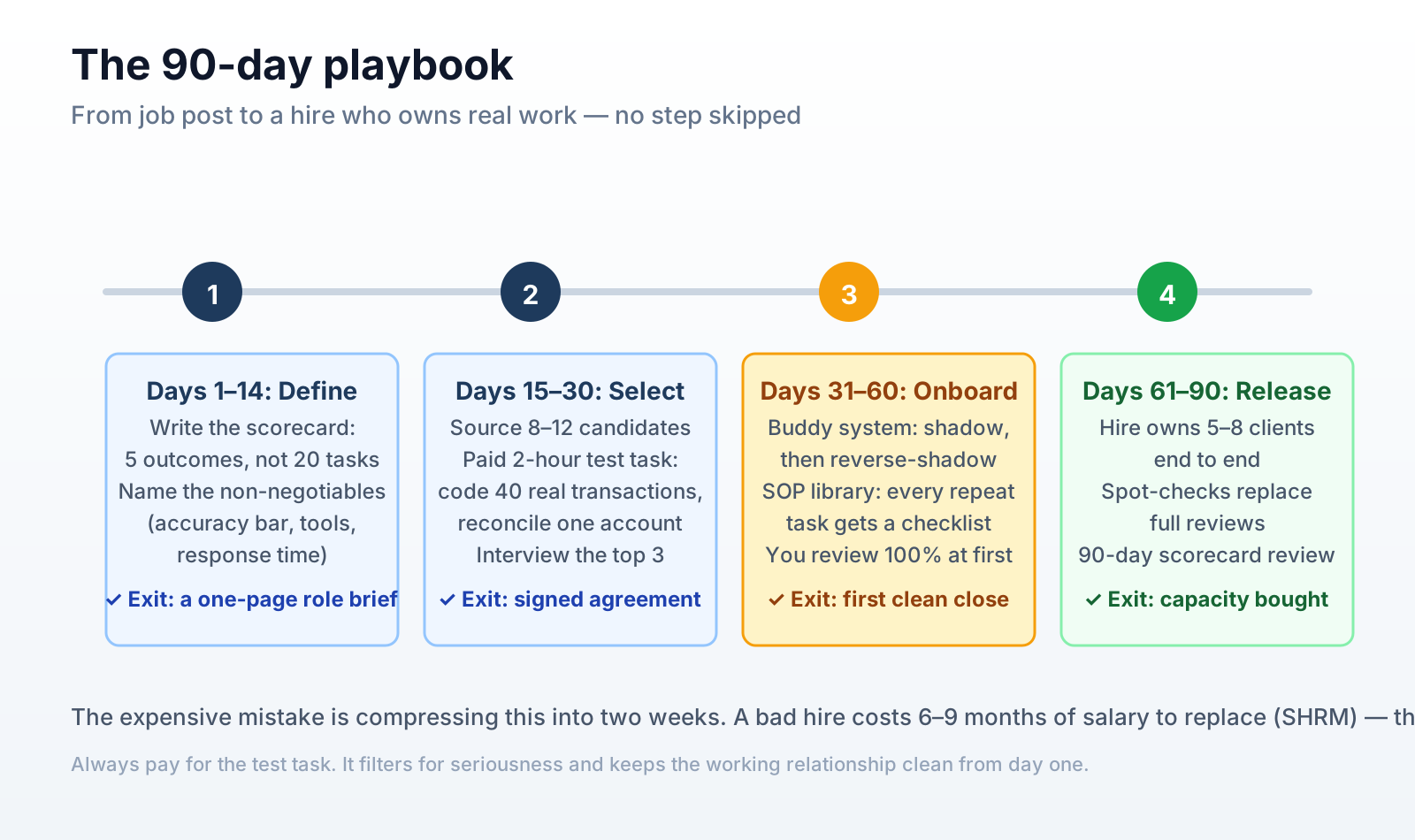
Days 1–14: Define. Write a one-page role brief built around a scorecard: five outcomes the hire must produce in 90 days, not twenty tasks they must perform. "Every assigned client reconciled by the 10th" beats "reconcile accounts." Name the non-negotiables up front: the accuracy bar, the tools, the response time, the hours. If you cannot write the scorecard, you are not ready to hire — you do not have a role yet, you have a feeling.
Days 15–30: Select. Source 8 to 12 candidates — referrals from other firm owners beat job boards for this role, because bookkeepers who are good at client work are known to other bookkeepers. Then the step everyone skips: a paid two-hour test task. Forty real transactions to code, one account to reconcile, from a scrubbed copy of real data. Pay for it — it filters for seriousness, it shows you actual work instead of interview performance, and it keeps the relationship clean from day one. Interview the top three. Check two references and ask each one: "would you hire them again to touch client books?"
Days 31–60: Onboard. Buddy system: they shadow you for a week, then you reverse-shadow them. Every repeat task gets a checklist in a shared SOP library — the hire builds the library as they learn, which means your systems improve because you hired. You review 100% of their work at first. The exit criterion for this phase is one full close with zero material corrections from you.
Days 61–90: Release. The hire owns five to eight clients end to end. Full reviews become spot-checks. At day 90, run the scorecard review against the five outcomes you wrote on day one. Renew, adjust, or part ways — the scorecard makes it a business decision instead of an awkward conversation.
The expensive mistake is compressing this into two weeks. Remember the turnover math: replacing a bad hire costs six to nine months of salary. Ninety deliberate days are cheap insurance.
Making the hire pay for itself
A hire is not an expense to minimize. It is capacity to monetize. Run the break-even before you post the role.
Take the contractor door: 20 hours a week at $35 an hour is $2,800 a month. At a $200 monthly retainer, that is 14 client-months — fourteen clients for one month, or seven clients for two. But the better math is capacity: 20 hours a week is about 87 hours a month, and at 3 hours of production per client, that is roughly 29 client-slots of capacity bought. You will not fill all 29 in quarter one. You need to fill 14 retainer-equivalents to break even, and every client after that is margin.
The deeper framing: you are not hiring someone to do the same work cheaper. You are buying back the 20 hours a week you currently spend on production so you can spend it on the two things only you can do — selling and reviewing. One new $200-a-month client is $2,400 a year; fourteen of them fund the contractor entirely, and the fifteenth is profit. Owners who hire "to get relief" break even. Owners who hire "to buy selling time" grow.
Two discipline checks. First, the margin check: revenue per labor hour, firm-wide, must rise after the hire — if it falls, you bought capacity you are not selling, and the fix is marketing, not a smaller hire. Second, the timing check from the capacity chart: hire at 80%, when you still have the slack to train well. Hiring at 110% means the training happens in the cracks, the hire learns your panic instead of your system, and you have paid SHRM's six-to-nine-months tuition to learn what the chart already told you.
Why hiring got harder — and why that favors the careful
Some context on the labor market you are hiring into. The AICPA has formally designated the accounting talent situation a "pipeline crisis." Accounting degree completions sit at a 20-year low. Roughly three-quarters of today's public-accounting CPAs will reach retirement eligibility within the next 15 years, and the active accounting and auditing workforce has already contracted by an estimated 17% since its 2019 peak. (Source: The Expert CFO, September 2026.) For bookkeeping clerks specifically, the BLS projects a 6% employment decline through 2035 — but still expects about 144,100 openings a year, every one of them a replacement for someone who retired or left.
Read that as a solo owner and the strategy writes itself. You are not going to outbid anyone for credentials — and you do not need to. Hire for trainability, reliability, and communication; teach the technical work through your SOP library and your review process. And treat retention as the strategy: in a market where experienced help is scarce, the cheapest hire is the one you do not have to make twice. Clear expectations, a real scorecard, flexibility on hours, and pay at or above the local market beat a foosball table every time — and in a five-person firm, your culture is just how it feels to work for you on a Tuesday.
The fourth door: shrink the production work first
There is a fourth option the first three doors assume away: need less production labor in the first place.
Step back to the capacity chart. The 3-hours-per-client figure is a choice, not a law of nature — it is the cost of doing production work by hand. When software does the routine work, the owner's job collapses to review. LedgerHQ's own economics illustration puts it at about 10 minutes of review per client each week with Tally handling the production — the site labels it an illustration using its Essentials pricing and notes plainly that it is not a promise of earnings and results depend on the work. But the mechanism is verifiable on the product's own homepage: "Tally does more than answer questions. She codes transactions, works reconciliations, follows up for missing information, and prepares the financials."
That changes the hiring math twice. First, it pushes the 80% line outward — the same 160 hours covers far more clients when production is automated, so the hire comes later. Second, it changes what the hire does on day one: instead of starting on rung 2 of the delegation ladder doing categorization by hand, your first hire starts closer to rung 4 and 5 — follow-ups, assembly, review support — because the machine already did rungs 1 through 3. You hire judgment earlier and data entry never.
And when you do hire, the firm workspace is built for it: "Pro adds the firm workspace, requests, company-owner access, and a team working across every company you manage. The software, Tally, and price stay the same." One place, every company, the whole team — at $20 per client per month, with a free preview running until January 1, 2027. The honest version: AI does not remove the need for human judgment in a bookkeeping firm. It moves your first hire up the ladder, so the person you pay for does the work that is actually worth paying for.
FAQ
Should my first hire be a contractor or an employee? Match the door to the demand. Lumpy, project-shaped work — a cleanup, a busy season, overflow you cannot yet see repeating — is contractor work. Steady, indefinite, 15-plus hours a week of core production is employee work, and calling it contracting does not survive the IRS's three-category test. When the work is steady and core to the firm, the part-time W-2 is usually both cheaper than the audit risk and better for retention.
How many hours should I guarantee a first hire? Guarantee the hours you can fund for six months without a single new client — that is your real floor. For most solos that is 15 to 20 hours a week. Guarantee fewer than you expect to need; it is easy to add hours to a good hire and corrosive to cut them from anyone.
What should I pay? At or above your local market, verified against current postings — not against what you paid three years ago. The BLS median of $50,670 ($24.36 an hour) is the national center; Robert Half's current contract postings run $22 to $40 an hour by market. Underpaying the first hire is the most expensive saving in this article: it buys you the turnover cycle at six to nine months of salary per departure.
Can I hire a VA in another country? Yes — as a contractor, under the same classification logic, with two additions: a real NDA and data-security agreement (they will see client financials), and a clear plan for time-zone overlap on the hours when questions need answers. Keep judgment work domestic until the relationship is proven.
What if the hire does not work out? That is what the 90-day scorecard is for. Review against the five outcomes you wrote before hiring, not against a general feeling. If it is not working, part ways quickly and kindly — a bad fit kept for a year costs more than the replacement cycle, because every other system in the firm routes around them.
Do I need payroll, workers' comp, and all of that for one part-time employee? Generally yes — an EIN, state unemployment registration, workers' compensation coverage, and compliant pay stubs are the standard package even at one employee, though specifics vary by state. A payroll provider handles nearly all of it for roughly the cost of one client retainer a month. Do not let the paperwork be the reason you misclassify someone as a contractor; that trades a small admin cost for a large audit risk.
Sources
- U.S. Bureau of Labor Statistics, Occupational Outlook Handbook: Bookkeeping, Accounting, and Auditing Clerks — median pay $50,670/year ($24.36/hour), May 2025; 1,532,400 jobs; −6% outlook 2025–35; ~144,100 annual openings. Updated August 2026. https://www.bls.gov/OOH/office-and-administrative-support/bookkeeping-accounting-and-auditing-clerks.htm
- U.S. Bureau of Labor Statistics, Employer Costs for Employee Compensation — March 2026: benefits 30.1% of total compensation for private-industry workers; wages 69.9%. https://www.bls.gov/news.release/ecec.nr0.htm
- Robert Half contract bookkeeper job listings — $22–$40/hour by market. Accessed October 2026. https://www.indeed.com/cmp/Robert-Half/salaries/Bookkeeper
- Zedtreeo, Freelance Bookkeeper Rates 2026 — US $25–$90/hour; Philippines $8–$18/hour; compiled from Upwork, Glassdoor, PayScale, and BLS data. https://zedtreeo.com/blog/freelance-bookkeeper-rates
- Upwork freelance bookkeeper job postings — live rate ranges $10–$50/hour. Accessed October 2026. https://www.upwork.com/freelance-jobs/apply/Monthly-Bookkeeper-Needed-hrs-month-Long-Term-Partnership_~021974651873333730550/
- Top Pro Accounting, Independent Contractor vs Employee: 1099 or W-2? — IRS three-category common-law test, IRC §3509 liability, §530 relief, Form SS-8. Updated August 2026. http://toproaccounting.com/en/insights/independent-contractor-vs-employee-1099-w2
- EveryCentCounts, Employee vs. Independent Contractor (2026) — three-factor test explainer citing IRS Publication 15-A (2026). April 2026. https://everycentcounts.net/blog/posts/2026-04-25-employee-vs-independent-contractor.html
- MyNetwork / SHRM, Illuminate the Hidden Costs of Turnover — replacing an employee costs 6–9 months of salary. October 2026. https://mynetworkmag.com/illuminate-the-hidden-costs-of-turnover/
- Marcel Schwantes / LinkedIn, The Turnover Cost Most Executives Never See — SHRM 2025 benchmarking: $5,475 average cost-per-hire (nonexecutive). July 2026. https://www.linkedin.com/pulse/turnover-cost-most-executives-hr-leaders-never-see-until-schwantes-qghfe
- The Expert CFO via Raleigh News Now, Accounting Talent Shortage report — AICPA "pipeline crisis," degree completions at 20-year low, ~75% retirement eligibility within 15 years, ~17% workforce contraction since 2019. September 21, 2026. https://news.raleighnewsnow.com/story/797567/accounting-talent-shortage-is-creating-new-demand-for-independent-cfo-consultants-the-expert-cfo-reports.html
- LedgerHQ homepage — Tally AI capabilities, Pro firm workspace with team access, $20-per-client pricing, Free Preview until January 1, 2027. Verified live October 11, 2026. https://ledgerhq.ai/